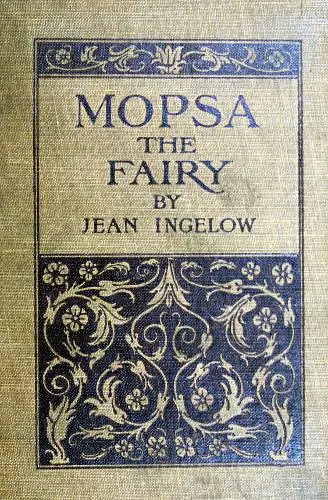
Mopsa the Fairy
Jean Ingelow
THE CLASSIC COLLECTION · 1875
"Fated to Be Free: A Novel" by Jean Ingelow is a fiction work crafted during the late 19th century. This narrative explores themes of family, loss, and the complexities of human relationships through the lens of the elderly Madam Melcombe and her descendants, who grapple with their legacy and connections to one another amidst their histories of estrangement and tragedy. The beginning of "Fated to Be Free" establishes a vividly described setting in a decaying manor and its surrounding garden, which serves as both a tangible and metaphorical representation of Madam Melcombe's life and the sorrows she has endured. The narrative revolves around her, an elderly matriarch who watches over a neglected garden filled with lilies—symbolic of her lost loved ones. As she reminisces about her past and her estranged sons, the story introduces Peter, her great-grandson, who is curious and innocent. His innocent exploration leads to accidental disturbances in the garden, prompting a reflection on the relationships, family dynamics, and secrets that haunt the characters, hinting at deeper themes of forgiveness and reconciliation that may unfold as the narrative progresses.
Introduction adapted from the source catalogue; source summaries may be automatically generated.
Free to read · English · 156,683 words · No account needed
MAKE TIME FOR A GOOD BOOK
On by default. Untick to stop anonymous reading totals. Each page counts after 10 seconds in view. How this works.
Anonymous counting is on unless you have switched it off.
"The world would lose its finest joys
Without its little girls and boys;
Their careless glee and simple ruth,
And innocence and trust and truth;
Ah! what would your poor poet do
Without such little folk as you?"
Locker.
"Well, anyhow," observed Mr. Nicholas Swan, the gardener, when the children came home and told him how Peter had cried--"anyhow, there's one less on you now to run over my borders. He was as meek as Moses, that child was, when first he came, but you soon made him as audacious as any of you."
"So they did, Nicholas dear," said one of the twins, a tall, dark haired
child.
"Oh, it's Nicholas dear, is it, Miss Barbara? Well, now, what next?"
"Why, the key of the fruit-house--we want the key."
"Key, indeed! Now, there's where it is. Make a wry path through your fields, and still you'll walk in it! I never ought to ha' got in the habit of lending you that key. What's the good of a key if a man can never keep it in his pocket? When I lived up at Mr. Daniel Mortimer's, the children never had my key--never."
"Well, come with us, then, and give us out the pears yourself. We won't
take one."
Nicholas, with a twin on each side, and the other children bringing up the rear, was now walked off to the fruit-house, grumbling as he went.
"I left Mr. Mortimer's, I did, because I couldn't stand the children; and now the world's a deal fuller of 'em than it was then. No, Miss Gladys, I'm not a-going any faster; I wouldn't run, if it was ever so. When the contrac' was signed of my wages, it was never wrote down that I had to run at any time."
And having now reached the fruit-house, he was just pulling out his big key, when something almost like shame showed itself in his ruddy face, as a decided and somewhat mocking voice addressed him.
"Well, Nicholas, I'm just amazed at ye! I've lived upward of sixty years in this island, Scotland and England both, and never did I see a man got over so by children in my life! Talking of my niece's children, are ye--Mrs. Daniel Mortimer's? I wonder at ye--they were just nothing to these."
Here Mr. Swan, having unlocked the door, dived into the fruit-house, and occupied himself for some moments in recovering his self-possession and making his selection; then emerging with an armful of pears, he shouted after Miss Christie Grant, who had got a good way down the walk by this time.
Your reading position is saved on this browser. Take it to another device with a library code. Reading pages adapt to text, rather than matching a printed edition.
Jean Ingelow
BEHIND THE BOOK
This eBook is for the use of anyone anywhere in the United States and most other parts of the world at no cost and with almost no restrictions whatsoever. You may copy it, give it away or re-use it under the terms of the Project Gutenberg License included with this eBook or online at www.gutenberg.org. If you are not located in the United States, you will have to check the laws of the country where you are located before using this eBook. Read the source licence.
The original source file, including credits and licence, is retained by this library. Request an original-format copy at no charge. Please include the book title and Project Gutenberg identifier #12303.
KEEP YOUR CURIOSITY GOING
Coulson Kernahan

Maurice Baring
Frances Wright
Cécile Tormay

Frederic Jesup Stimson

W. H. P. (William Henry Pope) Jarvis