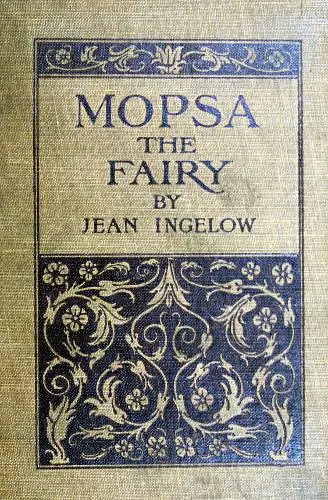
Mopsa the Fairy
Jean Ingelow
THE CLASSIC COLLECTION · 1875
"Fated to Be Free: A Novel" by Jean Ingelow is a fiction work crafted during the late 19th century. This narrative explores themes of family, loss, and the complexities of human relationships through the lens of the elderly Madam Melcombe and her descendants, who grapple with their legacy and connections to one another amidst their histories of estrangement and tragedy. The beginning of "Fated to Be Free" establishes a vividly described setting in a decaying manor and its surrounding garden, which serves as both a tangible and metaphorical representation of Madam Melcombe's life and the sorrows she has endured. The narrative revolves around her, an elderly matriarch who watches over a neglected garden filled with lilies—symbolic of her lost loved ones. As she reminisces about her past and her estranged sons, the story introduces Peter, her great-grandson, who is curious and innocent. His innocent exploration leads to accidental disturbances in the garden, prompting a reflection on the relationships, family dynamics, and secrets that haunt the characters, hinting at deeper themes of forgiveness and reconciliation that may unfold as the narrative progresses.
Introduction adapted from the source catalogue; source summaries may be automatically generated.
Free to read · English · 156,683 words · No account needed
MAKE TIME FOR A GOOD BOOK
On by default. Untick to stop anonymous reading totals. Each page counts after 10 seconds in view. How this works.
Anonymous counting is on unless you have switched it off.
"Learn now for all
That I, which know my heart, do here pronounce
By the very truth of it, I care not for you."--Cymbeline.
"John," said Valentine, ten days after this dinner party, "you have not called on D. yet, nor have I."
"No," John answered, observing his wish, "and it might not be a bad plan
for us to go together."
"Thank you, and if you would add the twins to--to make the thing easier
and less formal."
"Nonsense," said John; "but yes, I'll take some of the children, for of course you feel awkward." He did not add, "You should not have made such a fool of yourself," lest Valentine should answer, "I devoutly wish I had not;" but he went on, "And why don't you say Dorothea, instead of using a nickname?"
"I always used to call her D.," said Valentine.
"All the more reason why you should not now," answered John.
And Valentine murmured to himself--
"'These strong Egyptian fetters I must break, or lose myself in dotage' (Antony and Cleopatra)" This he added from old habit. "I'll quote everything I can think of to D., just to make her think I have forgotten her wish that I should leave off quoting; and if that is not doing my duty by St. George, I should like to know what is. Only that might put it into his head to quote too, and perhaps he might have the best of it. I fancy I hear him saying, 'Art thou learned?' I, as William, answer, 'No, sir.' 'Then learn this of me,' he makes reply, 'to have is to have; for all your writers do consent that ipse is he. Now you are not ipse, for I am he. He, sir, that hath married this woman. Therefore, you clown, abandon, which is--,' &c., &c. What a fool I am!"
John, adding the twins and little Bertram to the party, drove over on a Saturday afternoon, finding no one at home but Mrs. Henfrey.
"St. George," she said, "has taken to regular work, and sits at his desk all the morning, and for an hour or two in the afternoon, excepting on Saturday, when he gives himself a half-holiday, as if he was a schoolboy."
"And where was he now?" John asked.
"Somewhere about the place with Dorothea; he had been grubbing up the roots of the trees in a corner of the little wood at all leisure times; he thought of turning it into a vegetable garden."
"Why, we always had more vegetables than we could use," exclaimed Valentine, "and we were three times as large a family."
Your reading position is saved on this browser. Take it to another device with a library code. Reading pages adapt to text, rather than matching a printed edition.
Jean Ingelow
BEHIND THE BOOK
This eBook is for the use of anyone anywhere in the United States and most other parts of the world at no cost and with almost no restrictions whatsoever. You may copy it, give it away or re-use it under the terms of the Project Gutenberg License included with this eBook or online at www.gutenberg.org. If you are not located in the United States, you will have to check the laws of the country where you are located before using this eBook. Read the source licence.
The original source file, including credits and licence, is retained by this library. Request an original-format copy at no charge. Please include the book title and Project Gutenberg identifier #12303.
KEEP YOUR CURIOSITY GOING
Coulson Kernahan

Maurice Baring
Frances Wright
Cécile Tormay

Frederic Jesup Stimson

W. H. P. (William Henry Pope) Jarvis