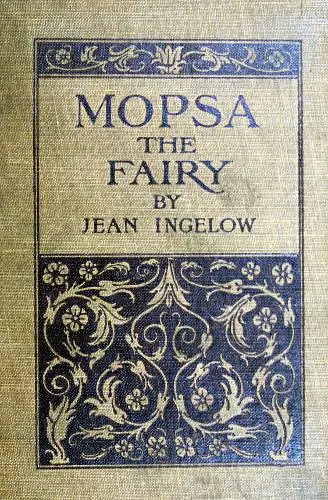
Mopsa the Fairy
Jean Ingelow
THE CLASSIC COLLECTION · 1875
"Fated to Be Free: A Novel" by Jean Ingelow is a fiction work crafted during the late 19th century. This narrative explores themes of family, loss, and the complexities of human relationships through the lens of the elderly Madam Melcombe and her descendants, who grapple with their legacy and connections to one another amidst their histories of estrangement and tragedy. The beginning of "Fated to Be Free" establishes a vividly described setting in a decaying manor and its surrounding garden, which serves as both a tangible and metaphorical representation of Madam Melcombe's life and the sorrows she has endured. The narrative revolves around her, an elderly matriarch who watches over a neglected garden filled with lilies—symbolic of her lost loved ones. As she reminisces about her past and her estranged sons, the story introduces Peter, her great-grandson, who is curious and innocent. His innocent exploration leads to accidental disturbances in the garden, prompting a reflection on the relationships, family dynamics, and secrets that haunt the characters, hinting at deeper themes of forgiveness and reconciliation that may unfold as the narrative progresses.
Introduction adapted from the source catalogue; source summaries may be automatically generated.
Free to read · English · 156,683 words · No account needed
MAKE TIME FOR A GOOD BOOK
On by default. Untick to stop anonymous reading totals. Each page counts after 10 seconds in view. How this works.
Anonymous counting is on unless you have switched it off.
Then Crayshaw, blushing hotly, essayed to hit Johnnie, who forthwith started up and was pursued by him with many a whoop and shout, in a wild circling chase among the trees. At length, finding he was not to be caught, Crayshaw returned a good deal heated, and Johnnie followed smiling blandly, and flung himself on the grass breathing hard.
"Well, I'm glad you two are not going to finish up your friendship with another fight," said Valentine.
"He's always prophesying something horrid about me," exclaimed Crayshaw. "Why am I to be married any more than he is, I should like to know? If I do, you'll certainly have to give up that visit to California, that Mr. Mortimer almost promised you should make with me. Gladys, I suppose he would not let you and Barbara come too?"
"Oh no. I am sure he would not."
"What fun we might have!"
"Yes."
"I don't see if you were a family man, why it shouldn't be done," said Johnnie, returning to the charge, "but if you won't marry, even to oblige your oldest friends, why you won't."
"Time's up," said Valentine, looking at his watch, "and there's my dog-cart coming round to the door."
The youth rose then with a sigh, took leave of Valentine, and reluctantly turned towards the house, all the young Mortimers following. They were rather late for the train, so that the parting was hurried, and poor little Gladys as she gazed after the dog-cart, while Johnnie drove and Crayshaw looked back, felt a great aching pain at her heart, and thought she should never forget him.
But perhaps she did.
The young Mortimers were to leave Melcombe themselves the next day, and Valentine was to accompany them home, sleeping one night at their father's house by way of breaking his journey, and seeing his family before he started on his voyage.
He was left alone, and watched his guests as their receding figures were lost among the blossoming trees. He felt strangely weak that afternoon, but he was happy. The lightness of heart that comes of giving up some wrong or undesirable course of action (one that he thought wrong) might long have been his, but he had not hitherto been able to get away from the scene of it.
To-morrow he was to depart. Oh, glad to-morrow!
He laid himself back in his seat, and looked at the blue hills, and listened to the sweet remote voices of the children, let apple-blossoms drop all over him, peered through great brown boughs at the empty sky, and lost himself in a sea of thought which seemed almost as new to him and as fathomless as that was.
Your reading position is saved on this browser. Take it to another device with a library code. Reading pages adapt to text, rather than matching a printed edition.
Jean Ingelow
BEHIND THE BOOK
This eBook is for the use of anyone anywhere in the United States and most other parts of the world at no cost and with almost no restrictions whatsoever. You may copy it, give it away or re-use it under the terms of the Project Gutenberg License included with this eBook or online at www.gutenberg.org. If you are not located in the United States, you will have to check the laws of the country where you are located before using this eBook. Read the source licence.
The original source file, including credits and licence, is retained by this library. Request an original-format copy at no charge. Please include the book title and Project Gutenberg identifier #12303.
KEEP YOUR CURIOSITY GOING
Coulson Kernahan

Maurice Baring
Frances Wright
Cécile Tormay

Frederic Jesup Stimson

W. H. P. (William Henry Pope) Jarvis