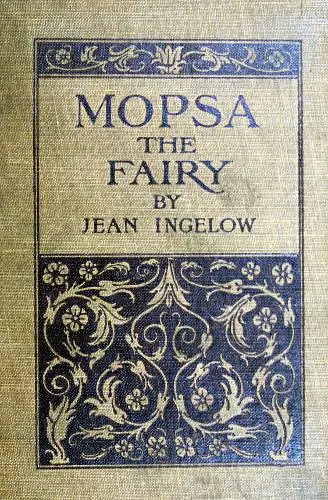
Mopsa the Fairy
Jean Ingelow
THE CLASSIC COLLECTION · 1875
"Fated to Be Free: A Novel" by Jean Ingelow is a fiction work crafted during the late 19th century. This narrative explores themes of family, loss, and the complexities of human relationships through the lens of the elderly Madam Melcombe and her descendants, who grapple with their legacy and connections to one another amidst their histories of estrangement and tragedy. The beginning of "Fated to Be Free" establishes a vividly described setting in a decaying manor and its surrounding garden, which serves as both a tangible and metaphorical representation of Madam Melcombe's life and the sorrows she has endured. The narrative revolves around her, an elderly matriarch who watches over a neglected garden filled with lilies—symbolic of her lost loved ones. As she reminisces about her past and her estranged sons, the story introduces Peter, her great-grandson, who is curious and innocent. His innocent exploration leads to accidental disturbances in the garden, prompting a reflection on the relationships, family dynamics, and secrets that haunt the characters, hinting at deeper themes of forgiveness and reconciliation that may unfold as the narrative progresses.
Introduction adapted from the source catalogue; source summaries may be automatically generated.
Free to read · English · 156,683 words · No account needed
MAKE TIME FOR A GOOD BOOK
On by default. Untick to stop anonymous reading totals. Each page counts after 10 seconds in view. How this works.
Anonymous counting is on unless you have switched it off.
"I should have thought he was a sight better wheer he is," said Swan. "But you've been so masterful and obstinate, Master Bertie, since you broke your arm!"
"It's not at all kind of you to disappoint us on father's wedding-day."
"Well, Mr. Melcombe shall judge. If he says, 'Charm it,' charm you shall; for he knows children's feelings as well as grown folks's. There never was anybody that was so like everybody else."
"It's conjuring, I tell you, cousin Val. Did you never see a conjuror pull out yards and yards of shavings from his mouth, and then roll them up till they were as small as a pea, and swallow them? This is conjuring too. We say, 'Underneath this hazelin mote;' that's the forked-stick, you know; and while we say it the adder is obliged to roll himself up tighter and tighter, just like those shavings, till he is quite gone."
"I can't swallow that!" exclaimed Valentine. "Well, off then."
"But I won't have the stick poked down his hole!" cried Swan, while Hugh shouted down his defiance--
"'Underneath this hazelin mote
There's a braggerty worm with a speckled throat,
Now!
Nine double hath he.'
"That means he's got nine rings."
"Well, I shall allers say I'm surprised at such nonsense. What do you think he cares for it all?"
"Why, we told you it would make him twist himself up to nothing. Go on, Hughie. It's very useful to be able to get rid of snakes."
"'Now from nine double to eight double,
And from eight double to seven double,
And from seven double to six double.
And from six double to five double,
And from five double to four double,
And from four double to three double.'
(He's getting very tight now!)
"'And from three double to two double,
And from two double to one double,
Now!
No double hath he,'
"There, now he's gone, doubled up to nothing. Now dig, Swanny, and you'll
see he's gone."
"It's only an old Cornish charm," said Valentine. "I often heard it when
I was a boy."
"I call it heathenish!" exclaimed Mr. Swan. "What do folks want with a charm when they've got a spade to chop the beast's head off with?"
"But as he's gone, Swan," observed Valentine, "of course you cannot dig him out; so you need not trouble yourself to dig at all."
"Oh, but that's not fair. We want, in case he's there, to see him."
Your reading position is saved on this browser. Take it to another device with a library code. Reading pages adapt to text, rather than matching a printed edition.
Jean Ingelow
BEHIND THE BOOK
This eBook is for the use of anyone anywhere in the United States and most other parts of the world at no cost and with almost no restrictions whatsoever. You may copy it, give it away or re-use it under the terms of the Project Gutenberg License included with this eBook or online at www.gutenberg.org. If you are not located in the United States, you will have to check the laws of the country where you are located before using this eBook. Read the source licence.
The original source file, including credits and licence, is retained by this library. Request an original-format copy at no charge. Please include the book title and Project Gutenberg identifier #12303.
KEEP YOUR CURIOSITY GOING
Coulson Kernahan

Maurice Baring
Frances Wright
Cécile Tormay

Frederic Jesup Stimson

W. H. P. (William Henry Pope) Jarvis