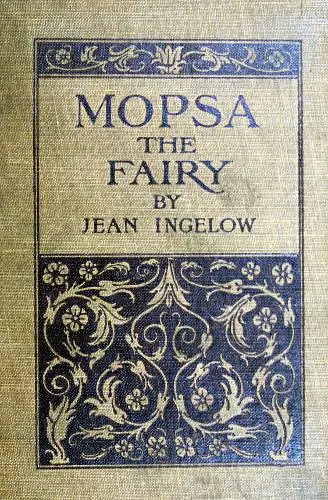
Mopsa the Fairy
Jean Ingelow
THE CLASSIC COLLECTION · 1875
"Fated to Be Free: A Novel" by Jean Ingelow is a fiction work crafted during the late 19th century. This narrative explores themes of family, loss, and the complexities of human relationships through the lens of the elderly Madam Melcombe and her descendants, who grapple with their legacy and connections to one another amidst their histories of estrangement and tragedy. The beginning of "Fated to Be Free" establishes a vividly described setting in a decaying manor and its surrounding garden, which serves as both a tangible and metaphorical representation of Madam Melcombe's life and the sorrows she has endured. The narrative revolves around her, an elderly matriarch who watches over a neglected garden filled with lilies—symbolic of her lost loved ones. As she reminisces about her past and her estranged sons, the story introduces Peter, her great-grandson, who is curious and innocent. His innocent exploration leads to accidental disturbances in the garden, prompting a reflection on the relationships, family dynamics, and secrets that haunt the characters, hinting at deeper themes of forgiveness and reconciliation that may unfold as the narrative progresses.
Introduction adapted from the source catalogue; source summaries may be automatically generated.
Free to read · English · 156,683 words · No account needed
MAKE TIME FOR A GOOD BOOK
On by default. Untick to stop anonymous reading totals. Each page counts after 10 seconds in view. How this works.
Anonymous counting is on unless you have switched it off.
Johnnie, in school-boy fashion, made a face at Valentine when the old man was not looking. It expressed good-humoured defiance and derision, but the only effect it produced was on himself, for it disturbed for the moment the great likeness to his grandfather that grew on him every day. John had clear features, thick light hair, and deep blue eyes. His son was dark, with bushy eyebrows, large stern features, and a high narrow head, like old Grand.
It was quite dark, and the depth of winter, but the thermometer was many degrees above freezing-point, and a warm south wind was blowing. Grand rose and rang the bell. "Are the stable lanterns lighted?" he asked.
"Yes, sir."
"Then you two boys come with me."
The boys, wondering and nothing loth, followed to the stable, and the brown eyes of two large ponies looked mildly into theirs.
"Trot them out," said Grand to the groom, "and let the young gentlemen have a good look at them."
Not a word did either of the boys say. An event of huge importance appeared to loom in the horizon of each: he cogitated over its probable conditions.
"I got a saddle for each of them," said Grand. "Valentine chose them, Johnnie. There now, we had better come in again." And when they were seated in the dining-room as before, and there was still silence, he went on, "You two, as I understand, are both in the same house at Harrow?"
"Yes, sir."
"And it is agreed that Johnnie could cure himself of his lisp if he chose, and if you would continually remind him of it?"
"Oh yes, certainly it is."
"Very well, if the thing is managed by next Easter, I'll give each of you one of those ponies; and," continued Grand cunningly, "you may have the use of them during the remainder of these holidays, provided you both promise, upon your honour, to begin the cure directly. If Johnnie has not left off lisping at Easter, I shall have the ponies sold."
"I'll lead him such a life that he shall wish he'd never been born; I will indeed," exclaimed Crayshaw fervently.
"Well," said Johnnie, "never wath a better time. Allez le, or, in
other wordth, go it."
"And every two or three days you shall bring him to me," continued Grand, "that I may hear him read and speak."
The next morning, before John went into the town, he was greeted by the two boys on their ponies, and came out to admire and hear the conditions.
Your reading position is saved on this browser. Take it to another device with a library code. Reading pages adapt to text, rather than matching a printed edition.
Jean Ingelow
BEHIND THE BOOK
This eBook is for the use of anyone anywhere in the United States and most other parts of the world at no cost and with almost no restrictions whatsoever. You may copy it, give it away or re-use it under the terms of the Project Gutenberg License included with this eBook or online at www.gutenberg.org. If you are not located in the United States, you will have to check the laws of the country where you are located before using this eBook. Read the source licence.
The original source file, including credits and licence, is retained by this library. Request an original-format copy at no charge. Please include the book title and Project Gutenberg identifier #12303.
KEEP YOUR CURIOSITY GOING
Coulson Kernahan

Maurice Baring
Frances Wright
Cécile Tormay

Frederic Jesup Stimson

W. H. P. (William Henry Pope) Jarvis