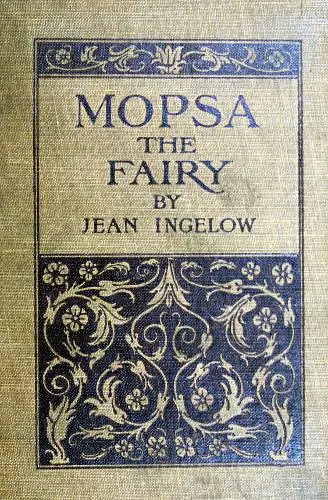
Mopsa the Fairy
Jean Ingelow
THE CLASSIC COLLECTION · 1875
"Fated to Be Free: A Novel" by Jean Ingelow is a fiction work crafted during the late 19th century. This narrative explores themes of family, loss, and the complexities of human relationships through the lens of the elderly Madam Melcombe and her descendants, who grapple with their legacy and connections to one another amidst their histories of estrangement and tragedy. The beginning of "Fated to Be Free" establishes a vividly described setting in a decaying manor and its surrounding garden, which serves as both a tangible and metaphorical representation of Madam Melcombe's life and the sorrows she has endured. The narrative revolves around her, an elderly matriarch who watches over a neglected garden filled with lilies—symbolic of her lost loved ones. As she reminisces about her past and her estranged sons, the story introduces Peter, her great-grandson, who is curious and innocent. His innocent exploration leads to accidental disturbances in the garden, prompting a reflection on the relationships, family dynamics, and secrets that haunt the characters, hinting at deeper themes of forgiveness and reconciliation that may unfold as the narrative progresses.
Introduction adapted from the source catalogue; source summaries may be automatically generated.
Free to read · English · 156,683 words · No account needed
MAKE TIME FOR A GOOD BOOK
On by default. Untick to stop anonymous reading totals. Each page counts after 10 seconds in view. How this works.
Anonymous counting is on unless you have switched it off.
"It's very unkind of her," exclaimed Barbara. "Father never exactly said that we were to have our own playroom to ourselves, but we know, and she knows, that he meant it."
Then, after a good deal of whispering, giggling, and consulting among the elder ones, the little boys were dismissed; and in the meantime Mr. Nicholas Swan, who, standing on a ladder outside, was nailing the vines (quite aware that the governess was going to have a reception which might be called a warning never to come there any more), may or may not have intended to make his work last as long as possible. At any rate, he could with difficulty forbear from an occasional grin, while, with his nails neatly arranged between his lips, he leisurely trained and pruned; and when he was asked by the young people to bring them up some shavings and a piece of wood, he went down to help in the mischief, whatever it might be, with an alacrity ill suited to his years and gravity.
"Now, I'll tell you what, young gentlemen," he remarked, when, ascending, he showed his honest face again, thrust in a log of wood, and exhibited an armful of shavings, "I'm agreeable to anything but gunpowder, or that there spark as comes cantering out o' your engine with a crack. No, Miss Gladys, ex-cuse me, I don't give up these here shavings till I know it's all right."
"Well, well, it ith all right," exclaimed Johnnie, "we're not going to do any harm! O Cray, he'th brought up a log ath big ath a fiddle. Quelle alouette!"
"How lucky it is that she has never seen Cray!" exclaimed Barbara. "Johnnie, do be calm; how are we to do it, if you laugh so? Now then, you are to be attending to the electrifying machine."
"Swanny," asked Crayshaw, "have you got a pipe in your pocket? I want
one to lie on my desk."
"Well, now, to think o' your asking me such a question, just as if I was ever known to take so much as a whiff in working hours--no, not in the tool-house, nor nowhere."
"But just feel. Come, you might."
"Well, now, this here is remarkable," exclaimed Swan, with a start as if of great surprise, when, after feeling in several pockets, a pipe appeared from the last one.
"Don't knock the ashes out."
"She's coming," said Swan, furtively glancing down, and then pretending to nail with great diligence. "And, my word, if here isn't Miss Christie with her!"
Your reading position is saved on this browser. Take it to another device with a library code. Reading pages adapt to text, rather than matching a printed edition.
Jean Ingelow
BEHIND THE BOOK
This eBook is for the use of anyone anywhere in the United States and most other parts of the world at no cost and with almost no restrictions whatsoever. You may copy it, give it away or re-use it under the terms of the Project Gutenberg License included with this eBook or online at www.gutenberg.org. If you are not located in the United States, you will have to check the laws of the country where you are located before using this eBook. Read the source licence.
The original source file, including credits and licence, is retained by this library. Request an original-format copy at no charge. Please include the book title and Project Gutenberg identifier #12303.
KEEP YOUR CURIOSITY GOING
Coulson Kernahan

Maurice Baring
Frances Wright
Cécile Tormay

Frederic Jesup Stimson

W. H. P. (William Henry Pope) Jarvis