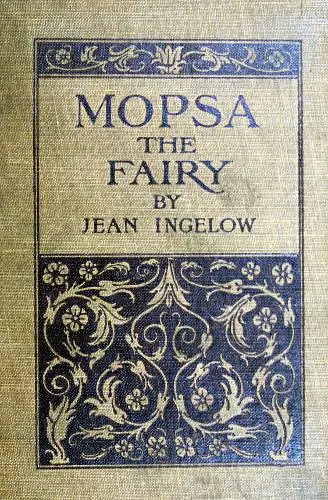
Mopsa the Fairy
Jean Ingelow
THE CLASSIC COLLECTION · 1875
"Fated to Be Free: A Novel" by Jean Ingelow is a fiction work crafted during the late 19th century. This narrative explores themes of family, loss, and the complexities of human relationships through the lens of the elderly Madam Melcombe and her descendants, who grapple with their legacy and connections to one another amidst their histories of estrangement and tragedy. The beginning of "Fated to Be Free" establishes a vividly described setting in a decaying manor and its surrounding garden, which serves as both a tangible and metaphorical representation of Madam Melcombe's life and the sorrows she has endured. The narrative revolves around her, an elderly matriarch who watches over a neglected garden filled with lilies—symbolic of her lost loved ones. As she reminisces about her past and her estranged sons, the story introduces Peter, her great-grandson, who is curious and innocent. His innocent exploration leads to accidental disturbances in the garden, prompting a reflection on the relationships, family dynamics, and secrets that haunt the characters, hinting at deeper themes of forgiveness and reconciliation that may unfold as the narrative progresses.
Introduction adapted from the source catalogue; source summaries may be automatically generated.
Free to read · English · 156,683 words · No account needed
MAKE TIME FOR A GOOD BOOK
On by default. Untick to stop anonymous reading totals. Each page counts after 10 seconds in view. How this works.
Anonymous counting is on unless you have switched it off.
"That milk looks so nice--give me some of it. How pleasant it is to feel cold and hungry, as one does in England! No, John, not ham; I will have some bread and marmalade. Do the children always wait on you, John, at breakfast?"
There was something peculiarly sweet and penetrative in the voices of Brandon and his sister; but this second quality sometimes appeared to give more significance to their words than they had intended.
"Always. Does it appear an odd arrangement in your eyes?"
"Father," said Barbara, "here is your paper. I have cut the leaves."
"Thank you, my dear; put it down. You should, consider, Emily, my great age and exaltation in the eyes of these youngsters. Don't you perceive that I am a middle-aged man, madam?"
"Middle-aged, indeed! You are not thirty-six till the end of September, you know--the 28th of September. And oh, John, you cannot think how young you look! just as if you had stolen all these children, and they were not really yours. You have so many of them, too, while I have only one, and he such a little one--he is only two years old."
While she spoke a bell began to ring, and the two elder children, wishing her good-bye, left the room.
"Do you think those girls are growing like their mother?" asked John.
"I think they are a little. Perhaps that pretty way they have of taking up their eye-glasses when they come forward to look at anything, makes them seem more like than they are."
John scarcely ever mentioned his wife, but before Emily most people
spoke without much reserve.
"Only one of the whole tribe is like her in mind and disposition," he
continued.
"And that's a good thing," thought Emily, but she did not betray her
thought.
While this talk went on the two younger children had got possession, of Mrs. Nemily's watch (which hung from her neck by a long Trichinopoly chain), and were listening to a chime that it played. Emily took the boy on her knee, and it did not appear that he considered himself too big to be nursed, but began to examine the watch, putting it to his ear, while he composedly rested his head on her shoulder.
"Poor little folk," thought John, "how naturally they take to the
caresses of a young mother!"
Another bell then rang.
"What order is kept in your house!" said Emily, as both the children departed, one with a kiss on her dimpled cheek and the other on his little scratched fist, which already told of much climbing.
Your reading position is saved on this browser. Take it to another device with a library code. Reading pages adapt to text, rather than matching a printed edition.
Jean Ingelow
BEHIND THE BOOK
This eBook is for the use of anyone anywhere in the United States and most other parts of the world at no cost and with almost no restrictions whatsoever. You may copy it, give it away or re-use it under the terms of the Project Gutenberg License included with this eBook or online at www.gutenberg.org. If you are not located in the United States, you will have to check the laws of the country where you are located before using this eBook. Read the source licence.
The original source file, including credits and licence, is retained by this library. Request an original-format copy at no charge. Please include the book title and Project Gutenberg identifier #12303.
KEEP YOUR CURIOSITY GOING
Coulson Kernahan

Maurice Baring
Frances Wright
Cécile Tormay

Frederic Jesup Stimson

W. H. P. (William Henry Pope) Jarvis