
Adolescence
Stephen Paget
THE CLASSIC COLLECTION · 1907
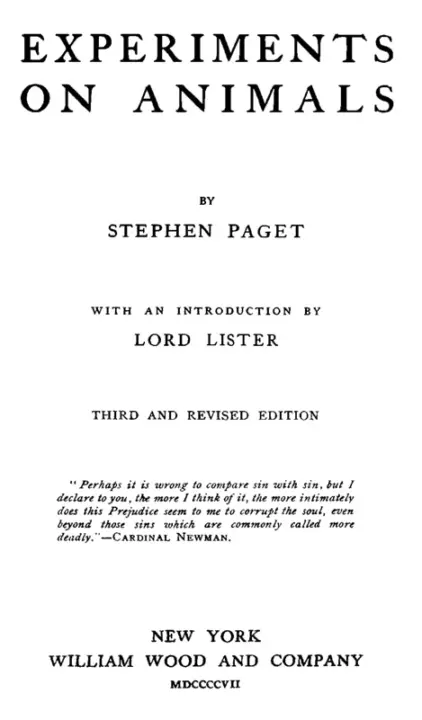
"Experiments on Animals" by Stephen Paget is a scientific publication written in the early 20th century. This work serves as a detailed account of the role that experiments on animals have played in advancing medical knowledge, particularly in physiology and pathology. Paget draws on his extensive experience and research conducted as the Secretary of the Association for the Advancement of Medicine by Research to illustrate the ethical, scientific, and legislative aspects surrounding vivisection and animal experimentation. The opening of the book sets a scholarly tone as Paget outlines the motivations behind his writing and the importance of empirical evidence in medical research. He reflects on the challenges and controversies associated with animal experimentation, particularly in the context of the Act of 1876 regulating such practices in Britain. The first chapter delves into historical anecdotes, starting with Galen's contributions to physiology through animal dissections, emphasizing the pivotal role of experimental methodology in uncovering fundamental truths about the bodily functions of various species. Overall, the beginning establishes a foundation of the significance and impact of animal studies in the evolution of medical science.
Introduction adapted from the source catalogue; source summaries may be automatically generated.
Free to read · English · 104,427 words · No account needed
MAKE TIME FOR A GOOD BOOK
On by default. Untick to stop anonymous reading totals. Each page counts after 10 seconds in view. How this works.
Anonymous counting is on unless you have switched it off.
This series of inoculations was begun in February 1895, for the protection of the coolies on various tea-estates. The results are excellent, and deal with large numbers.[31] The latest report from Dr. Arthur Powell, the Medical Officer, is quoted in Dr. Simpson's 1896 report:--
At Kalain--
1079 not inoculated had 50 cases, with 30 deaths.
1250 inoculated--3 cases, with 2 deaths.[32]
At Kalaincherra--
685 not inoculated had 10 cases, with 7 deaths.
155 inoculated--no cases.
At Degubber--
254 not inoculated had 12 cases, with 10 deaths.
407 inoculated--5 cases, all recovered.
At Duna--
121 not inoculated had 4 cases, with 2 deaths.
29 inoculated--no cases.
At Sandura--
454 not inoculated had 2 cases, with 1 death.
51 inoculated--2 cases, with 1 death.
At Karkuri--
198 not inoculated had 15 cases, with 9 deaths.
443 inoculated--3 cases, with 1 death.
At Craig Park--
185 not inoculated had 1 fatal case.
46 inoculated--no cases.
Not inoculated, 2976, with 94 cases and 60 deaths. Inoculated, 2381, with 13 cases and 4 deaths.
[31] "As a field for testing the value of inoculation, the tea-factories of India possess many advantages. The labourers being under contract, the after-history of those inoculated is easily followed up. Each morning the adults are paraded for roll-call; and all sick must attend hospital, where a record is made of their disease and treatment." (Dr. Powell, Lancet, 13th July 1896.)
[32] "It is unfortunate that neither of the fatal cases among the inoculated was seen by any medical man, not even an unqualified doctor Babu." Dr. Powell does not think, from what was told him, that one of them was cholera.
To the preceding instances, which are rather old now, must be added the following more recent report, from the Indian Medical Gazette, September 1901:--
"We are glad to see, from a paragraph in the Report of the Sanitary Commissioner for Bengal (Major H. J. Dyson, I.M.S., F.R.C.S.), that an increased number of anti-cholera inoculations were performed during the year 1900. Assistant-Surgeon G. C. Mukerjee, who was in charge of this work, reports that in the Puralia Coolie Depot no less than 13,291 persons were inoculated against cholera, including over 1000 children. All these cases of inoculation were among labour emigrants proceeding to the tea-gardens of Assam and Cachar. The employers of labour are beginning to realise the value of cholera inoculation. It is unfortunately not always easy, or even possible, to follow up the after-history of persons inoculated; but Major Dyson has quoted a table, received from the Superintendent of Emigration, which shows the number of cases among the inoculated and the non-inoculated at Goalundo. From this table, it is seen that out of 1527 non-inoculated coolies, who passed through Goalundo, 33, or 2.09 per cent., got cholera; whereas of 873 inoculated coolies, only 2, or 0.2 per cent., were attacked by the disease; that is, the unprotected suffered about ten times as much as the inoculated. Assistant-Surgeon Mukerjee also reports that during his cold-weather tour he passed through some villages in the Manbhum district, in which he had practised inoculation the previous year: and, though there had been epidemics of cholera in them, the inoculated persons escaped. They came to him in numbers, stating that they owed their safety to the inoculation."
Your reading position is saved on this browser. Take it to another device with a library code. Reading pages adapt to text, rather than matching a printed edition.
Stephen Paget
BEHIND THE BOOK
This eBook is for the use of anyone anywhere in the United States and most other parts of the world at no cost and with almost no restrictions whatsoever. You may copy it, give it away or re-use it under the terms of the Project Gutenberg License included with this eBook or online at www.gutenberg.org. If you are not located in the United States, you will have to check the laws of the country where you are located before using this eBook. Read the source licence.
The original source file, including credits and licence, is retained by this library. Request an original-format copy at no charge. Please include the book title and Project Gutenberg identifier #42660.
KEEP YOUR CURIOSITY GOING
Cécile Tormay

Moritz Busch
John L. Ransom
Frances Wright
Cécile Tormay

Mabel Potter Daggett