
Last letters from the living dead man
David Patterson (Spirit) Hatch
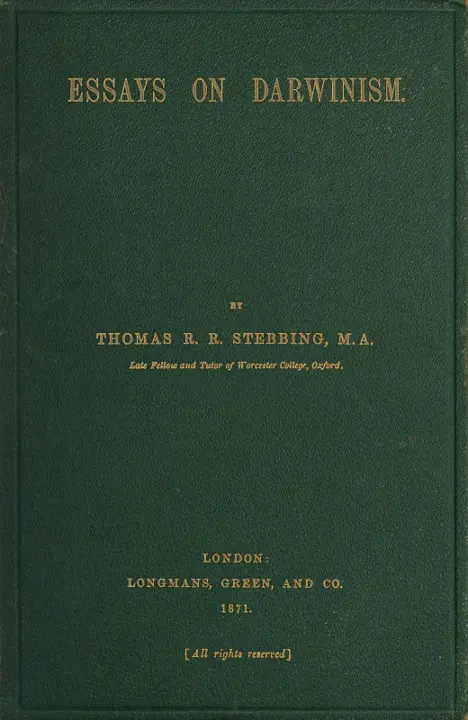
THE CLASSIC COLLECTION · 1871
"Essays on Darwinism" by Thomas Roscoe Rede Stebbing is a collection of essays written in the late 19th century. This work delves into the implications and nuances of Darwin's theories of natural selection and evolution, emphasizing the importance of understanding the science behind these groundbreaking ideas. Stebbing addresses common misconceptions, critiques of Darwinism, and the connections between evolution and broader existential queries about life and humanity. The opening of this scholarly work serves as a preface, laying the foundation for a more in-depth exploration of Darwinian thought. Stebbing praises Darwin's clarity and commitment to truth while critically examining the misunderstandings surrounding his theories. He highlights how many reject Darwinism without engaging with the material and emphasizes the need for a thoughtful and open-minded exploration of these scientific principles. This introduction sets the stage for subsequent essays, which promise to tackle various aspects of Darwinism, the intersection of science and religion, and the implications of evolutionary theory for humanity and morality.
Introduction adapted from the source catalogue; source summaries may be automatically generated.
Free to read · English · 48,503 words · No account needed
MAKE TIME FOR A GOOD BOOK
On by default. Untick to stop anonymous reading totals. Each page counts after 10 seconds in view. How this works.
Anonymous counting is on unless you have switched it off.
The calling in of subsidiary principles may be thought to spoil the boasted simplicity of the theory. But such an opinion is hypercritical. One might truthfully say of a great patriot that all he did was in obedience to the simple law of duty, without implying that he was exempt from the law of association of ideas, or independent of the mechanical, chemical, and vital laws which regulate many of the functions of all human beings alike.
[1] These papers were read at various dates between February 1869 and January 1871, before the Torquay Natural History Society.
[2] Read before the Devonshire Association, July 1870.
[3] Horace, Odes, I. xvi. 13:--
Fertur Prometheus addere principi
Limo coactus particulam undique
Desectam, et insani leonis
Vim stomacho apposuisse nostro.
[4] Lyell, ‘Principles of Geology,’ vol. ii. p. 324. Tenth Edition.
[5] Darwin, ‘Animals and Plants under Domestication,’ vol. ii. p. 251.
[6] 1,073,741,824 grains.
[7] ‘On the Origin of Species,’ p. 74. Fourth Edition.
[8] Darwin, ‘Animals and Plants under Domestication,’ vol. ii. p. 379.
[9] 37 dwts. 7 grs., or 895 grs., between seven and eight times the size of the wild fruit. See ‘Animals and Plants under Domestication,’ vol. i. p. 356.
[10] Darwin, ‘Animals and Plants under Domestication,’ passim.
[11] ‘Animals and Plants under Domestication,’ vol. ii. pp. 348-351.
[12] An important caution may here be quoted from Mr. Herbert Spencer. ‘An impression,’ he says, ‘has been given by those who have popularized the sentiments of Embryologists, that, during its development, each higher organism passes through stages in which it resembles the adult forms of lower organisms--that the embryo of a man is at one time like a fish, and at another time like a reptile. This is not the fact. The fact established is, that up to a certain point the embryos of a man and a fish continue similar, and that then differences begin to appear and increase--the one embryo approaching more and more towards the form of a fish; the other diverging from it more and more. And so with the resemblances to the more advanced types.’--Principles of Biology, vol. i. p. 143.
[13] ‘Origin of Species,’ p. 270. Mr. Darwin shows how the hexagonal cells of the hive-bee can have arisen from the simple cylindrical form, by bringing the cylinders sufficiently near together, so that their outlines, if completed, would intersect.
The humble-bee makes separate and very irregular rounded cells.
The melipona domestica makes cells that are nearly spherical, but too near together for the spheres to be complete, flat walls of wax being built where they tend to intersect.
A little extra regularity, advantageous for the saving of wax and labour, would produce the symmetrical comb of the hive-bee with its two layers of hexagonal prisms.
[14] See ‘Principles of Biology,’ vol. i. pp. 428-431.
Your reading position is saved on this browser. Take it to another device with a library code. Reading pages adapt to text, rather than matching a printed edition.
BEHIND THE BOOK
This eBook is for the use of anyone anywhere in the United States and most other parts of the world at no cost and with almost no restrictions whatsoever. You may copy it, give it away or re-use it under the terms of the Project Gutenberg License included with this eBook or online at www.gutenberg.org. If you are not located in the United States, you will have to check the laws of the country where you are located before using this eBook. Read the source licence.
The original source file, including credits and licence, is retained by this library. Request an original-format copy at no charge. Please include the book title and Project Gutenberg identifier #48987.
KEEP YOUR CURIOSITY GOING
David Patterson (Spirit) Hatch

David Patterson (Spirit) Hatch

David Patterson (Spirit) Hatch
Coulson Kernahan

Ralph Waldo Emerson

Maurice Baring