
Last letters from the living dead man
David Patterson (Spirit) Hatch
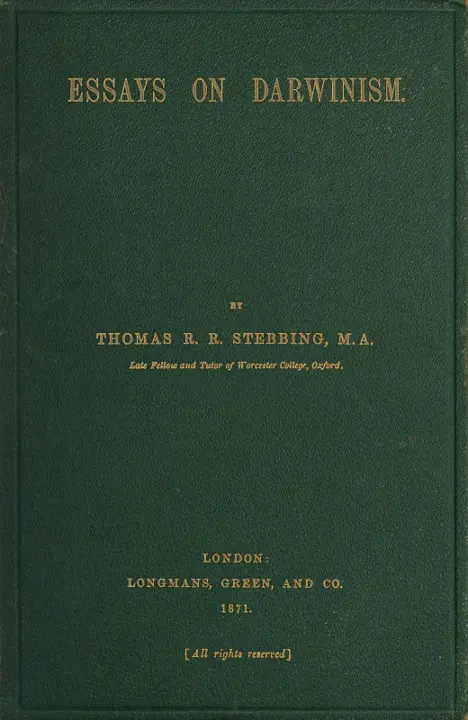
THE CLASSIC COLLECTION · 1871
"Essays on Darwinism" by Thomas Roscoe Rede Stebbing is a collection of essays written in the late 19th century. This work delves into the implications and nuances of Darwin's theories of natural selection and evolution, emphasizing the importance of understanding the science behind these groundbreaking ideas. Stebbing addresses common misconceptions, critiques of Darwinism, and the connections between evolution and broader existential queries about life and humanity. The opening of this scholarly work serves as a preface, laying the foundation for a more in-depth exploration of Darwinian thought. Stebbing praises Darwin's clarity and commitment to truth while critically examining the misunderstandings surrounding his theories. He highlights how many reject Darwinism without engaging with the material and emphasizes the need for a thoughtful and open-minded exploration of these scientific principles. This introduction sets the stage for subsequent essays, which promise to tackle various aspects of Darwinism, the intersection of science and religion, and the implications of evolutionary theory for humanity and morality.
Introduction adapted from the source catalogue; source summaries may be automatically generated.
Free to read · English · 48,503 words · No account needed
MAKE TIME FOR A GOOD BOOK
On by default. Untick to stop anonymous reading totals. Each page counts after 10 seconds in view. How this works.
Anonymous counting is on unless you have switched it off.
[15] ‘Origin of Species,’ p. 213; ‘Principles of Biology,’ vol. i. pp. 392, 394. The walking-fishes of India and the mud-fishes of Ceylon and New Zealand are described in an interesting article by Dr. Day of Torquay, in ‘All the Year Round’ for June 11th, 1870. Dr. Day seems to think the climbing powers of the anabas scandens less satisfactorily attested than other attributes of these extraordinary groups.
[16] Carpenter, ‘Animal Physiology,’ chap. 14.
[17] The design of this Essay was not, as has been erroneously supposed, to disprove the universality of the Deluge by help of Darwinism, but to remove one great obstacle to the general acceptance of Darwinism by disproving the universality of the Deluge. Taking the Theory of Development for granted, a recent universal Deluge would be too obviously impossible to need arguing against.
[18] Lyell, ‘Principles of Geology,’ ii. 332.
[19] Ibid. ii. 344.
[20] Lyell, ii. 336.
[21] ‘The Malay Archipelago,’ vol. ii. p. 448.
[22] ‘Genesis of the Earth and of Man,’ p. 117; quoted in Sir J. Lubbock’s ‘Prehistoric Times,’ p. 314.
[23] A religious and supremely orthodox poet of the last century enquires, ‘Where is the dust that has not been alive?’--Young, ‘Night Thoughts,’ Night IX, 1. 87.
[24] ‘Mushrooms and Toadstools.’--Worthington G. Smith, p. 17.
[25] ‘Genesis of the Earth and of Man,’ pp. 113, 114.
[26] Genesis, chap. xi.
[27] Sir John Lubbock, ‘Prehistoric Times,’ pp. 338, 346, 452;
Herodotus, iv. 26.
[28] See Mill’s ‘History of British India,’ book ii. ch. i. and notes.
[29] ‘Prehistoric Man,’ Dr. Daniel Wilson, p. 101.
[30] ‘The Daughter of Galileo,’ by the author of ‘Mary Powell,’ p. 283.
[31] ‘Origin of Species,’ p. 268.
[32] ‘Good Words for the Young,’ June 1870. Animal Defences. By A. W.
Drayson.
[33] Wallace, ‘Essays on Natural Selection,’ p. 227.
[34] ‘The Spectator,’ No. 120.
[35] ‘Spectator,’ No. 121.
[36] Nos. 156, 157.
[37] ‘Spectator,’ No. 519.
[38] ‘Natural History,’ § 985. ‘It is a common experience that dogs know the dog-killer; when, as in times of infection, some petty fellow is sent out to kill the dogs; and that though they have never seen him before, yet they will all come forth, and bark and fly at him.’
[39] See ‘Knight’s Half-Hours with the Best Authors.’ No. 185: from ‘The Fool of Quality.’
[40] ‘Essays on Natural Selection,’ p. 248.
[41] Ibid. p. 128.
[42] This Essay was originally prepared as a sermon for Trinity Sunday. For the text were quoted the well-known words of 2 Peter ii. 16, ‘The dumb ass, speaking with man’s voice, forbad the madness of the prophet.’ The design was to show that some of the most unpopular novelties in scientific opinion bore no necessary antagonism to the deepest mysteries of Christian doctrine. In regard to such an attempt it is perhaps needless to add that the kindliness of the design was not fully appreciated by those for whose benefit it was intended.
Your reading position is saved on this browser. Take it to another device with a library code. Reading pages adapt to text, rather than matching a printed edition.
BEHIND THE BOOK
This eBook is for the use of anyone anywhere in the United States and most other parts of the world at no cost and with almost no restrictions whatsoever. You may copy it, give it away or re-use it under the terms of the Project Gutenberg License included with this eBook or online at www.gutenberg.org. If you are not located in the United States, you will have to check the laws of the country where you are located before using this eBook. Read the source licence.
The original source file, including credits and licence, is retained by this library. Request an original-format copy at no charge. Please include the book title and Project Gutenberg identifier #48987.
KEEP YOUR CURIOSITY GOING
David Patterson (Spirit) Hatch

David Patterson (Spirit) Hatch

David Patterson (Spirit) Hatch
Coulson Kernahan

Ralph Waldo Emerson

Maurice Baring