
Last letters from the living dead man
David Patterson (Spirit) Hatch
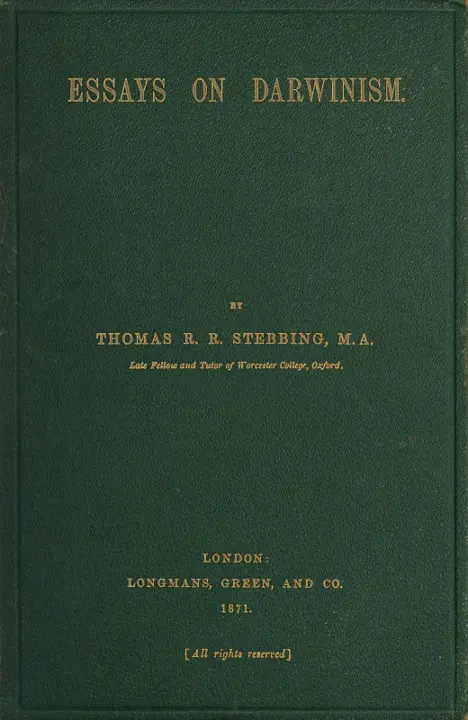
THE CLASSIC COLLECTION · 1871
"Essays on Darwinism" by Thomas Roscoe Rede Stebbing is a collection of essays written in the late 19th century. This work delves into the implications and nuances of Darwin's theories of natural selection and evolution, emphasizing the importance of understanding the science behind these groundbreaking ideas. Stebbing addresses common misconceptions, critiques of Darwinism, and the connections between evolution and broader existential queries about life and humanity. The opening of this scholarly work serves as a preface, laying the foundation for a more in-depth exploration of Darwinian thought. Stebbing praises Darwin's clarity and commitment to truth while critically examining the misunderstandings surrounding his theories. He highlights how many reject Darwinism without engaging with the material and emphasizes the need for a thoughtful and open-minded exploration of these scientific principles. This introduction sets the stage for subsequent essays, which promise to tackle various aspects of Darwinism, the intersection of science and religion, and the implications of evolutionary theory for humanity and morality.
Introduction adapted from the source catalogue; source summaries may be automatically generated.
Free to read · English · 48,503 words · No account needed
MAKE TIME FOR A GOOD BOOK
On by default. Untick to stop anonymous reading totals. Each page counts after 10 seconds in view. How this works.
Anonymous counting is on unless you have switched it off.
It remains only to say a few words on the argument from the calculation of chances which is supposed to reduce the survival by natural selection of any particular useful variation almost or altogether to an arithmetical impossibility. ‘The advantage,’ we are told, ‘whatever it may be, is utterly outbalanced by numerical inferiority. A million creatures are born: ten thousand survive to produce offspring. One of the million has twice as good a chance as any other of surviving: but the chances are fifty to one against the gifted individual’s being one of the hundred survivors. No doubt the chances are twice as great against any one other individual, but this does not prevent their being enormously in favour of some average individual[69].’ In this calculation it seems to be overlooked that every individual will vary more or less, and that out of a million variations there is a very great probability that one should give much more than the amount of advantage which the calculation supposes. Nor does it follow that a variation conferring great advantage in the struggle for life should be great in comparison with a creature’s general organization. There is a very probable alternative, that when the advantages are exceedingly slight they may be shared by a great many, and that when falling to the lot of only one or a few, they may be exceedingly important. The doctrines of reversion and inheritance are pressed into the service of the arithmetical argument to show that the acquired advantage would be gradually diminished and finally lost. But Mr. Darwin tells us that, ‘when a new character appears, it is occasionally from the first well-fixed[70].’ The chances upon one principle that a character will not be transmitted are not worth consideration, if, under the operation of some other principle known or unknown, the transmission of the character actually takes place. We are asked whether one white man, introduced into an island otherwise inhabited only by negroes, would be likely to give the whole island eventually a white, or even a yellow, population. Without trying the experiment, we may perhaps safely answer in the negative. But the illustration loses much or all of its point, when we consider how little the circumstances of the experiment would correspond with what ordinarily happens in nature, how little we know whether the white man’s colour would be really an advantage or the reverse, and how complicated are the differences between a white man and a negro. If the blackness of the negro be due to Natural Selection in any considerable degree, we should expect it to suit the conditions which surround him in his native habitation better than a white skin would do. In this case the pallor introduced into the breed by a solitary stranger would gradually disappear in obedience to the principles of Natural Selection, not in opposition to them. To take once more the instance of the giraffe; the useful variation is here by hypothesis an elongated neck; it is conceivable that out of large herds the few survivors of a drought might be exclusively such as possessed this advantage to some extent. These would probably transmit to a large majority of their descendants the tendency to vary in a given direction which they had themselves all more or less exhibited. Their progeny, moreover, would be placed in exceptionally favourable circumstances by the very fact that in the previous drought so many of the same species had been starved to death, who would otherwise have furnished their chief competitors in the struggle for existence. It is still objected that upon this supposition many other animals ought to have acquired giraffe-like necks. But such an expectation is far from being warranted by the principles of Natural Selection. Since all variations are potentially useful, but only those are preserved which suit the surrounding conditions among which they are exhibited, the calculation of chances will itself plead for the probability that a variety of variations will be preserved, rather than the same many times over. Other species competing with the giraffe for food would be little likely to gain an advantage over it by a slight increase in length of neck, though by other variations they might achieve a decided superiority. It is obvious, also, that the advantage assigned to the elongated neck would belong to many other possible variations, such as a lengthened proboscis, far-reaching arms, the climbing powers of the snake or the monkey, the flight of the bird or the insect; all of which may be due to Natural Selection and the subsidiary principles which the theory of Development embraces.
Your reading position is saved on this browser. Take it to another device with a library code. Reading pages adapt to text, rather than matching a printed edition.
BEHIND THE BOOK
This eBook is for the use of anyone anywhere in the United States and most other parts of the world at no cost and with almost no restrictions whatsoever. You may copy it, give it away or re-use it under the terms of the Project Gutenberg License included with this eBook or online at www.gutenberg.org. If you are not located in the United States, you will have to check the laws of the country where you are located before using this eBook. Read the source licence.
The original source file, including credits and licence, is retained by this library. Request an original-format copy at no charge. Please include the book title and Project Gutenberg identifier #48987.
KEEP YOUR CURIOSITY GOING
David Patterson (Spirit) Hatch

David Patterson (Spirit) Hatch

David Patterson (Spirit) Hatch
Coulson Kernahan

Ralph Waldo Emerson

Maurice Baring