
Last letters from the living dead man
David Patterson (Spirit) Hatch
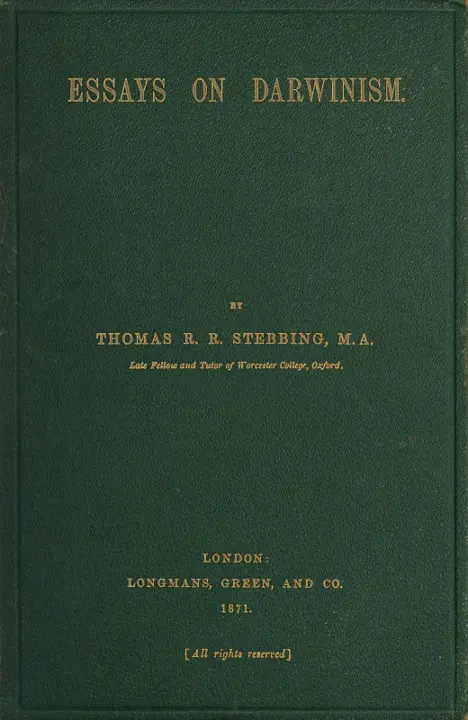
THE CLASSIC COLLECTION · 1871
"Essays on Darwinism" by Thomas Roscoe Rede Stebbing is a collection of essays written in the late 19th century. This work delves into the implications and nuances of Darwin's theories of natural selection and evolution, emphasizing the importance of understanding the science behind these groundbreaking ideas. Stebbing addresses common misconceptions, critiques of Darwinism, and the connections between evolution and broader existential queries about life and humanity. The opening of this scholarly work serves as a preface, laying the foundation for a more in-depth exploration of Darwinian thought. Stebbing praises Darwin's clarity and commitment to truth while critically examining the misunderstandings surrounding his theories. He highlights how many reject Darwinism without engaging with the material and emphasizes the need for a thoughtful and open-minded exploration of these scientific principles. This introduction sets the stage for subsequent essays, which promise to tackle various aspects of Darwinism, the intersection of science and religion, and the implications of evolutionary theory for humanity and morality.
Introduction adapted from the source catalogue; source summaries may be automatically generated.
Free to read · English · 48,503 words · No account needed
MAKE TIME FOR A GOOD BOOK
On by default. Untick to stop anonymous reading totals. Each page counts after 10 seconds in view. How this works.
Anonymous counting is on unless you have switched it off.
Darwinism, 3-33;
obscurely anticipated, 2;
its supporters, 3;
prejudice against, 4, 152;
its bearing on the seeming imperfection of nature, 24;
inconsistent with a recent universal deluge, 31, 34.
Dawkins, Mr. W. Boyd, lecture on coal by, 143.
Dawson, Dr., Acadian Geology, 120, 140.
Day, Dr., paper by, on the Mud-fish and Anabas scandens, 28.
Denudation, 143.
Deucalion’s Flood, argument from rebutted, 150.
Development, theory of, by whom originated and supported, 4;
opinion of its absurdity, 6;
facts and principles necessary to, (variation, 7;
Inheritance and Reversion, 9;
struggle for life, 11;
antiquity of the globe, 30;
freedom of the globe from any recent universal catastrophe, 31);
application of, to human body and mind, 62, 95;
time required for, 122;
not materially affected by hypothesis of spontaneous
generation, 127.
Ducklings, experiment with, 73.
Earth, immense age of, required by Theory of Development, 30, 67;
proved by geology, 31, 54, 107, 121;
popular impression as to age of, 93, 121;
reckoned by millions of years, 123.
Egypt, its monuments, 51;
its chronology, 56, 101.
Elephant, its sagacity, 3;
its rate of breeding, 13;
its different species, 46;
its memory, 66;
epithet applied to it by Pope, 74;
in Devonshire, 112.
Esquimaux, their ignorance of arithmetic, 103.
Flint-tools, 109, 111, 113.
Flood, the Noachian, 34-61;
historical account of, 38;
explanation suggested, 41;
how consistent with Darwinism, 50;
traditions of a, 58;
no traces of its universality, 59.
Food, its influence on the animal and vegetable kingdoms, 12; in the competition for life, 22.
Fossils, an evidence of variation, 20;
different in different strata, 116;
time required for vicissitudes of, 119;
necessary imperfection of, 134;
their scarcity and abundance, 141;
numerous chances of loss and destruction for, 146.
Fuegians, nakedness of, 112, note.
Galileo, his doctrine of the earth’s motion condemned, 60, 148.
Genesis, book of, its chronology, 55.
‘Genesis of Species,’ by Mr. Mivart, 173.
Geology, its conclusions, 31, 53;
imperfection of its record, 133-146.
Giraffes, 176, 179.
Glacial Period, its effect on distribution of species, 47.
Gooseberry, the big, 16.
Horse, career of, in America, 48;
its endurance and ambition, 3;
its intelligence, 66;
instance thereof, 74;
its intercourse with man, 80.
Hypotheses, use of, 131.
Inheritance, 9;
at different periods of life, 18.
Instinct, of bees, 25;
employment and gradations of, in various animals, 28;
compared with reason, 62-81, 164;
fallacious theory of, 67;
ignored by ducklings, 73;
fancied excellence of, 86.
Kent’s cavern, 109-115.
Language, time required for variations of, 57;
its influence on mankind, 77, 87;
origin of, 103.
Light, rapidity of, 97.
Limestone, formation of, 109;
contents of, 115;
slow formation of, 117;
Devonian, older than the New Red Sandstone, 118.
Lindley, Dr., his experiment with immersed vegetables, 143.
Linnæus, on the common descent of species, 3.
Lion, its generosity, 3;
instance of its affection, 76;
instance of its gratitude, 83;
in Britain, 112.
Locke, on the reason of brutes, 74.
Lubbock, Sir John, ‘Prehistoric Times,’ 54, 104, 107, 112; ‘Origin of Civilization,’ 107.
Lyell, Sir Charles, ‘Principles of Geology,’ 3, 54;
‘Antiquity of Man,’ 107;
‘Elements of Geology,’ 109.
Madagascar, its species and genera, 46.
Malay, compared with the Papuan by Mr. Wallace, 49, 150.
Your reading position is saved on this browser. Take it to another device with a library code. Reading pages adapt to text, rather than matching a printed edition.
BEHIND THE BOOK
This eBook is for the use of anyone anywhere in the United States and most other parts of the world at no cost and with almost no restrictions whatsoever. You may copy it, give it away or re-use it under the terms of the Project Gutenberg License included with this eBook or online at www.gutenberg.org. If you are not located in the United States, you will have to check the laws of the country where you are located before using this eBook. Read the source licence.
The original source file, including credits and licence, is retained by this library. Request an original-format copy at no charge. Please include the book title and Project Gutenberg identifier #48987.
KEEP YOUR CURIOSITY GOING
David Patterson (Spirit) Hatch

David Patterson (Spirit) Hatch

David Patterson (Spirit) Hatch
Coulson Kernahan

Ralph Waldo Emerson

Maurice Baring