
Last letters from the living dead man
David Patterson (Spirit) Hatch
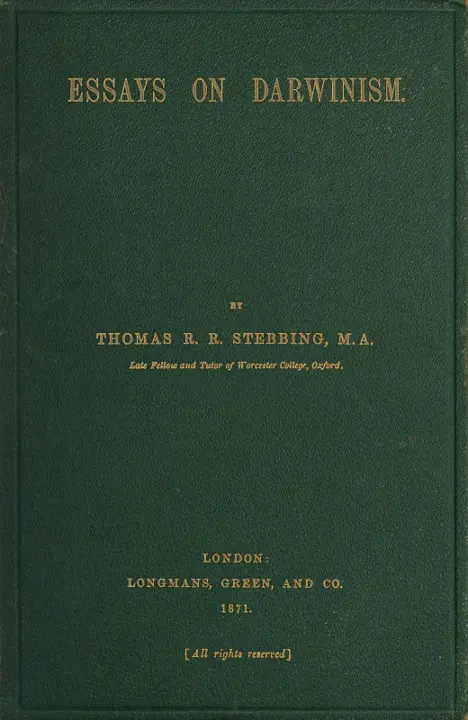
THE CLASSIC COLLECTION · 1871
"Essays on Darwinism" by Thomas Roscoe Rede Stebbing is a collection of essays written in the late 19th century. This work delves into the implications and nuances of Darwin's theories of natural selection and evolution, emphasizing the importance of understanding the science behind these groundbreaking ideas. Stebbing addresses common misconceptions, critiques of Darwinism, and the connections between evolution and broader existential queries about life and humanity. The opening of this scholarly work serves as a preface, laying the foundation for a more in-depth exploration of Darwinian thought. Stebbing praises Darwin's clarity and commitment to truth while critically examining the misunderstandings surrounding his theories. He highlights how many reject Darwinism without engaging with the material and emphasizes the need for a thoughtful and open-minded exploration of these scientific principles. This introduction sets the stage for subsequent essays, which promise to tackle various aspects of Darwinism, the intersection of science and religion, and the implications of evolutionary theory for humanity and morality.
Introduction adapted from the source catalogue; source summaries may be automatically generated.
Free to read · English · 48,503 words · No account needed
MAKE TIME FOR A GOOD BOOK
On by default. Untick to stop anonymous reading totals. Each page counts after 10 seconds in view. How this works.
Anonymous counting is on unless you have switched it off.
[64] This and the three following letters were originally addressed to the Editor of the Torquay Directory, in answer to a gentleman who, in company with large multitudes of his fellow-Britons, both male and female, holds and upon occasion upholds a mass of opinions on Science and Religion, any one of which opinions individually may be right or may be wrong, but which, when held collectively, seem to my humble understanding to be logically incoherent.
[65] Reprinted from ‘Nature,’ No. 30.
[66] Reprinted from ‘Nature,’ No. 56.
[67] Applying to these caterpillars Mr. A Murray’s recent hypothesis for explaining ‘mimicry’ by hybridization, we should draw the poetical inference that a happy marriage is possible between a butterfly and a rose-bush.
[68] ‘Nature,’ No. 66.
[69] ‘Genesis of Species,’ p. 57, quotation (somewhat obscure as it stands) from the North British Review for June, 1867.
[70] ‘Animals and Plants under Domestication,’ vol. ii. p. 63.
Abiogenesis, note on hypothesis of, 126-132.
Addison, his opinion about Instinct, 71;
his description of the brood-hen, 72;
his account of a hen with brood of ducks, 73;
on the insensible gradations of species, 74.
African desert, geological evidence of, 122.
Anabas scandens, its climbing powers, 28;
Dr. Day’s opinion thereon, 28, note.
Androcles, story of, 82.
Animal mounds, of Wisconsin, 105.
Ants, slave-making, 29, 69;
French philosopher’s account of, 73.
Artificial selection, part of Natural selection, 16.
Baboons, warfare of, 69.
Bacon, Lord, his statement about dogs, 75.
Barbarism, time required for development of, 57.
Bees, progress of, in cell-making, 25;
their accuracy overrated, 69, 86.
Bennett, Mr. A. W., Mathematical test applied by, 168;
Review by, 173.
Birds’ nests, reasoning powers employed in construction of, 69, 86; compared with human dwellings, 70; use of human manufactures in, 71.
British Association, exploration of Kent’s cavern by, 109.
Britons, ancient, condition of, 111.
Brookes, Henry, story of a lion quoted from, 76.
Brutes, man’s treatment of, 11, 90;
opinion that God is the soul of, 71;
compared with men, 74;
their moral qualities, 75, 88;
their laws and constitutions, 77;
their perceptions and emotions, 80;
language of scripture about, 84;
motives of pleasure and pain applied to, 88;
children compared with, 89.
Cannibalism, 57;
of British tribes, 112.
Caterpillars, resembling twigs, 170.
Chalk, continuous formation of, 117.
Civilization, its dependence on language and the art of writing, 88.
Coal-measures, 119-121, 140.
Columbus, his opinion of the earth’s spherical form condemned,
60, 148.
Coquand’s Oysters of the Chalk, Professor Flower’s review
of, 145, 165.
Correlation, 17, 166, 176.
Creation, sudden, not reconcilable with the order of nature, 25;
theories of, compared, 32;
prejudice in favour of its suddenness, 63, 64;
Biblical theory of, 129.
Creations, many distinct, not warranted by scripture or science,
20, 116, 135;
special, for special localities, untenable, 21.
Danes, ancient, food and weapons of, 104.
Darwin, his account of the development of his theory, 4;
his calculation about elephants, 13;
allusion to his theory of Pangenesis, 33;
his explanation of the fauna and flora of mountain-tops, 46;
his account of slave-making ants, 69;
his treatment of geology, 134;
his chapter on instinct, 163.
Your reading position is saved on this browser. Take it to another device with a library code. Reading pages adapt to text, rather than matching a printed edition.
BEHIND THE BOOK
This eBook is for the use of anyone anywhere in the United States and most other parts of the world at no cost and with almost no restrictions whatsoever. You may copy it, give it away or re-use it under the terms of the Project Gutenberg License included with this eBook or online at www.gutenberg.org. If you are not located in the United States, you will have to check the laws of the country where you are located before using this eBook. Read the source licence.
The original source file, including credits and licence, is retained by this library. Request an original-format copy at no charge. Please include the book title and Project Gutenberg identifier #48987.
KEEP YOUR CURIOSITY GOING
David Patterson (Spirit) Hatch

David Patterson (Spirit) Hatch

David Patterson (Spirit) Hatch
Coulson Kernahan

Ralph Waldo Emerson

Maurice Baring