
Last letters from the living dead man
David Patterson (Spirit) Hatch
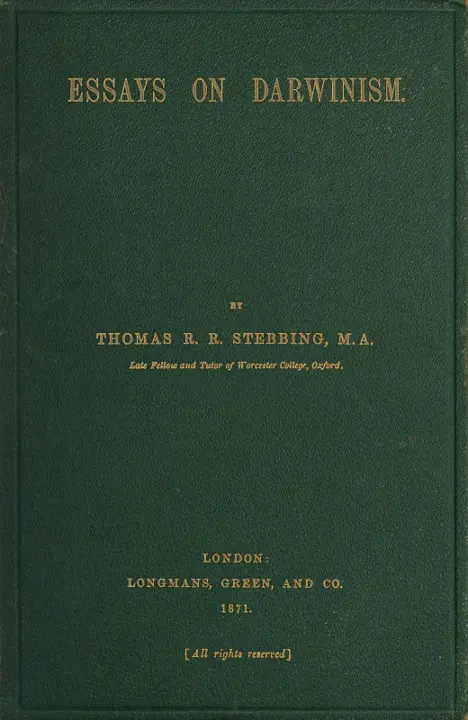
THE CLASSIC COLLECTION · 1871
"Essays on Darwinism" by Thomas Roscoe Rede Stebbing is a collection of essays written in the late 19th century. This work delves into the implications and nuances of Darwin's theories of natural selection and evolution, emphasizing the importance of understanding the science behind these groundbreaking ideas. Stebbing addresses common misconceptions, critiques of Darwinism, and the connections between evolution and broader existential queries about life and humanity. The opening of this scholarly work serves as a preface, laying the foundation for a more in-depth exploration of Darwinian thought. Stebbing praises Darwin's clarity and commitment to truth while critically examining the misunderstandings surrounding his theories. He highlights how many reject Darwinism without engaging with the material and emphasizes the need for a thoughtful and open-minded exploration of these scientific principles. This introduction sets the stage for subsequent essays, which promise to tackle various aspects of Darwinism, the intersection of science and religion, and the implications of evolutionary theory for humanity and morality.
Introduction adapted from the source catalogue; source summaries may be automatically generated.
Free to read · English · 48,503 words · No account needed
MAKE TIME FOR A GOOD BOOK
On by default. Untick to stop anonymous reading totals. Each page counts after 10 seconds in view. How this works.
Anonymous counting is on unless you have switched it off.
Man, his destructiveness, 11;
his likeness to other animals in blood, fibre, and skeleton, 29;
distribution of his varieties, 48;
traced back for thousands of years, 51;
a common origin for all families of, 52;
his chief endowments, 67;
compared as a builder with birds, 70;
his brain and hairless skin, 73;
his bodily structure, 85;
his opinion of war, 86;
real origin of, forgotten, 102.
Marriage-customs, slow change of, 106.
Marsupials, 46;
fossil, 47.
Matlock Bath, formation of stalagmite at, 110, 114.
Memory, necessary to intelligence, 66;
unequal distribution of, 66.
Miracles, treatment of false ones, 40;
of the Old Testament, 83.
Mivart, St. George, Mr., ‘Genesis of Species’ by, 173.
Mushroom, time required for its growth, 55.
Mygale, the trap-door spider, its ingenious nest, 29.
Natural Selection, illustrated by artificial selection, 14; the slowness of its movement, 18; explains the order of nature, and in part its seeming disorder, 26; limits of, propounded by Mr. Wallace, 62.
Nile, articles in sediment of, 108.
Origin of life, opinions on, 94.
Oysters, memory of, 66;
obscure politics of, 77.
Palæontology, Lyell’s definition of, 135.
Papuan, compared with the Malay, 49, 150.
Parfitt, Mr., on Fossil Sponge Spicules, 136, 139.
Pengelly, Mr., on pre-historic man, 105;
exploration of Kent’s cavern by, 109, 110, 113.
Pigeons, subjected to man’s selection, 14, 16, 17.
Plants, their struggle for food, 12;
their movements, 28.
Pope, his epithet for the elephant, 74.
Reason, progressive development of, in individual minds, 62, 67; that of men, one in kind with the intelligence of brutes, 66, 84; helps to, 86.
Relative terms, 97, 171.
Religion, development of, 64, 90.
Reversion, 9;
limits artificial selection, 17.
Rudimentary organs, 21.
Sandstone, New Red, 118.
Savages, question of their degeneracy, 57;
brain, skin, and voice of, 78.
Science, not antagonistic to Christian doctrine, 82, note.
Scripture, no warrant for distinct creations, 20;
does not profess to
teach Natural Science, 35;
its use of ordinary language, 36;
its historical account of the Flood, 38;
explanation thereof, 41;
disregard of secondary causes in, 83;
character of genealogies in, 99;
mistaken quotation of, 124;
invidious connection of, with false science, 151;
supposed opposition between it and Darwinism, 157.
Species, permanence of, 9;
some benefited by change of habitat, 21;
variations of, how advantageous, 27;
difficulty of collecting all for the Ark, 43;
distribution of, 45.
Spencer, Mr. Herbert, his caution about embryonic forms, 19, note; his accurate phrase, ‘Survival of the fittest,’ 154; his ‘Principles of Biology,’ 161.
Sponges, not to be hurried, 117;
range of in geology, 136;
final cause of, 138.
Stalagmite, thickness of in Kent’s cavern, 110;
time required for forming, 113;
dates carved upon, 115.
Stratification, uniform order of, 116, 122.
Struggle for life, 11;
great fecundity useful to a species in, 24.
Sylvia Sutoria, the tailor-bird, its nest, 29.
Tails, rudimentary, in man, 22, 155.
Tennyson, language of ‘the Brook’ in, 125.
Theories, when to be accepted, 18.
Thought, time required for, 64;
movement of, depending on language, 87.
Time, immense duration of, required by the Theory of Natural
Selection, 30, 67;
lapse of, 93-125;
(see Earth, age of);
inexhaustible, 98, 125.
Tinière, delta of, 107.
Tyndal, Professor, on ‘The Minuteness of Waves of Light,’ 97.
Usher, archbishop, Bible-chronology of, 99, 110.
Variability, 7;
objection to, considered, 128.
Your reading position is saved on this browser. Take it to another device with a library code. Reading pages adapt to text, rather than matching a printed edition.
BEHIND THE BOOK
This eBook is for the use of anyone anywhere in the United States and most other parts of the world at no cost and with almost no restrictions whatsoever. You may copy it, give it away or re-use it under the terms of the Project Gutenberg License included with this eBook or online at www.gutenberg.org. If you are not located in the United States, you will have to check the laws of the country where you are located before using this eBook. Read the source licence.
The original source file, including credits and licence, is retained by this library. Request an original-format copy at no charge. Please include the book title and Project Gutenberg identifier #48987.
KEEP YOUR CURIOSITY GOING
David Patterson (Spirit) Hatch

David Patterson (Spirit) Hatch

David Patterson (Spirit) Hatch
Coulson Kernahan

Ralph Waldo Emerson

Maurice Baring