
John Bull’s Womankind (Les Filles de John Bull)
Max O'Rell
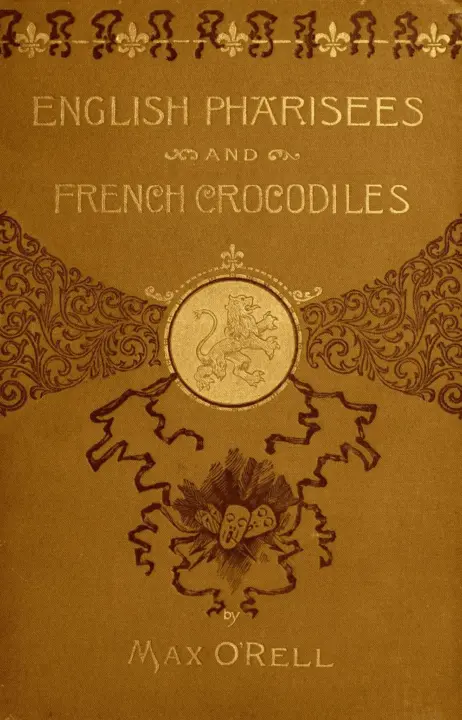
THE CLASSIC COLLECTION · 1892
"English Pharisees, French Crocodiles, and Other Anglo-French Typical Characters" by Max O'Rell is a sociocultural commentary written in the late 19th century. The work provides observations and sketches of the characteristics and behaviors of various Anglo-French figures, capturing the nuances of cultural interactions between England and France. Through wit and satire, the author delves into topics such as national stereotypes and the peculiarities that define these neighboring societies, making it relevant for those interested in cultural studies and humor. The opening of the book serves as an introduction to the author's perspective on the concept of "foreigners" and discusses the misunderstandings that arise between different nationalities, particularly the English and the French. O'Rell uses humor to highlight the absurdities of preconceived notions about foreign cultures, illustrating how perceptions can be skewed through ignorance or limited experiences. As he moves through anecdotes, the author emphasizes the value in understanding and appreciating the qualities of others, urging readers to look beyond stereotypes and foster a sense of inclusivity.
Introduction adapted from the source catalogue; source summaries may be automatically generated.
Free to read · English · 34,941 words · No account needed
MAKE TIME FOR A GOOD BOOK
On by default. Untick to stop anonymous reading totals. Each page counts after 10 seconds in view. How this works.
Anonymous counting is on unless you have switched it off.
France, ruined by the wars and extravagances of Louis XIV., exasperated by the turpitudes of Louis XV., encouraged by the weakness of Louis XVI., revolts. Thrones tremble, and the whole world is awe-struck at the terrible Revolution. Kings league themselves together against her; but such is her might that, with soldiers half armed, half clothed, half fed, she puts to flight the allied armies of the enemies, who had sworn to crush her.
Up rises a man and wrests from her all the liberty she had just bought at the price of so much bloodshed. To steady himself upon an unsteady throne, Napoleon engages in dynastic wars for ten years, marching his victorious army from capital to capital, while Europe wonders and trembles. At length the eagle falls, and France, sick of military glory, beaten, but not humiliated, takes breath and submits to the Restoration imposed upon her by the allied invaders. To console herself for the loss of the Republic, a form of government least calculated to foster literature and the fine arts, she profits by the return of monarchical rule to inaugurate the Golden Age of 1830. I say the Age of 1830, for such is the name this epoch, one of the most glorious in the history of France, will be known by in the next century. Now appear, in poetry, Victor Hugo, Lamartine, Alfred de Musset, Beranger; in fiction, Balzac, Chateaubriand, Alexandre Dumas, George Sand; in history, Thiers, Guizot; in political oratory, Manuel, Foy, Berryer; in criticism, Sainte-Beuve, Jules Janin; in painting, Horace Vernet, Ingres, Delacroix, Gudin; in music, Boieldieu, Herold, Halevy, Auber; in tragedy, Talma, Rachel; in comedy, Mars, Duvernoy; in opera, Nourrit, Duprez, Lablache, Baroilhet, Malibran.
I have mentioned but a few of the princes of talent.
To keep her hand in practice, she makes the conquest of Algeria, and, later on, having nothing else particular in hand, she takes it into her head to make the Suez Canal, a gigantic undertaking, which of itself would be enough to save the nineteenth century from oblivion. Ever enamored of great names, she re-establishes the Empire, because there is a man in the world who bears the name of the victor of Austerlitz. Smitten once more with that strange malady, the love of glory, she fights Russia in 1855 to prevent her from going to Constantinople, and Austria in 1859 to create Italian unity. Then comes that terrible year, the year 1870. With an army of 350,000 men, she sanctions a war, like the child that she is, with a nation, which for sixteen years had been silently preparing to avenge her defeat at Jena, and which had 1,200,0000 men ready to take the field. She is conquered, and, alas! humiliated. She pays her conquerors $1,000,000,000, but this she has almost forgotten, and sees wrenched from her two provinces that she loved and was beloved by; this she will never forget. The following year, she holds up her head, the richest and most esteemed of European nations. To-day, if she only had a leader, republican or monarch, she would be the strongest.
Your reading position is saved on this browser. Take it to another device with a library code. Reading pages adapt to text, rather than matching a printed edition.
Max O'Rell

Max O'Rell

Max O'Rell
Max O'Rell
BEHIND THE BOOK
This eBook is for the use of anyone anywhere in the United States and most other parts of the world at no cost and with almost no restrictions whatsoever. You may copy it, give it away or re-use it under the terms of the Project Gutenberg License included with this eBook or online at www.gutenberg.org. If you are not located in the United States, you will have to check the laws of the country where you are located before using this eBook. Read the source licence.
The original source file, including credits and licence, is retained by this library. Request an original-format copy at no charge. Please include the book title and Project Gutenberg identifier #34684.
KEEP YOUR CURIOSITY GOING

David Patterson (Spirit) Hatch

David Patterson (Spirit) Hatch

David Patterson (Spirit) Hatch

Ralph Waldo Emerson

Maurice Baring

Oscar Wilde & James McNeill Whistler