John Bull’s Womankind (Les Filles de John Bull)
Max O'Rell
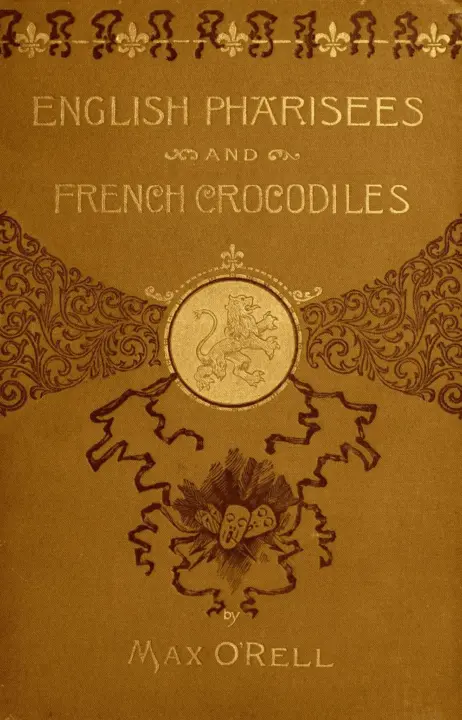
THE CLASSIC COLLECTION · 1892
"English Pharisees, French Crocodiles, and Other Anglo-French Typical Characters" by Max O'Rell is a sociocultural commentary written in the late 19th century. The work provides observations and sketches of the characteristics and behaviors of various Anglo-French figures, capturing the nuances of cultural interactions between England and France. Through wit and satire, the author delves into topics such as national stereotypes and the peculiarities that define these neighboring societies, making it relevant for those interested in cultural studies and humor. The opening of the book serves as an introduction to the author's perspective on the concept of "foreigners" and discusses the misunderstandings that arise between different nationalities, particularly the English and the French. O'Rell uses humor to highlight the absurdities of preconceived notions about foreign cultures, illustrating how perceptions can be skewed through ignorance or limited experiences. As he moves through anecdotes, the author emphasizes the value in understanding and appreciating the qualities of others, urging readers to look beyond stereotypes and foster a sense of inclusivity.
Introduction adapted from the source catalogue; source summaries may be automatically generated.
Free to read · English · 34,941 words · No account needed
MAKE TIME FOR A GOOD BOOK
On by default. Untick to stop anonymous reading totals. Each page counts after 10 seconds in view. How this works.
Anonymous counting is on unless you have switched it off.
The existence of a hereditary House of Lords is a standing insult to the common sense of the English people.
England is governed by the eldest sons of the aristocracy.
Now, all who have had much to do with youth are perfectly agreed that, as a rule, the eldest son is the least intelligent in each family.
The first born is a ballon d'essai.
Moreover, the eldest son of the aristocrat is the sole heir to his father's title and estates. He knows that the fortune cannot escape him. And so, at school, he does no work; he leaves that sort of thing to his younger brothers, who will have to make their way in the world. When he leaves school or college, his chief subjects of preoccupation are Jews and jockeys.
It is needless to add that, in the House of Lords, the proportion of Conservatives to Liberals is overwhelming.
Consequently, when the Liberals are in power, the House of Lords is a dangerous institution, which may at every moment hinder the working of the governmental machine; and when the Conservatives are in power, the House of Lords is a useless institution, because its approbation can be relied upon in advance by the Government.
Does it not seem as if any second chamber must necessarily be dangerous
or useless?
There is an episode of French history which, to my mind, has been
forgotten much too soon.
It teaches a great lesson on the usefulness of Upper Houses.
It was under the Second Empire.
The French Senate was then, intellectually speaking, a body of men superior to the House of Lords, since they were picked men--chosen by the Emperor, it is true, but still chosen. With the exception of Sainte-Beuve, these senators of the Empire were more or less Bonapartists; cardinals, archbishops, marshals, generals, literary men, all men of importance. The duty of the Senate was to watch over the Constitution, and to stop any bill, passed by the Chamber of Deputies, that might have endangered the existence of the actual form of Government.
Well, in July, 1870, the Franco-Prussian war broke out, and, on the 4th of September, in the same year, the Chamber of Deputies deposed the Emperor, and proclaimed the Republic.
Here was a grand opportunity for the senators of showing their power, and of earning the 30,000 francs that they each received from their master.
Yet what happened?
Not one voice was raised by the Senate against the act of the deputies.
Your reading position is saved on this browser. Take it to another device with a library code. Reading pages adapt to text, rather than matching a printed edition.
Max O'Rell
Max O'Rell
Max O'Rell
Max O'Rell
BEHIND THE BOOK
This eBook is for the use of anyone anywhere in the United States and most other parts of the world at no cost and with almost no restrictions whatsoever. You may copy it, give it away or re-use it under the terms of the Project Gutenberg License included with this eBook or online at www.gutenberg.org. If you are not located in the United States, you will have to check the laws of the country where you are located before using this eBook. Read the source licence.
The original source file, including credits and licence, is retained by this library. Request an original-format copy at no charge. Please include the book title and Project Gutenberg identifier #34684.
KEEP YOUR CURIOSITY GOING

David Patterson (Spirit) Hatch

David Patterson (Spirit) Hatch

David Patterson (Spirit) Hatch

Ralph Waldo Emerson

Maurice Baring

Oscar Wilde & James McNeill Whistler