THE CLASSIC COLLECTION✦Hawthorne (English Men of Letters Series)CLASSIC FREE BOOKS
Hawthorne (English Men of Letters Series)
Henry James
THE CLASSIC COLLECTION · 1875
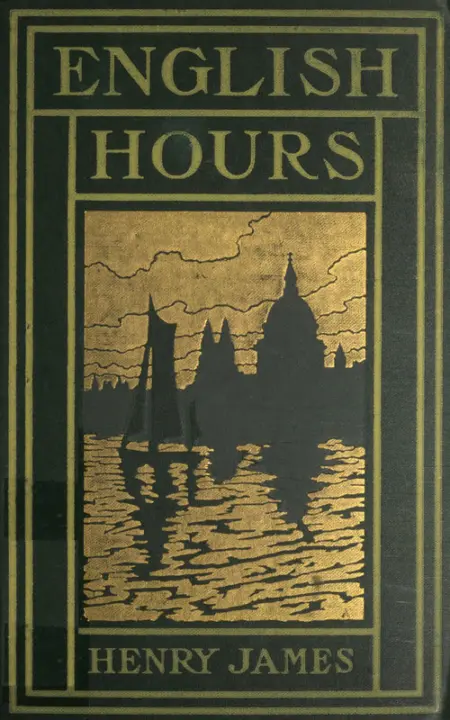
"English Hours" by Henry James is a collection of travel essays published in 1905. Drawing from more than thirty years of writing about England, James chronicles his experiences in his adopted country, from London's "greasy" streets to the pastoral countryside of Devon, Warwickshire, and Suffolk. With knowing affection, he captures both the "dreadful, delightful" British capital and the quiet charms of rural towns like Rye, offering readers an intimate portrait of Victorian and Edwardian England through American eyes.
Introduction adapted from the source catalogue; source summaries may be automatically generated.
Free to read · English · 76,282 words · No account needed
MAKE TIME FOR A GOOD BOOK
On by default. Untick to stop anonymous reading totals. Each page counts after 10 seconds in view. How this works.
Anonymous counting is on unless you have switched it off.
I returned to the habitation of my friend—for I too was guilty of “staying”—through an old Norman portal, massively arched and quaintly sculptured, across whose hollow threshold the eye of fancy might see the ghosts of monks and the shadows of abbots pass noiselessly to and fro. This aperture admits you to a beautiful ambulatory of the thirteenth century—a long stone gallery or cloister, repeated in two stories, with the interstices of its traceries now glazed, but with its long, low, narrow, charming vista still perfect and picturesque, with its flags worn away by monkish sandals and with huge round-arched doorways opening from its inner side into great rooms roofed like cathedrals. These rooms are furnished with narrow windows, of almost defensive aspect, set in embrasures three feet deep and ornamented with little grotesque mediæval faces. To see one of the small monkish masks grinning at you while you dress and undress, or while you look up in the intervals of inspiration from your letter-writing, is a mere detail in the entertainment of living in a ci-devant priory. This entertainment is inexhaustible; for every step you take in such a house confronts you in one way or another with the remote past. You devour the documentary, you inhale the historic. Adjoining the house is a beautiful ruin, part of the walls and windows and bases of the piers of the magnificent church administered by the predecessor of your host, the mitred abbot. These relics are very desultory, but they are still abundant, and they testify to the great scale and the stately beauty of the abbey. You may lie upon the grass at the base of an ivied fragment, measure the girth of the great stumps of the central columns, half-smothered in soft creepers, and think how strange it is that in this quiet hollow, in the midst of lonely hills, so exquisite and elaborate a work of art should have risen. It is but an hour’s walk to another great ruin, which has held together more completely. There the central tower stands erect to half its altitude and the round arches and massive pillars of the nave make a perfect vista on the unencumbered turf. You get an impression that when Catholic England was in her prime great abbeys were as thick as milestones. By native amateurs even now the region is called “wild,” though to American eyes it seems almost suburban in its smoothness and finish. There is a noiseless little railway running through the valley, and there is an ancient little town at the abbey gates—a town indeed with no great din of vehicles, but with goodly brick houses, with a dozen “publics,” with tidy, whitewashed cottages, and with little girls, as I have said, bobbing curtsies in the street. Yet even now, if one had wound one’s way into the valley by the railroad, it would be rather a surprise to find a great architectural display in a setting so peaceful and pastoral. How impressive then must the beautiful church have been in the days of its prosperity, when the pilgrim came down to it from the grassy hillside and its bells made the stillness sensible! The abbey was in those days a great affair; it sprawled, as my companion said, all over the place. As you walk away from it you think you have got to the end of its geography, but you encounter it still in the shape of a rugged outhouse enriched with an early-English arch, of an ancient well hidden in a kind of sculptured cavern. It is noticeable that even if you are a traveller from a land where there are no early-English—and indeed few late-English—arches, and where the well-covers are, at their hoariest, of fresh-looking shingles, you grow used with little delay to all this antiquity. Anything very old seems extremely natural; there is nothing we suffer to get so near us as the tokens of the remote. It is not too much to say that after spending twenty-four hours in a house that is six hundred years old you seem yourself to have lived in it six hundred years. You seem yourself to have hollowed the flags with your tread and to have polished the oak with your touch. You walk along the little stone gallery where the monks used to pace, looking out of the gothic window-places at their beautiful church, and you pause at the big, round, rugged doorway that admits you to what is now the drawing-room. The massive step by which you ascend to the threshold is a trifle crooked, as it should be; the lintels are cracked and worn by the myriad-fingered years. This strikes your casual glance. You look up and down the miniature cloister before you pass in; it seems wonderfully old and queer. Then you turn into the drawing-room, where you find modern conversation and late publications and the prospect of dinner. The new life and the old have melted together; there is no dividing-line. In the drawing-room wall is a queer funnel-shaped hole, with the broad end inward, like a small casemate. You ask what it is, but people have forgotten. It is something of the monks; it is a mere detail. After dinner you are told that there is of course a ghost, a grey friar who is seen in the dusky hours at the end of passages. Sometimes the servants see him; they afterwards go surreptitiously to sleep in the village. Then, when you take your chamber-candle and go wandering bedward by a short cut through empty rooms, you are conscious of an attitude toward the grey friar which you hardly know whether to read as a fond hope or as a great fear.
Your reading position is saved on this browser. Take it to another device with a library code. Reading pages adapt to text, rather than matching a printed edition.
Henry James
Henry James
Henry James

Henry James
BEHIND THE BOOK
This eBook is for the use of anyone anywhere in the United States and most other parts of the world at no cost and with almost no restrictions whatsoever. You may copy it, give it away or re-use it under the terms of the Project Gutenberg License included with this eBook or online at www.gutenberg.org. If you are not located in the United States, you will have to check the laws of the country where you are located before using this eBook. Read the source licence.
The original source file, including credits and licence, is retained by this library. Request an original-format copy at no charge. Please include the book title and Project Gutenberg identifier #58938.
KEEP YOUR CURIOSITY GOING
Wilfrid Scawen Blunt
Wilfrid Scawen Blunt

E. W. (Edgar Watson) Howe

David Patterson (Spirit) Hatch

David Patterson (Spirit) Hatch

David Patterson (Spirit) Hatch