THE CLASSIC COLLECTION✦Hawthorne (English Men of Letters Series)CLASSIC FREE BOOKS
Hawthorne (English Men of Letters Series)
Henry James
THE CLASSIC COLLECTION · 1875
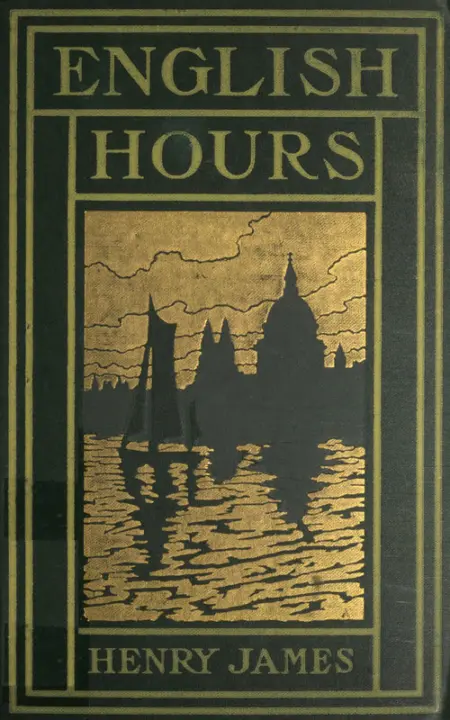
"English Hours" by Henry James is a collection of travel essays published in 1905. Drawing from more than thirty years of writing about England, James chronicles his experiences in his adopted country, from London's "greasy" streets to the pastoral countryside of Devon, Warwickshire, and Suffolk. With knowing affection, he captures both the "dreadful, delightful" British capital and the quiet charms of rural towns like Rye, offering readers an intimate portrait of Victorian and Edwardian England through American eyes.
Introduction adapted from the source catalogue; source summaries may be automatically generated.
Free to read · English · 76,282 words · No account needed
MAKE TIME FOR A GOOD BOOK
On by default. Untick to stop anonymous reading totals. Each page counts after 10 seconds in view. How this works.
Anonymous counting is on unless you have switched it off.
A friend of mine, an American, who knew this country, had told me not to fail, while I was in the neighbourhood, to go to Stokesay and two or three other places. “Edward IV and Elizabeth,” he said, “are still hanging about there.” So admonished, I made a point of going at least to Stokesay, and I saw quite what my friend meant. Edward IV and Elizabeth indeed are still to be met almost anywhere in the county; as regards domestic architecture few parts of England are still more vividly old-English. I have rarely had, for a couple of hours, the sensation of dropping back personally into the past so straight as while I lay on the grass beside the well in the little sunny court of this small castle and lazily appreciated the still definite details of mediæval life. The place is a capital example of a small gentil-hommière of the thirteenth century. It has a good deep moat, now filled with wild verdure, and a curious gate-house of a much later period—the period when the defensive attitude had been wellnigh abandoned. This gate-house, which is not in the least in the style of the habitation, but gabled and heavily timbered, with quaint cross-beams protruding from surfaces of coarse white plaster, is a very effective anomaly in regard to the little grey fortress on the other side of the court. I call this a fortress, but it is a fortress which might easily have been taken, and it must have assumed its present shape at a time when people had ceased to peer through narrow slits at possible besiegers. There are slits in the outer walls for such peering, but they are noticeably broad and not particularly oblique, and might easily have been applied to the uses of a peaceful parley. This is part of the charm of the place; human life there must have lost an earlier grimness; it was lived in by people who were beginning to believe in good intentions. They must have lived very much together; that is one of the most obvious reflections in the court of a mediæval dwelling. The court was not always grassy and empty, as it is now, with only a couple of gentlemen in search of impressions lying at their length, one of them handling a wine-flask that colours the clear water drawn from the well into a couple of tumblers by a decent, rosy, smiling, talking old woman who has come bustling out of the gate-house and who has a large, dropsical, innocent husband standing about on crutches in the sun and making no sign when you ask after his health. This poor man has reached that ultimate depth of human simplicity at which even a chance to talk about one’s ailments is not appreciated. But the civil old woman talks for every one, even for an artist who has come out of one of the rooms, where I see him afterward reproducing its mouldering repose. The rooms are all unoccupied and in a state of extreme decay, though the castle is, as yet, far from being a ruin. From one of the windows I see a young lady sitting under a tree, across a meadow, with her knees up, dipping something into her mouth. It is indubitably a camel’s hair paint-brush; the young lady is inevitably sketching. These are the only besiegers to which the place is exposed now, and they can do no great harm, as I doubt whether the young lady’s aim is very good. We wandered about the empty interior, thinking it a pity such things should fall to pieces. There is a beautiful great hall—great, that is, for a small castle (it would be extremely handsome in a modern house)—with tall, ecclesiastical-looking windows, and a long staircase at one end, which climbs against the wall into a spacious bedroom. You may still apprehend very well the main lines of that simpler life; and it must be said that, simpler though it was, it was apparently by no means destitute of many of our own conveniences. The chamber at the top of the staircase ascending from the hall is charming still, with its irregular shape, its low-browed ceiling, its cupboards in the walls, its deep bay window formed of a series of small lattices. You can fancy people stepping out from it upon the platform of the staircase, whose rugged wooden logs, by way of steps, and solid, deeply-guttered handrail, still remain. They looked down into the hall, where, I take it, there was always a congregation of retainers, much lounging and waiting and passing to and fro, with a door open into the court. The court, as I said just now, was not the grassy, æsthetic spot which you may find it at present of a summer’s day; there were beasts tethered in it, and hustling men-at-arms, and the earth was trampled into puddles. But my lord or my lady, looking down from the chamber-door, commanded the position and, no doubt, issued their orders accordingly. The sight of the groups on the floor beneath, the calling up and down, the oaken tables spread and the brazier in the middle—all this seemed present again; and it was not difficult to pursue the historic vision through the rest of the building—through the portion which connected the great hall with the tower (where the confederate of the sketching young lady without had set up the peaceful three-legged engine of his craft); through the dusky, roughly circular rooms of the tower itself, and up the corkscrew staircase of the same to that most charming part of every old castle, where visions must leap away off the battlements to elude you—the bright, dizzy platform at the tower-top, the place where the castle-standard hung and the vigilant inmates surveyed the approaches. Here, always, you really overtake the impression of the place—here, in the sunny stillness, it seems to pause, panting a little, and give itself up.
Your reading position is saved on this browser. Take it to another device with a library code. Reading pages adapt to text, rather than matching a printed edition.
Henry James
Henry James
Henry James

Henry James
BEHIND THE BOOK
This eBook is for the use of anyone anywhere in the United States and most other parts of the world at no cost and with almost no restrictions whatsoever. You may copy it, give it away or re-use it under the terms of the Project Gutenberg License included with this eBook or online at www.gutenberg.org. If you are not located in the United States, you will have to check the laws of the country where you are located before using this eBook. Read the source licence.
The original source file, including credits and licence, is retained by this library. Request an original-format copy at no charge. Please include the book title and Project Gutenberg identifier #58938.
KEEP YOUR CURIOSITY GOING
Wilfrid Scawen Blunt
Wilfrid Scawen Blunt

E. W. (Edgar Watson) Howe

David Patterson (Spirit) Hatch

David Patterson (Spirit) Hatch

David Patterson (Spirit) Hatch