THE CLASSIC COLLECTION✦Hawthorne (English Men of Letters Series)CLASSIC FREE BOOKS
Hawthorne (English Men of Letters Series)
Henry James
THE CLASSIC COLLECTION · 1875
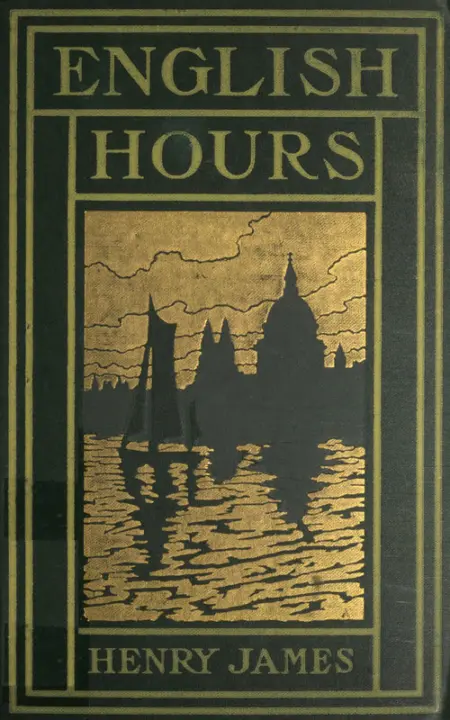
"English Hours" by Henry James is a collection of travel essays published in 1905. Drawing from more than thirty years of writing about England, James chronicles his experiences in his adopted country, from London's "greasy" streets to the pastoral countryside of Devon, Warwickshire, and Suffolk. With knowing affection, he captures both the "dreadful, delightful" British capital and the quiet charms of rural towns like Rye, offering readers an intimate portrait of Victorian and Edwardian England through American eyes.
Introduction adapted from the source catalogue; source summaries may be automatically generated.
Free to read · English · 76,282 words · No account needed
MAKE TIME FOR A GOOD BOOK
On by default. Untick to stop anonymous reading totals. Each page counts after 10 seconds in view. How this works.
Anonymous counting is on unless you have switched it off.
I do not think, even, that my sensibility to the charm of this delightful region—for its hillside prospect of old red farmhouses lighting up the dark-green bottoms, of gables and chimney-tops of great houses peeping above miles of woodland, and, in the vague places of the horizon, of far-away towns and sites that one had always heard of—was conditioned upon having “property” in the neighbourhood, so that the little girls in the town should suddenly drop curtsies to me in the street; though that too would certainly have been pleasant. At the same time having a little property would without doubt have made the attachment stronger. People who wander about the world without money in their pockets indulge in dreams—dreams of the things they would buy if their pockets were workable. These dreams are very apt to have relation to a good estate in any neighbourhood in which the wanderer may happen to find himself. For myself, I have never been in a country so unattractive that I didn’t find myself “drawn” to its most exemplary mansion. In New England and other portions of the United States I have felt my heart go out to the Greek temple, the small Parthenon, in white-painted wood; in Italy I have made imaginary proposals for the yellow-walled villa with statues on the roof. My fancy, in England, has seldom fluttered so high as the very best house, but it has again and again hovered about one of the quiet places, unknown to fame, which are locally spoken of as merely “good.” There was one in especial, in the neighbourhood I allude to, as to which the dream of having impossibly acquired it from an embarrassed owner kept melting into the vision of “moving in” on the morrow. I saw this place unfortunately, to small advantage; I saw it in the rain, but I am glad fine weather didn’t meddle with the affair, for the irritation of envy might in this case have poisoned the impression. It was a long, wet Sunday, and the waters were deep. I had been in the house all day, for the weather can best be described by my saying that it had been deemed to exonerate us from church. But in the afternoon, the prospective interval between lunch and tea assuming formidable proportions, my host took me a walk, and in the course of our walk he led me into a park which he described as “the paradise of a small English country-gentleman.” It was indeed a modern Eden, and the trees might have been trees of knowledge. They were of high antiquity and magnificent girth and stature; they were strewn over the grassy levels in extraordinary profusion, and scattered upon and down the slopes in a fashion than which I have seen nothing more felicitous since I last looked at the chestnuts above the Lake of Como. The point was that the property was small, but that one could perceive nowhere any limit. Shortly before we turned into the park the rain had renewed itself, so that we were awkwardly wet and muddy; but, being near the house, my companion proposed to leave his card in a neighbourly way. The house was most agreeable; it stood on a kind of terrace, in the middle of a lawn and garden, and the terrace overhung one of the most copious rivers in England, as well as looking across to those blue undulations of which I have already spoken. On the terrace also was a piece of ornamental water, and there was a small iron paling to divide the lawn from the park. All this I beheld in the rain. My companion gave his card to the butler with the remark that we were too much bespattered to come in, and we turned away to complete our circuit. As we turned away I became acutely conscious of what I should have been tempted to call the cruelty of this proceeding. My imagination gauged the whole position. It was a blank, a blighted Sunday afternoon—no one could come. The house was charming, the terrace delightful, the oaks magnificent, the view most interesting. But the whole thing confessed to the blankness if not to the dulness. In the house was a drawing-room, and in the drawing-room was—by which I meant must be—an English lady, a perfectly harmonious figure. There was nothing fatuous in believing that on this rainy Sunday afternoon it would not please her to be told that two gentlemen had walked across the country to her door only to go through the ceremony of leaving a card. Therefore, when, before we had gone many yards, I heard the butler hurrying after us, I felt how just my sentiment of the situation had been. Of course we went back, and I carried my muddy boots into the drawing-room—just the drawing-room I had imagined—where I found—I will not say just the lady I had imagined, but a lady even more in keeping. Indeed there were two ladies, one of whom was staying in the house. In whatever company you find yourself in England, you may always be sure that some one present is “staying,” and you come in due time to feel the abysses within the word. The large windows of the drawing-room I speak of looked away over the river to the blurred and blotted hills, where the rain was drizzling and drifting. It was very quiet, as I say; there was an air of large leisure. If one wanted to do anything here, there was evidently plenty of time—and indeed of every other appliance—to do it. The two ladies talked about “town:” that is what people talk about in the country. If I were disposed I might represent them as talking with a positive pathos of yearning. At all events I asked myself how it could be that one should live in this charming place and trouble one’s head about what was going on in London in July. Then we had fine strong tea and bread and butter.
Your reading position is saved on this browser. Take it to another device with a library code. Reading pages adapt to text, rather than matching a printed edition.
Henry James
Henry James
Henry James

Henry James
BEHIND THE BOOK
This eBook is for the use of anyone anywhere in the United States and most other parts of the world at no cost and with almost no restrictions whatsoever. You may copy it, give it away or re-use it under the terms of the Project Gutenberg License included with this eBook or online at www.gutenberg.org. If you are not located in the United States, you will have to check the laws of the country where you are located before using this eBook. Read the source licence.
The original source file, including credits and licence, is retained by this library. Request an original-format copy at no charge. Please include the book title and Project Gutenberg identifier #58938.
KEEP YOUR CURIOSITY GOING
Wilfrid Scawen Blunt
Wilfrid Scawen Blunt

E. W. (Edgar Watson) Howe

David Patterson (Spirit) Hatch

David Patterson (Spirit) Hatch

David Patterson (Spirit) Hatch