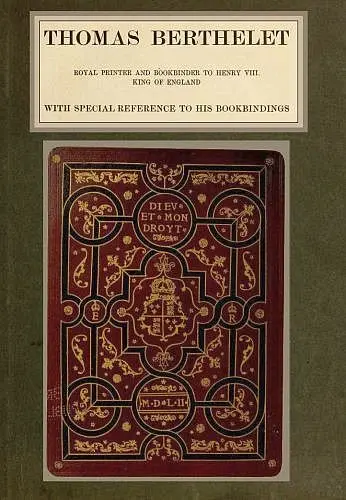
Thomas Berthelet, Royal Printer and Bookbinder to Henry VIII., King of England
Cyril Davenport
THE CLASSIC COLLECTION · 1909
"English Heraldic Book-stamps" by Cyril Davenport is a historical account written in the early 20th century. The book explores the fascinating world of heraldic book-stamps, detailing coats-of-arms and crests that adorn bookbindings across England, Scotland, and Ireland, with a focus on their historical significance and identification. The opening of the book sets the stage for an exhaustive examination of heraldic stamps, emphasizing that the material presented is just a collection of what exists, with suggestions of the vast number yet to be discovered. Davenport expresses a desire to document these symbols better, noting that little attention has previously been given to English heraldry in this context compared to French counterparts. He outlines the historical roots of heraldry, touching upon its military origins and the evolution of coats-of-arms on books from the late 15th century onward, establishing a foundation for the detailed descriptions and illustrations to follow in the subsequent chapters.
Introduction adapted from the source catalogue; source summaries may be automatically generated.
Free to read · English · 61,003 words · No account needed
MAKE TIME FOR A GOOD BOOK
On by default. Untick to stop anonymous reading totals. Each page counts after 10 seconds in view. How this works.
Anonymous counting is on unless you have switched it off.
Henry Benedict (born 5th March 1725, died 13th July 1807) was the second son of James Francis Edward, called the Chevalier St. George, son of James II., King of England, and Mary of Modena, who married Mary Clementina, daughter of James Sobieski, in 1719.
Prince Henry, who occasionally used the Royal Crown of England over his coat-of-arms, is called sometimes Henry IX., King of England. He entered the Romish Church as a priest at an early age, and in 1747 he was made a Cardinal by Benedict XIV., and held several Bishoprics and the Archbishopric of Corinth, but was usually known as Cardinal York. He assumed certain airs of dignity abroad in consequence of his Royal ancestry and claims, and in 1788, on the death of his elder brother, he had a medal made and inscribed "HENRICUS NONUS MAGNAE BRITANNIAE REX."
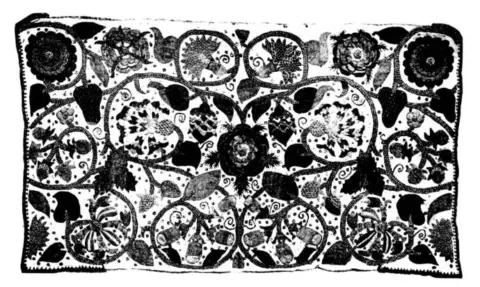
The Cardinal lived almost always abroad, and suffered much by loss of revenue caused by the French Revolution; he had to part with much of his private property, jewels, and plate. At this juncture George III. generously assisted Cardinal York, and made him a handsome allowance, in gratitude for which His Eminence bequeathed to the Prince of Wales, afterwards George IV., many of the Crown Jewels which James II. had taken with him to France. Some of the most important of these stones now adorn the English Imperial Crown. The Cardinal had a large library, and several of his books are at Windsor and at the British Museum. The majority of these are in leather, but some are embroidered.
Arms.--Quarterly; 1st and 4th grand quarters, France and England quarterly; 2nd grand quarter, Scotland; 3rd grand quarter, Ireland. All as used by James I. (q.v.); and over all a label arg. of three points.
A variety of this stamp has thistles instead of roses in the border.
[APOLLONIUS GALLUS. Exsuscitata Apollonii Pergaei ΠΕΡΙ ΕΠΛΦΩΝ Geometria. Parisiis, 1600.]
Variety.--Arms as before. Within the garter, and ensigned with a
Princely coronet.
[VITTORI. Tesoro de las tres lenguas Francesa, Italiana, ej Española. Geneve, 1609.]
A Prince of Wales's triple ostrich plume, commonly used as a corner stamp, all impressed in silver.
[ALUNNO.
Della Fabrica del
Mondo.
Venetia, 1575.]
A Prince of Wales's triple ostrich plume; the coronet, ribs of feathers, and motto generally impressed in gold, the feathers in silver. Used mostly as a centre stamp.
[LIPSIUS. Admiranda.
Antverpiae, 1599.]
A Badge of a lion rampant guardant, with princely coronet, always
impressed entirely in gold.
[REUSNERUS.
ΒΑΣΙΛΙΚΩΝ opus genealogicum
Catholicum
de praecipuis familiis
Imperatorum.
Francofurti, 1592.]
A Badge of a Tudor rose, with princely coronet.
[BOCCACCIO.
I casi degl' Huomini
Illustri.
Fiorenza, 1598.]
A Badge of a fleur-de-lys.
[BARETUS. An Alvearie, or triple Dictionarie.
London, 1573.]
Your reading position is saved on this browser. Take it to another device with a library code. Reading pages adapt to text, rather than matching a printed edition.
Cyril Davenport

Cyril Davenport
Cyril Davenport
BEHIND THE BOOK
This eBook is for the use of anyone anywhere in the United States and most other parts of the world at no cost and with almost no restrictions whatsoever. You may copy it, give it away or re-use it under the terms of the Project Gutenberg License included with this eBook or online at www.gutenberg.org. If you are not located in the United States, you will have to check the laws of the country where you are located before using this eBook. Read the source licence.
The original source file, including credits and licence, is retained by this library. Request an original-format copy at no charge. Please include the book title and Project Gutenberg identifier #47714.
KEEP YOUR CURIOSITY GOING
Cécile Tormay

Moritz Busch
John L. Ransom
Frances Wright
Cécile Tormay

Mabel Potter Daggett