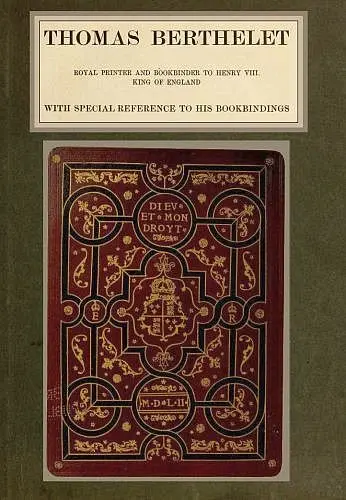
Thomas Berthelet, Royal Printer and Bookbinder to Henry VIII., King of England
Cyril Davenport
THE CLASSIC COLLECTION · 1909
"English Heraldic Book-stamps" by Cyril Davenport is a historical account written in the early 20th century. The book explores the fascinating world of heraldic book-stamps, detailing coats-of-arms and crests that adorn bookbindings across England, Scotland, and Ireland, with a focus on their historical significance and identification. The opening of the book sets the stage for an exhaustive examination of heraldic stamps, emphasizing that the material presented is just a collection of what exists, with suggestions of the vast number yet to be discovered. Davenport expresses a desire to document these symbols better, noting that little attention has previously been given to English heraldry in this context compared to French counterparts. He outlines the historical roots of heraldry, touching upon its military origins and the evolution of coats-of-arms on books from the late 15th century onward, establishing a foundation for the detailed descriptions and illustrations to follow in the subsequent chapters.
Introduction adapted from the source catalogue; source summaries may be automatically generated.
Free to read · English · 61,003 words · No account needed
MAKE TIME FOR A GOOD BOOK
On by default. Untick to stop anonymous reading totals. Each page counts after 10 seconds in view. How this works.
Anonymous counting is on unless you have switched it off.
Sir Kenelm Digby wrote a large number of books, religious, philosophical, and scientific; he was a man of much imagination, and took delight in inventing quack medicines. He possessed a large library; many of his books were presented to the Bodleian Library at Oxford, others are said to have been given to Louis XIV., and others again were scattered. On some of the volumes the coat-of-arms of Digby alone occurs, but in the majority of cases the coat-of-arms is quartered with various other family coats, and has also the coat-of-arms of Venetia Stanley either impaled or borne as an escutcheon of pretence. Many of Sir Kenelm's books were bound in Paris.
Arms.--Impaled.
Dexter: Az., 10 billets or, 4, 3, 2, and 1, on a chief of the second a demi lion rampant issuant sa. Dormer.
Sinister: Per pale, az. and gu., 3 lions rampant arg. Herbert.
Coronet.--That of an Earl.
[Common Prayer. Dublin, 1621.]
Robert Dormer (born circ. 1610 (?), died 20th September 1643) was the only son of Sir William Dormer, son of Robert, Baron Dormer of Wyng. In 1616 Robert Dormer succeeded to the Barony of Dormer on the death of his grandfather, his father having predeceased him. In 1628 he was created Earl of Carnarvon, and in 1641 he was Lord Lieutenant of Bucks. Lord Carnarvon was killed at the Battle of Newbury, where he fought as a Royalist. He married in 1625 Anna Sophia Herbert, daughter of Philip, Earl of Pembroke.
Arms.--Quarterly.
1st and 4th; arg., a human heart gu., imperially crowned ppr., on a chief az., 3 mullets of the field. Douglas.
2nd and 3rd; az., a bend between 6 crosses crosslet fitchée or.
Marr.
All within a bordure or, charged with the double tressure (flory counterflory) of Scotland, added by Charles II. to the coat of William Douglas, Earl of Queensberry, when he conferred upon him the Marquisate of Queensberry in 1681.
Coronet.--That of a Duke.
Supporters.--On each side a Pegasus arg., winged, maned, and hoofed
or.
Motto.--FORDWARD.
[BOETHIUS. Scotorum Historiae a prima gentis origine. Paris, 1526.]
Crest.--A man's heart gu., ensigned with an imperial crown ppr., and
winged or. Douglas.
Coronet.--That of a Duke.
Initials.--W. D. (William Douglas).
[PLINY. C. Plinii Secundi Historiae Naturalis, Lib. xxxvii. Lugd. Batavorum, 1635.]
William Douglas (born circ. 1637, died 28th March 1695), Viscount Drumlanrig, was the son of James Douglas, second Earl of Queensberry. In 1671 Lord Drumlanrig succeeded to his father's honours, and in 1681 he received a step in the Peerage, being created first Marquis of Queensberry. In 1684 he was created Duke of Queensberry. His Grace was Justice-General of Scotland in 1680 and a Lord of Session, and from 1682 to 1686 he was High Governor of Edinburgh Castle.
Your reading position is saved on this browser. Take it to another device with a library code. Reading pages adapt to text, rather than matching a printed edition.
Cyril Davenport
Cyril Davenport
Cyril Davenport
BEHIND THE BOOK
This eBook is for the use of anyone anywhere in the United States and most other parts of the world at no cost and with almost no restrictions whatsoever. You may copy it, give it away or re-use it under the terms of the Project Gutenberg License included with this eBook or online at www.gutenberg.org. If you are not located in the United States, you will have to check the laws of the country where you are located before using this eBook. Read the source licence.
The original source file, including credits and licence, is retained by this library. Request an original-format copy at no charge. Please include the book title and Project Gutenberg identifier #47714.
KEEP YOUR CURIOSITY GOING
Cécile Tormay

Moritz Busch
John L. Ransom
Frances Wright
Cécile Tormay

Mabel Potter Daggett