Things to be Remembered in Daily Life With Personal Experiences and Recollections
John Timbs
THE CLASSIC COLLECTION · 1869
"Eccentricities of the Animal Creation" by John Timbs is a zoological treatise written in the late 19th century. This work delves into the peculiar characteristics and behaviors of various animals, blending observations from natural history with engaging anecdotes. The book appears to aim at educating readers about fascinating facts surrounding animals, capturing both their whimsical traits and significant historical contexts. The opening of the book introduces the topic of zoological curiosities, highlighting humankind's long-standing interest in animal life across different cultures and eras. It references historical accounts of zoological gardens dating back thousands of years, discussing their origins and the exotic creatures kept within them. Timbs specifically emphasizes the rich history of zoological collections in places like China, Greece, and England, noting earlier examples such as the famous menagerie in the Tower of London. Additionally, the introduction sets the stage for subsequent chapters that promise to explore various eccentricities and remarkable habits of animals, indicating a blend of education and storytelling aimed at both young and adult audiences.
Introduction adapted from the source catalogue; source summaries may be automatically generated.
Free to read · English · 87,626 words · No account needed
MAKE TIME FOR A GOOD BOOK
On by default. Untick to stop anonymous reading totals. Each page counts after 10 seconds in view. How this works.
Anonymous counting is on unless you have switched it off.
Magpies, in windy weather, often fly in small flocks of three or four together, uttering a strong harsh cry.
Mice when they squeak much, and gambol in the house, foretel a change of weather, and often rain.
Owls.--When an owl hoots or screeches, sitting on the top of a house, or by the side of a window, it is said to foretel death. "The fact," says Forster, "seems to be this: the Owl, as Virgil justly observes, is more noisy at the change of weather, and as it often happens that patients with lingering diseases die at the change of weather, so the Owl seems, by a mistaken association of ideas, to forebode the calamity."
Peacocks squalling by night often foretel a rainy day. Forster adds, "This prognostic does not often fail; and the indication is made more certain by the crowing of Cocks all day, the braying of the Donkey, the low flight of Swallows, the aching of rheumatic persons, and by the frequent appearance of spiders on the walls of the house."
Pigeons.--It is a sign of rain when Pigeons return slowly to the dove-houses before the usual time of day.
Ravens, when observed early in the morning, at a great height in the air, soaring round and round, and uttering a hoarse, croaking sound, indicate that the day will be fine. On the contrary, this bird affords us a sign of coming rain by another sort of cry; the difference between these two voices being more easily learned from nature than described. The Raven frequenting the shore and dipping himself in the water is also a sign of rain.
Redbreasts, when they, with more than usual familiarity, lodge on our window-frames, and peck against the glass with their bills, indicate severe weather, of which they have a presentiment, which brings them nearer to the habitations of man.
Rooks gathering together, and returning home from their pastures early, and at unwonted hours, forebode rain. When Rooks whirl round in the air rapidly, and come down in small flocks, making a roaring noise with their wings, rough weather invariably follows. On the contrary, when Rooks are very noisy about their trees, and fly about as if rejoicing, Virgil assures us they foresee a return of fine weather, and an end of the showers.
Spiders, when seen crawling on the walls more than usual, indicate rain. "This prognostic," says Forster, "seldom fails, I have noticed it for many years, particularly in winter, but more or less at all times of the year. In summer the quantity of webs of the garden spiders denote fair weather."
Your reading position is saved on this browser. Take it to another device with a library code. Reading pages adapt to text, rather than matching a printed edition.
John Timbs
John Timbs
John Timbs
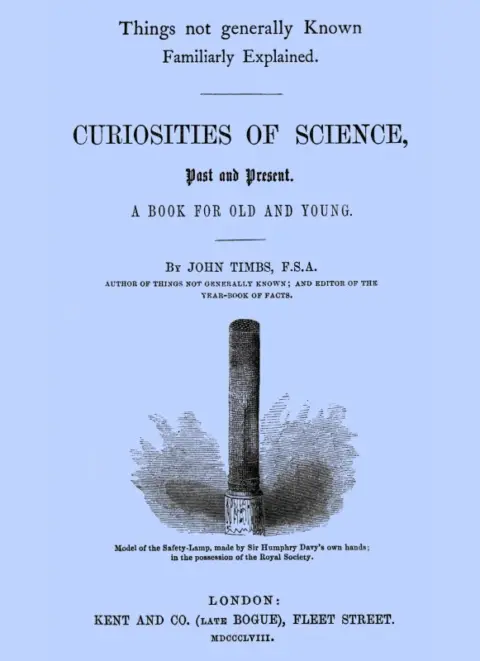
John Timbs
BEHIND THE BOOK
This eBook is for the use of anyone anywhere in the United States and most other parts of the world at no cost and with almost no restrictions whatsoever. You may copy it, give it away or re-use it under the terms of the Project Gutenberg License included with this eBook or online at www.gutenberg.org. If you are not located in the United States, you will have to check the laws of the country where you are located before using this eBook. Read the source licence.
The original source file, including credits and licence, is retained by this library. Request an original-format copy at no charge. Please include the book title and Project Gutenberg identifier #44422.
KEEP YOUR CURIOSITY GOING
Cécile Tormay

Moritz Busch
John L. Ransom
Frances Wright
Cécile Tormay

Mabel Potter Daggett