Things to be Remembered in Daily Life With Personal Experiences and Recollections
John Timbs
THE CLASSIC COLLECTION · 1869
"Eccentricities of the Animal Creation" by John Timbs is a zoological treatise written in the late 19th century. This work delves into the peculiar characteristics and behaviors of various animals, blending observations from natural history with engaging anecdotes. The book appears to aim at educating readers about fascinating facts surrounding animals, capturing both their whimsical traits and significant historical contexts. The opening of the book introduces the topic of zoological curiosities, highlighting humankind's long-standing interest in animal life across different cultures and eras. It references historical accounts of zoological gardens dating back thousands of years, discussing their origins and the exotic creatures kept within them. Timbs specifically emphasizes the rich history of zoological collections in places like China, Greece, and England, noting earlier examples such as the famous menagerie in the Tower of London. Additionally, the introduction sets the stage for subsequent chapters that promise to explore various eccentricities and remarkable habits of animals, indicating a blend of education and storytelling aimed at both young and adult audiences.
Introduction adapted from the source catalogue; source summaries may be automatically generated.
Free to read · English · 87,626 words · No account needed
MAKE TIME FOR A GOOD BOOK
On by default. Untick to stop anonymous reading totals. Each page counts after 10 seconds in view. How this works.
Anonymous counting is on unless you have switched it off.
Dolphins as well as Porpoises, when they come about a ship, and sport and gambol on the surface of the water, betoken a storm.
Dogs, before rain, grow sleepy and dull, lie drowsily before the fire, and are not easily aroused. They also often eat grass, which indicates that their stomachs, like ours, are apt to be disturbed before change of weather. It is also said to be a sign of change of weather when Dogs howl and bark much in the night. Dogs also dig in the earth with their feet before rain, and often make deep holes in the ground.
Ducks.--The loud and clamorous quacking of Ducks, Geese, and other water-fowl, is a sign of rain; as also when they wash themselves, and flutter about in the water more than usual. Virgil has well described all these habits of aquatic birds.
Fieldfares, when they arrive early, and in great numbers, in autumn, foreshow a hard winter, which has probably set in in the regions from which they have come.
Fishes, when they bite more readily, and gambol near the surface of streams or pools, foreshow rain.
Flies, and various sorts of insects, become more troublesome, and sting and bite more than usual, before, as well as in the intervals of rainy weather, particularly in autumn.
Frogs, by their clamorous croaking, indicate rainy weather, as does likewise their coming about in great numbers in the evening; but this last sign applies more obviously to toads.
Geese washing, or taking wing with a clamorous noise, and flying to
the water, portend rain.
Gnats afford several indications. When they fly in a vortex in the beams of the setting sun they forebode fair weather; when they frisk about more widely in the open air at eventide they foreshow heat; and when they assemble under trees, and bite more than usual, they indicate rain.
Hogs, when they shake the stalks of corn, and spoil them, often indicate rain. When they run squeaking about, and jerk up their heads, windy weather is about to commence; hence the Wiltshire proverb, that "Pigs can see the wind."
Horses foretel the coming of rain by starting more than ordinarily, and by restlessness on the road.
Jackdaws are unusually clamorous before rain, as are also Starlings. Sometimes before change of weather the daws make a great noise in the chamber wherein they build.
Kine (cattle) are said to foreshow rain when they lick their fore-feet, or lie on their right side. Some say oxen licking themselves against the hair is a sign of wet.
Kites, when they soar very high in the air, denote fair weather, as do
also Larks.
Your reading position is saved on this browser. Take it to another device with a library code. Reading pages adapt to text, rather than matching a printed edition.
John Timbs
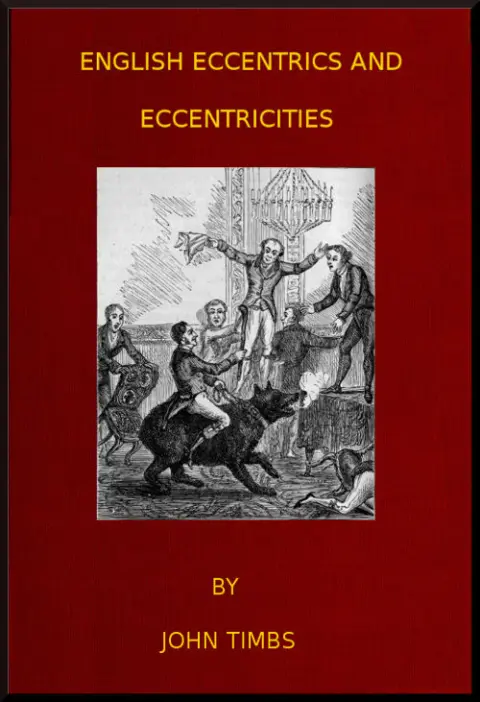
John Timbs
John Timbs
John Timbs
BEHIND THE BOOK
This eBook is for the use of anyone anywhere in the United States and most other parts of the world at no cost and with almost no restrictions whatsoever. You may copy it, give it away or re-use it under the terms of the Project Gutenberg License included with this eBook or online at www.gutenberg.org. If you are not located in the United States, you will have to check the laws of the country where you are located before using this eBook. Read the source licence.
The original source file, including credits and licence, is retained by this library. Request an original-format copy at no charge. Please include the book title and Project Gutenberg identifier #44422.
KEEP YOUR CURIOSITY GOING
Cécile Tormay

Moritz Busch
John L. Ransom
Frances Wright
Cécile Tormay

Mabel Potter Daggett