
Last letters from the living dead man
David Patterson (Spirit) Hatch
THE CLASSIC COLLECTION · 1892
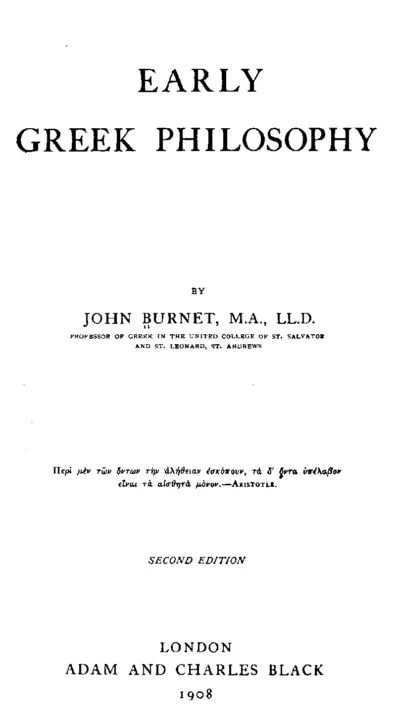
"Early Greek Philosophy" by John Burnet is a scholarly account of ancient Greek philosophical thought written in the late 19th century. The work explores the evolution of philosophical ideas and cosmological theories from the early Greek thinkers, particularly focusing on how their inquiries laid the groundwork for subsequent philosophical developments. The opening of the text introduces the cosmological character of early Greek philosophy, emphasizing that it arose from the breakdown of traditional views of the world and life. Burnet explains that the earliest philosophers were preoccupied with understanding nature and existence, as old maxims were challenged and replaced by rigorous inquiry. He sets the stage for a detailed examination of various schools of thought, beginning with the Milesian school and its notable figures, such as Thales, who began to systematize knowledge in an attempt to explain the universe's order and structure. Overall, the initial chapters highlight the shift from mythological explanations to rational inquiry that characterized this formative period of philosophical history.
Introduction adapted from the source catalogue; source summaries may be automatically generated.
Free to read · English · 137,668 words · No account needed
MAKE TIME FOR A GOOD BOOK
On by default. Untick to stop anonymous reading totals. Each page counts after 10 seconds in view. How this works.
Anonymous counting is on unless you have switched it off.
and represented the number ten as the triangle of four. In other words, it showed at a glance that 1 + 2 + 3 + 4 = 10. Speusippos tells us of several properties which the Pythagoreans discovered in the dekad. It is, for instance, the first number that has in it an equal number of prime and composite numbers. How much of this goes back to Pythagoras himself, we cannot tell; but we are probably justified in referring to him the conclusion that it is “according to nature” that all Hellenes and barbarians count up to ten and then begin over again.
Footnote 235:
Cf. the formula Οὐ μὰ τὸν ἁμετέρᾳ γενεᾷ παραδόντα τετρακτύν, which is all the more likely to be old that it is put into the mouth of Pythagoras by the forger of the Χρυσᾶ ἔπη, thus making him swear by himself! See Diels, Arch. iii. p. 457. The Doric dialect shows, however, that it belongs to the later generations of the school.
Footnote 236:
Speusippos wrote a work on the Pythagorean numbers, based chiefly on Philolaos, and a considerable fragment of it is preserved in the Theologumena Arithmetica. It will be found in Diels, Vorsokratiker, p. 235, 15, and is discussed by Tannery, Science hellène, pp. 374 sqq.
Footnote 237:
For these see Theon, Expositio, pp. 93 sqq. Hiller. The τετρακτύς used by Plato in the Timaeus is the second described by Theon (Exp. p. 94, 10 sqq.). It is no doubt Pythagorean, but hardly as old as Pythagoras.
It is obvious that the tetraktys may be indefinitely extended so as to exhibit the sums of the series of successive numbers in a graphic form, and these sums are accordingly called “triangular numbers.”
For similar reasons, the sums of the series of successive odd numbers are called “square numbers,” and those of successive even numbers “oblong.” If odd numbers are added to the unit in the form of gnomons, the result is always a similar figure, namely a square, while, if even numbers are added, we get a series of rectangles,[238] as shown by the figure:—
Square Numbers. Oblong Numbers. ─────────────┐ ───────────────┐ • • • │ • • • • │ ───────┐ │ ───────────┐ │ • • │ • │ • • • │ • │ ──┐ │ │ ──────┐ │ │ • │ • │ • │ • • │ • │ • │
It is clear, then, that we are entitled to refer the study of sums of series to Pythagoras himself; but whether he went beyond the oblong, and studied pyramidal or cubic numbers, we cannot say.[239]
Footnote 238:
Cf. Milhaud, Philosophes géomètres, pp. 115 sqq. Aristotle puts the matter thus (Phys. Γ, 4. 203 a 13): περιτιθεμένων γὰρ τῶν γνωμόνων περὶ τὸ ἓν καὶ χωρὶς ὁτὲ μὲν ἄλλο ἀεὶ γίγνεσθαι τὸ εἶδος, ὁτὲ δὲ ἕν. This is more clearly stated by Ps.-Plut. (Stob. i. p. 22, 16), Ἔτι δὲ τῇ μονάδι τῶν ἐφεξῆς περισσῶν περιτιθεμένων ὁ γινόμενος ἀεὶ τετράγωνός ἐστι· τῶν δὲ ἀρτίων ὁμοίως περιτιθεμένων ἑτερομήκεις καὶ ἄνισοι πάντες ἀποβαίνουσιν, ἴσως δὲ ἰσάκις οὐδείς. I cannot feel satisfied with any of the explanations which have been given of the words καὶ χωρίς in the Aristotelian passage (see Zeller, p. 351, n. 2), and I would therefore suggest ταῖς χώραις comparing Boutheros (Stob. i. p. 19, 9), who says, according to the MS. reading, Καὶ ὁ μὲν (ὁ περισσός), ὁπόταν γεννῶνται ἀνὰ λόγον καὶ πρὸς μονάδας, ταῖς αὑτοῦ χώραις καταλαμβάνει τοὺς ταῖς γραμμαῖς περιεχομένους (sc. ἀριθμούς).
Footnote 239:
Your reading position is saved on this browser. Take it to another device with a library code. Reading pages adapt to text, rather than matching a printed edition.
BEHIND THE BOOK
This eBook is for the use of anyone anywhere in the United States and most other parts of the world at no cost and with almost no restrictions whatsoever. You may copy it, give it away or re-use it under the terms of the Project Gutenberg License included with this eBook or online at www.gutenberg.org. If you are not located in the United States, you will have to check the laws of the country where you are located before using this eBook. Read the source licence.
The original source file, including credits and licence, is retained by this library. Request an original-format copy at no charge. Please include the book title and Project Gutenberg identifier #67097.
KEEP YOUR CURIOSITY GOING
David Patterson (Spirit) Hatch
Cécile Tormay

Moritz Busch
Coulson Kernahan
John L. Ransom

Ralph Waldo Emerson