
Last letters from the living dead man
David Patterson (Spirit) Hatch
THE CLASSIC COLLECTION · 1892
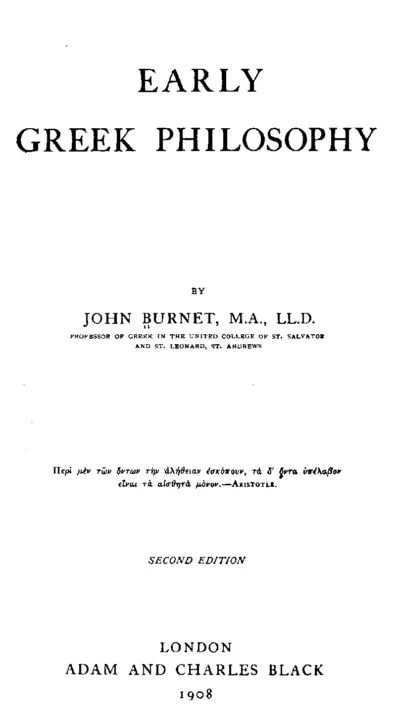
"Early Greek Philosophy" by John Burnet is a scholarly account of ancient Greek philosophical thought written in the late 19th century. The work explores the evolution of philosophical ideas and cosmological theories from the early Greek thinkers, particularly focusing on how their inquiries laid the groundwork for subsequent philosophical developments. The opening of the text introduces the cosmological character of early Greek philosophy, emphasizing that it arose from the breakdown of traditional views of the world and life. Burnet explains that the earliest philosophers were preoccupied with understanding nature and existence, as old maxims were challenged and replaced by rigorous inquiry. He sets the stage for a detailed examination of various schools of thought, beginning with the Milesian school and its notable figures, such as Thales, who began to systematize knowledge in an attempt to explain the universe's order and structure. Overall, the initial chapters highlight the shift from mythological explanations to rational inquiry that characterized this formative period of philosophical history.
Introduction adapted from the source catalogue; source summaries may be automatically generated.
Free to read · English · 137,668 words · No account needed
MAKE TIME FOR A GOOD BOOK
On by default. Untick to stop anonymous reading totals. Each page counts after 10 seconds in view. How this works.
Anonymous counting is on unless you have switched it off.
In the first place, the doxographical tradition proves that Theophrastos discussed the views of all the early philosophers as to whether there was one world or an infinite number, and there can be no doubt that, when he ascribed “innumerable worlds” to the Atomists, he meant coexistent and not successive worlds. Now, if he had really classed two such different views under one head, he would at least have been careful to point out in what respect they differed, and there is no trace of any such distinction in our tradition. On the contrary, Anaximander, Anaximenes, Archelaos, Xenophanes, Diogenes, Leukippos, Demokritos, and Epicurus are all mentioned together as holding the doctrine of “innumerable worlds” on all sides of this one,[119] and the only distinction drawn between their views is that, while Epicurus made the distances between these worlds unequal, Anaximander said all the worlds were equidistant.[120] Zeller rejected this evidence, which he supposed to be merely that of Stobaios, on the ground that we can have no confidence in a writer who attributes “innumerable worlds” to Anaximenes, Archelaos, and Xenophanes. With regard to the first two, I hope to show that the statement is quite correct, and that it is not even incorrect in the case of the last.[121] In any case, it can be proved that the passage comes from Aetios,[122] and there is no reason for doubting that, in the last resort, it is derived from Theophrastos, though the name of Epicurus may have been added later. This is still further confirmed by what Simplicius says in his commentary on the Physics.[123]
Those who assumed innumerable worlds, e.g. Anaximander, Leukippos, Demokritos, and, at a later date, Epicurus, held that they came into being and passed away ad infinitum, some always coming into being and others passing away.
Footnote 119:
Aet. ii. 1, 3 (Dox. p. 327). Zeller is wrong in understanding κατὰ πᾶσαν περιαγωγήν here of the revolution of a cycle. It means simply “in every direction we turn,” and so does the alternative reading κατὰ πᾶσαν περίστασιν. The six περιστάσεις are πρόσω, ὀπίσω, ἄνω, κάτω, δεξιά, ἀριστερά (Nicom. Introd. p. 85, 11, Hoche), and Polybios uses περίστασις of surrounding space.
Footnote 120:
Aet. ii. 1, 8 (Dox. p. 329), τῶν ἀπείρους ἀποφηναμένων τοὺς κόσμους Ἀναξίμανδρος τὸ ἴσον αὐτοὺς ἀπέχειν ἀλλήλων, Ἐπίκουρος ἄνισον εἶναι τὸ μεταξὺ τῶν κόσμων διάστημα.
Footnote 121:
For Anaximenes, see § 30; Xenophanes, § 59; Archelaos, Chap. X.
Footnote 122:
This is shown by the fact that the list of names is given also by Theodoret. See Appendix, § 10.
Footnote 123:
Simpl. Phys. p. 1121, 5 (R. P. 21 b). Zeller says (p. 234, n. 4) that Simplicius elsewhere (de Caelo, p. 273 b 43) makes the same statement more doubtfully. But the words ὡς δοκεῖ, on which he relies, are hardly an expression of doubt, and refer, in any case, to the derivation of the doctrine of “innumerable worlds” from that of the ἄπειρον, not to the doctrine itself.
Your reading position is saved on this browser. Take it to another device with a library code. Reading pages adapt to text, rather than matching a printed edition.
BEHIND THE BOOK
This eBook is for the use of anyone anywhere in the United States and most other parts of the world at no cost and with almost no restrictions whatsoever. You may copy it, give it away or re-use it under the terms of the Project Gutenberg License included with this eBook or online at www.gutenberg.org. If you are not located in the United States, you will have to check the laws of the country where you are located before using this eBook. Read the source licence.
The original source file, including credits and licence, is retained by this library. Request an original-format copy at no charge. Please include the book title and Project Gutenberg identifier #67097.
KEEP YOUR CURIOSITY GOING
David Patterson (Spirit) Hatch
Cécile Tormay

Moritz Busch
Coulson Kernahan
John L. Ransom

Ralph Waldo Emerson