
Last letters from the living dead man
David Patterson (Spirit) Hatch
THE CLASSIC COLLECTION · 1892
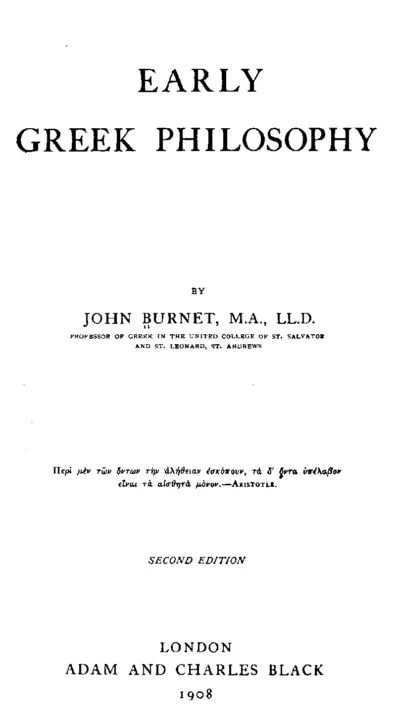
"Early Greek Philosophy" by John Burnet is a scholarly account of ancient Greek philosophical thought written in the late 19th century. The work explores the evolution of philosophical ideas and cosmological theories from the early Greek thinkers, particularly focusing on how their inquiries laid the groundwork for subsequent philosophical developments. The opening of the text introduces the cosmological character of early Greek philosophy, emphasizing that it arose from the breakdown of traditional views of the world and life. Burnet explains that the earliest philosophers were preoccupied with understanding nature and existence, as old maxims were challenged and replaced by rigorous inquiry. He sets the stage for a detailed examination of various schools of thought, beginning with the Milesian school and its notable figures, such as Thales, who began to systematize knowledge in an attempt to explain the universe's order and structure. Overall, the initial chapters highlight the shift from mythological explanations to rational inquiry that characterized this formative period of philosophical history.
Introduction adapted from the source catalogue; source summaries may be automatically generated.
Free to read · English · 137,668 words · No account needed
MAKE TIME FOR A GOOD BOOK
On by default. Untick to stop anonymous reading totals. Each page counts after 10 seconds in view. How this works.
Anonymous counting is on unless you have switched it off.
Footnote 938:
Arist. Phys. Α, 3. 187 a 1 (R. P. 134 b).
Footnote 939:
Arist. de Caelo, Γ, 4. 303 a 8, τρόπον γάρ τινα καὶ οὕτοι (Λεύκιππος καὶ Δημόκριτος) πάντα τὰ ὄντα ποιοῦσιν ἀριθμοὺς καὶ ἐξ ἀριθμῶν. This also serves to explain what Herakleides may have meant by attributing the theory of corporeal ὄγκοι to the Pythagorean Ekphantos of Syracuse (above, p. 338, n. 794).
[Sidenote: Atoms.]
174. We must observe that the atom is not mathematically indivisible, for it has magnitude; it is, however, physically indivisible, because, like the One of Parmenides, it contains in it no empty space.[940] Each atom has extension, and all the atoms are exactly alike in substance.[941] Therefore all differences in things must be accounted for either by the shape of the atoms or by their arrangement. It seems probable that the three ways in which differences arise, namely, shape, position, and arrangement, were already distinguished by Leukippos; for Aristotle mentions his name in connexion with them.[942] This explains, too, why the atoms are called “forms” or “figures,” a way of speaking which seems to be of Pythagorean origin.[943] That they are also called φύσις[944] is quite intelligible if we remember what was said of that word in the Introduction (§ VII.). The differences in shape, order, and position just referred to account for the “opposites,” the “elements” being regarded rather as aggregates of these (πανσπερμίαι), as by Anaxagoras.[945]
Footnote 940:
The Epicureans misunderstood this point, or misrepresented it in order to magnify their own originality (see Zeller, p. 857, n. 3; Eng. trans. ii. p. 225, n. 2).
Footnote 941:
Arist. de Caelo, Α, 7. 275 b 32, τὴν δὲ φύσιν εἶναί φασιν αὐτῶν μίαν; Phys. Γ, 4. 203 a 34, αὐτῷ (Δημοκρίτῳ) τὸ κοινὸν σῶμα πάντων ἐστὶν ἀρχή.
Footnote 942:
Arist. Met. Α, 4. 985 b 13 (R. P. 192); cf. de Gen. Corr. 315 b 6. As Diels suggests, the illustration from the letters of the alphabet is probably due to Demokritos. It shows, in any case, how the word στοιχεῖον came to be used later for “element.” We must read, with Wilamowitz, τὸ δὲ Ζ τοῦ Η θέσει for τὸ δὲ Ζ τοῦ Ν θέσει, the older form of the letter Ζ being just an Η laid upon its side (Diels, Elementum, p. 13, n. 1).
Footnote 943:
Demokritos wrote a work, Περὶ ἰδεῶν (Sext. Math. vii. 137; R. P. 204), which Diels identifies with the Περὶ τῶν διαφερόντων ῥυσμῶν of Thrasylos, Tetr. v. 3. Theophrastos refers to Demokritos, ἐν τοῖς περὶ τῶν εἰδῶν (de Sensibus, § 51). Plut. adv. Col. 1111 a, εἶναι δὲ πάντα τὰς ἀτόμους, ἰδέας ὑπ’ αὐτοῦ καλουμένας (so the MSS.: ἰδίως, Wyttenbach; <ἢ> ἰδέας, Diels). Arist. Phys. Γ, 4. 203 a 21, (Δημόκριτος) ἐκ τῆς πανσπερμίας τῶν σχημάτων (ἄπειρα ποιεῖ τὰ στοιχεῖα). Cf. de Gen. Corr. Α, 2. 315 b 7 (R. P. 196).
Footnote 944:
Arist. Phys. Θ, 9. 265 b 25; Simpl. Phys. p. 1318, 33, ταῦτα γὰρ (τὰ ἄτομα σώματα) ἐκεῖνοι φύσιν ἐκάλουν.
Footnote 945:
Simpl. Phys. p. 36, 1 (Diels, Vors. p. 346), and R. P. 196 a.
[Sidenote: The void.]
Your reading position is saved on this browser. Take it to another device with a library code. Reading pages adapt to text, rather than matching a printed edition.
BEHIND THE BOOK
This eBook is for the use of anyone anywhere in the United States and most other parts of the world at no cost and with almost no restrictions whatsoever. You may copy it, give it away or re-use it under the terms of the Project Gutenberg License included with this eBook or online at www.gutenberg.org. If you are not located in the United States, you will have to check the laws of the country where you are located before using this eBook. Read the source licence.
The original source file, including credits and licence, is retained by this library. Request an original-format copy at no charge. Please include the book title and Project Gutenberg identifier #67097.
KEEP YOUR CURIOSITY GOING
David Patterson (Spirit) Hatch
Cécile Tormay

Moritz Busch
Coulson Kernahan
John L. Ransom

Ralph Waldo Emerson