
Last letters from the living dead man
David Patterson (Spirit) Hatch
THE CLASSIC COLLECTION · 1892
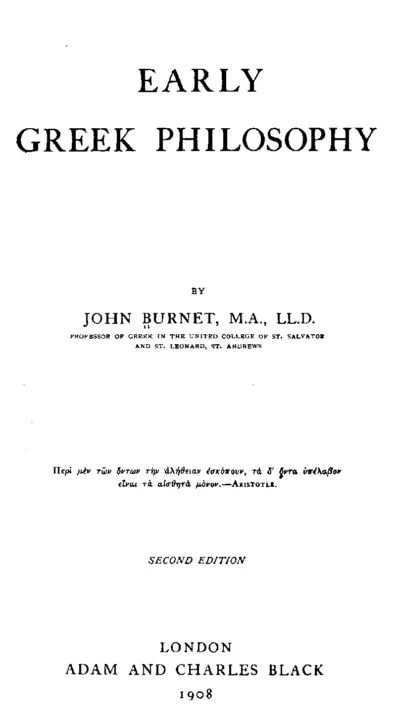
"Early Greek Philosophy" by John Burnet is a scholarly account of ancient Greek philosophical thought written in the late 19th century. The work explores the evolution of philosophical ideas and cosmological theories from the early Greek thinkers, particularly focusing on how their inquiries laid the groundwork for subsequent philosophical developments. The opening of the text introduces the cosmological character of early Greek philosophy, emphasizing that it arose from the breakdown of traditional views of the world and life. Burnet explains that the earliest philosophers were preoccupied with understanding nature and existence, as old maxims were challenged and replaced by rigorous inquiry. He sets the stage for a detailed examination of various schools of thought, beginning with the Milesian school and its notable figures, such as Thales, who began to systematize knowledge in an attempt to explain the universe's order and structure. Overall, the initial chapters highlight the shift from mythological explanations to rational inquiry that characterized this formative period of philosophical history.
Introduction adapted from the source catalogue; source summaries may be automatically generated.
Free to read · English · 137,668 words · No account needed
MAKE TIME FOR A GOOD BOOK
On by default. Untick to stop anonymous reading totals. Each page counts after 10 seconds in view. How this works.
Anonymous counting is on unless you have switched it off.
143. In the first place, Aristotle is quite decided in his opinion that Pythagoreanism was intended to be a cosmological system like the others. “Though the Pythagoreans,” he tells us, “made use of less obvious first principles and elements than the rest, seeing that they did not derive them from sensible objects, yet all their discussions and studies had reference to nature alone. They describe the origin of the heavens, and they observe the phenomena of its parts, all that happens to it and all it does.”[771] They apply their first principles entirely to these things, “agreeing apparently with the other natural philosophers in holding that reality was just what could be perceived by the senses, and is contained within the compass of the heavens,”[772] though “the first principles and causes of which they made use were really adequate to explain realities of a higher order than the sensible.”[773]
Footnote 771:
Arist. Met. Α, 8. 989 b 29 (R. P. 92 a).
Footnote 772:
Arist. Met. Α, 8. 990 a 3, ὁμολογοῦντες τοῖς ἄλλοις φυσιολόγοις ὅτι τό γ’ ὂν τοῦτ’ ἐστὶν ὅσον αἰσθητόν ἐστὶ καὶ περιείληφεν ὁ καλούμενος οὐρανός.
Footnote 773:
Met. ib. 990 a 5, τὰς δ’ αἰτίας καὶ τὰς ἀρχάς, ὥσπερ εἴπομεν, ἱκανὰς λέγουσιν ἐπαναβῆναι καὶ ἐπὶ τὰ ἀνωτέρω τῶν ὄντων, καὶ μᾶλλον ἢ τοῖς περὶ φύσεως λόγοις ἁρμοττούσας.
The doctrine is more precisely stated by Aristotle to be that the elements of numbers are the elements of things, and that therefore things are numbers.[774] He is equally positive that these “things” are sensible things,[775] and indeed that they are bodies,[776] the bodies of which the world is constructed.[777] This construction of the world out of numbers was a real process in time, which the Pythagoreans described in detail.[778]
Footnote 774:
Met. Α, 5. 986 a 1, τὰ τῶν ἀριθμῶν στοιχεῖα τῶν ὄντων στοιχεῖα πάντων ὑπέλαβον εἶναι; Ν, 3. 1090 a 22, εἶναι μὲν ἀριθμοὺς ἐποίησαν τὰ ὄντα, οὐ χωριστοὺς δέ, ἀλλ’ ἐξ ἀριθμῶν τὰ ὄντα.
Footnote 775:
Met. Μ, 6. 1080 b 2, ὡς ἐκ τῶν ἀριθμῶν ἐνυπαρχόντων ὄντα τὰ αἰσθητά; ib. 1080 b 17, ἐκ τούτου (τοῦ μαθηματικοῦ ἀριθμοῦ) τὰς αἰσθητὰς οὐσίας συνεστάναι φασίν.
Footnote 776:
Met. Μ, 8. 1083 b 11, τὰ σώματα ἐξ ἀριθμῶν εἶναι συγκείμενα; ib. b 17, ἐκεῖνοι δὲ τὸν ἀριθμὸν τὰ ὄντα λέγουσιν· τὰ γοῦν θεωρήματα προσάπτουσι τοῖς σώμασιν ὡς ἐξ ἐκείνων ὄντων τῶν ἀριθμῶν; Ν, 3. 1090 a 32, κατὰ μέντοι τὸ ποιεῖν ἐξ ἀριθμῶν τὰ φυσικὰ σώματα, ἐκ μὴ ἐχόντων βάρος μηδὲ κουφότητα ἔχοντα κουφότητα καὶ βάρος.
Footnote 777:
Met. Α, 5. 986 a 2, τὸν ὅλον οὐρανὸν ἁρμονίαν εἶναι καὶ ἀριθμόν; Α, 8. 990 a 21, τὸν ἀριθμὸν τοῦτον ἐξ οὗ συνέστηκεν ὁ κόσμος; Μ, 6. 1080 b 18, τὸν γὰρ ὅλον οὐρανὸν κατασκευάζουσιν ἐξ ἀριθμῶν; de Caelo, Γ, 1. 300 a 15, τοῖς ἐξ ἀριθμῶν συνιστᾶσι τὸν οὐρανόν· ἔνιοι γὰρ τὴν φύσιν ἐξ ἀριθμῶν συνιστᾶσιν, ὥσπερ τῶν Πυθαγορείων τινές.
Footnote 778:
Met. Ν, 3. 1091 a 18, κοσμοποιοῦσι καὶ φυσικῶς βούλονται λέγειν.
Further, the numbers were intended to be mathematical numbers, though they were not separated from the things of sense.[779] On the other hand, they were not mere predicates of something else, but had an independent reality of their own. “They did not hold that the limited and the unlimited and the one were certain other substances, such as fire, water, or anything else of that sort; but that the unlimited itself and the one itself were the reality of the things of which they are predicated, and that is why they said that number was the reality of everything.”[780] Accordingly the numbers are, in Aristotle’s own language, not only the formal, but also the material, cause of things.[781] According to the Pythagoreans, things are made of numbers in the same sense as they were made of fire, air, or water in the theories of their predecessors.
Footnote 779:
Met. Μ, 6. 1080 b 16; Ν, 3. 1090 a 20.
Your reading position is saved on this browser. Take it to another device with a library code. Reading pages adapt to text, rather than matching a printed edition.
BEHIND THE BOOK
This eBook is for the use of anyone anywhere in the United States and most other parts of the world at no cost and with almost no restrictions whatsoever. You may copy it, give it away or re-use it under the terms of the Project Gutenberg License included with this eBook or online at www.gutenberg.org. If you are not located in the United States, you will have to check the laws of the country where you are located before using this eBook. Read the source licence.
The original source file, including credits and licence, is retained by this library. Request an original-format copy at no charge. Please include the book title and Project Gutenberg identifier #67097.
KEEP YOUR CURIOSITY GOING
David Patterson (Spirit) Hatch
Cécile Tormay

Moritz Busch
Coulson Kernahan
John L. Ransom

Ralph Waldo Emerson