
Last letters from the living dead man
David Patterson (Spirit) Hatch
THE CLASSIC COLLECTION · 1892
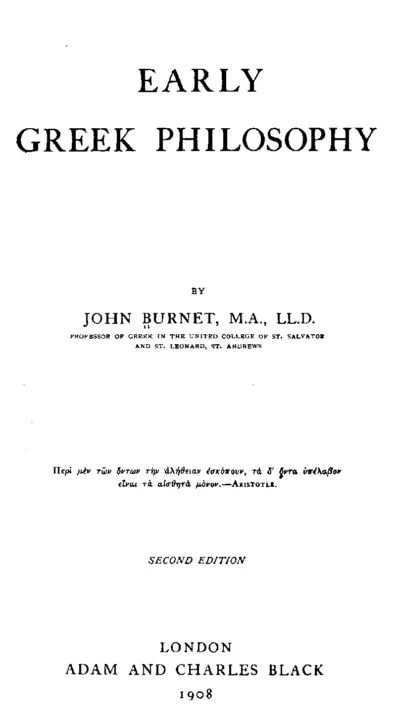
"Early Greek Philosophy" by John Burnet is a scholarly account of ancient Greek philosophical thought written in the late 19th century. The work explores the evolution of philosophical ideas and cosmological theories from the early Greek thinkers, particularly focusing on how their inquiries laid the groundwork for subsequent philosophical developments. The opening of the text introduces the cosmological character of early Greek philosophy, emphasizing that it arose from the breakdown of traditional views of the world and life. Burnet explains that the earliest philosophers were preoccupied with understanding nature and existence, as old maxims were challenged and replaced by rigorous inquiry. He sets the stage for a detailed examination of various schools of thought, beginning with the Milesian school and its notable figures, such as Thales, who began to systematize knowledge in an attempt to explain the universe's order and structure. Overall, the initial chapters highlight the shift from mythological explanations to rational inquiry that characterized this formative period of philosophical history.
Introduction adapted from the source catalogue; source summaries may be automatically generated.
Free to read · English · 137,668 words · No account needed
MAKE TIME FOR A GOOD BOOK
On by default. Untick to stop anonymous reading totals. Each page counts after 10 seconds in view. How this works.
Anonymous counting is on unless you have switched it off.
There is no difficulty in the MS. διατμηθέντος if we take λόγοιο as “discourse,” “argument” (cf. διαιρεῖν). Diels conjectures διασσηθέντος, rendering “when their words have passed through the sieve of thy mind.” Nor does it seem to me necessary to read χαρτά for κάρτα in the first line.
Footnote 546:
The four elements are introduced under mythological names, for which see below, p. 264, n. 583. Diels is clearly right in removing the comma after τέγγει, and rendering Nestis quae lacrimis suis laticem fundit mortalibus destinatum.
Footnote 547:
Reading μετὰ τοῖσιν. I still think, however, that Knatz’s palaeographically admirable conjuncture μετὰ θεοῖσιν (i.e. among the elements) deserves consideration.
Footnote 548:
Keeping ἄλλοτε with Diels.
Footnote 549:
Reading ἄμβροτα δ’ ὅσσ’ ἴδει with Diels. For the word ἶδος, cf. frs. 62, 5; 73, 2. The reference is to the moon, etc., which are made of solidified Air, and receive their light from the fiery hemisphere. See below, § 113.
Footnote 550:
Reading with Blass (Jahrb. f. kl. Phil., 1883, p. 19):
οὕτω μή σ’ ἀπάτη φρένα καινύτω κ.τ.λ.
Cf. Hesychios: καινύτω· νικάτω. This is practically what the MSS. of Simplicius give, and Hesychios has many Empedoklean glosses.
Footnote 551:
The “goddess” is, of course, the Muse. Cf. fr. 5.
Footnote 552:
The word μονίῃ, if it is right, cannot mean “rest,” but only solitude. There is no reason for altering περιηγέι, though Simplicius has περιγηθέι.
Footnote 553:
The masculine καλλήσας shows that the subject cannot have been Φιλότης; and Karsten was doubtless right in believing that Empedokles introduced the simile of a baker here. It is in his manner to take illustrations from human arts.
Footnote 554:
The MSS. of Clement have ἥλιον ἀρχήν and the reading ἡλίου ἀρχήν is a mere makeshift. Diels reads ἥλικά τ’ ἀρχήν, “the first (elements) equal in age.”
Footnote 555:
The lines are referred to Xenophanes by Aristotle, who quotes them de Caelo, Β, 13. 294 a 21. See above, Chap. II. p. 137.
Footnote 556:
I have translated Diels’s conjecture ἀπεστέγασεν δέ οἱ αὐγάς, | ἔστ’ ἂν ἴῃ καθύπερθεν. The MSS. have ἀπεσκεύασεν and ἔστε αἶαν.
Footnote 557:
Reading στείροις with Diels, Hermes, xv. loc. cit.
Footnote 558:
Retaining εἴδεος (i.e. ἴδεος), which is read in the MSS. of Simplicius. Cf. above, p. 243, n. 549.
Footnote 559:
That Empedokles regarded milk as putrefied blood is stated by Aristotle (de Gen. An. Δ, 8. 777 a 7). The word πύον means pus. There may be a punning allusion to πυός, “beestings,” but that has its vowel long.
Footnote 560:
Said of women in reference to births in the seventh and ninth months.
Footnote 561:
Of the membrane round the fœtus.
Footnote 562:
Reading ἴδεα ποιπνύουσα with Diels.
Footnote 563:
See Beare, p. 16, n. 1, where Plato, Tim. 45 b 4 (τοῦ πυρὸς ὅσον τὸ μὲν κάειν οὐκ ἔσχεν, τὸ δὲ παρέχειν φῶς ἥμερον), is aptly quoted. Alexander ad loc. understands κατὰ βηλόν to mean κατ’ οὐρανόν, which seems improbable.
Footnote 564:
On fr. 99, see Beare, p. 96, n. 1.
Footnote 565:
Your reading position is saved on this browser. Take it to another device with a library code. Reading pages adapt to text, rather than matching a printed edition.
BEHIND THE BOOK
This eBook is for the use of anyone anywhere in the United States and most other parts of the world at no cost and with almost no restrictions whatsoever. You may copy it, give it away or re-use it under the terms of the Project Gutenberg License included with this eBook or online at www.gutenberg.org. If you are not located in the United States, you will have to check the laws of the country where you are located before using this eBook. Read the source licence.
The original source file, including credits and licence, is retained by this library. Request an original-format copy at no charge. Please include the book title and Project Gutenberg identifier #67097.
KEEP YOUR CURIOSITY GOING
David Patterson (Spirit) Hatch
Cécile Tormay

Moritz Busch
Coulson Kernahan
John L. Ransom

Ralph Waldo Emerson