
Last letters from the living dead man
David Patterson (Spirit) Hatch
THE CLASSIC COLLECTION · 1892
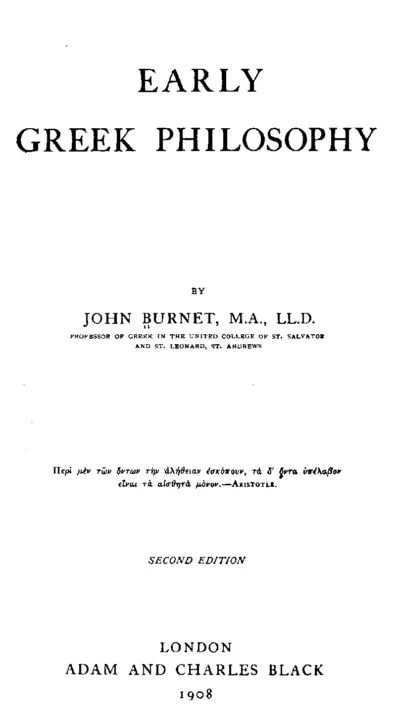
"Early Greek Philosophy" by John Burnet is a scholarly account of ancient Greek philosophical thought written in the late 19th century. The work explores the evolution of philosophical ideas and cosmological theories from the early Greek thinkers, particularly focusing on how their inquiries laid the groundwork for subsequent philosophical developments. The opening of the text introduces the cosmological character of early Greek philosophy, emphasizing that it arose from the breakdown of traditional views of the world and life. Burnet explains that the earliest philosophers were preoccupied with understanding nature and existence, as old maxims were challenged and replaced by rigorous inquiry. He sets the stage for a detailed examination of various schools of thought, beginning with the Milesian school and its notable figures, such as Thales, who began to systematize knowledge in an attempt to explain the universe's order and structure. Overall, the initial chapters highlight the shift from mythological explanations to rational inquiry that characterized this formative period of philosophical history.
Introduction adapted from the source catalogue; source summaries may be automatically generated.
Free to read · English · 137,668 words · No account needed
MAKE TIME FOR A GOOD BOOK
On by default. Untick to stop anonymous reading totals. Each page counts after 10 seconds in view. How this works.
Anonymous counting is on unless you have switched it off.
(Fire) swiftly rushing upwards....
And many fires burn beneath the earth. R. P. 171 a.
For so as it ran, it met them at that time, though often otherwise. R.
P. 171 a.
But the air sank down upon the earth with its long roots. R. P. 171 a.
Sea the sweat of the earth. R. P. 170 b.
Salt was solidified by the impact of the sun’s beams.
On it (the earth) many heads sprung up without necks and arms wandered bare and bereft of shoulders. Eyes strayed up and down in want of foreheads. R. P. 173 a.
Solitary limbs wandered seeking for union.
But, as divinity was mingled still further with divinity, these things joined together as each might chance, and many other things besides them continually arose.
Shambling creatures with countless hands.
Many creatures with faces and breasts looking in different directions were born; some, offspring of oxen with faces of men, while others, again, arose as offspring of men with the heads of oxen, and creatures in whom the nature of women and men was mingled, furnished with sterile[557] parts. <<5>> R. P. 173 b.
Come now, hear how the Fire as it was separated caused the night-born shoots of men and tearful women to arise; for my tale is not off the point nor uninformed. Whole-natured forms first arose from the earth, having a portion both of water and fire.[558] These did the fire, desirous of <<5>> reaching its like, send up, showing as yet neither the charming form of women’s limbs, nor yet the voice and parts that are proper to men. R. P. 173 c.
... But the substance of (the child’s) limbs is divided between them, part of it in men’s and part in women’s (body).
And upon him came desire reminding him through sight.
... And it was poured out in the pure parts; and when it met with cold
women arose from it.
The divided meadows of Aphrodite.
For in its warmer part the womb brings forth males, and that is why men are dark and more manly and shaggy.
On the tenth day of the eighth month the white putrefaction
arises.[559]
Double bearing.[560]
Sheepskin.[561]
But if thy assurance of these things was in any way deficient as to how, out of Water and Earth and Air and Fire mingled together, arose the forms and colours of all those mortal things that have been fitted together by Aphrodite, and so are now come into being.... <<5>>
How tall trees and the fishes in the sea....
And even as at that time Kypris, preparing warmth,[562] after she had moistened the Earth in water, gave it to swift fire to harden it.... R. P. 171.
Your reading position is saved on this browser. Take it to another device with a library code. Reading pages adapt to text, rather than matching a printed edition.
BEHIND THE BOOK
This eBook is for the use of anyone anywhere in the United States and most other parts of the world at no cost and with almost no restrictions whatsoever. You may copy it, give it away or re-use it under the terms of the Project Gutenberg License included with this eBook or online at www.gutenberg.org. If you are not located in the United States, you will have to check the laws of the country where you are located before using this eBook. Read the source licence.
The original source file, including credits and licence, is retained by this library. Request an original-format copy at no charge. Please include the book title and Project Gutenberg identifier #67097.
KEEP YOUR CURIOSITY GOING
David Patterson (Spirit) Hatch
Cécile Tormay

Moritz Busch
Coulson Kernahan
John L. Ransom

Ralph Waldo Emerson