
Last letters from the living dead man
David Patterson (Spirit) Hatch
THE CLASSIC COLLECTION · 1892
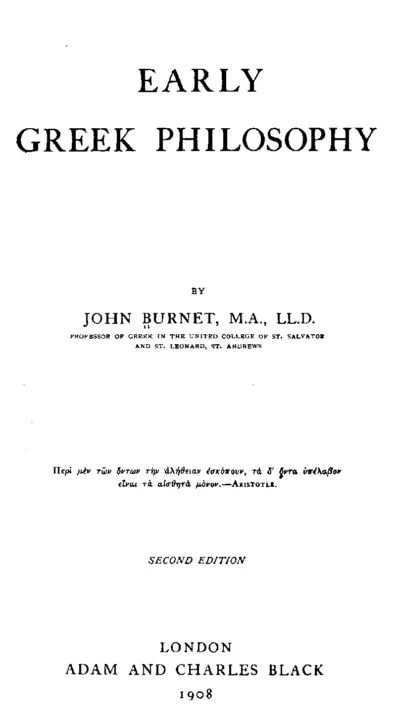
"Early Greek Philosophy" by John Burnet is a scholarly account of ancient Greek philosophical thought written in the late 19th century. The work explores the evolution of philosophical ideas and cosmological theories from the early Greek thinkers, particularly focusing on how their inquiries laid the groundwork for subsequent philosophical developments. The opening of the text introduces the cosmological character of early Greek philosophy, emphasizing that it arose from the breakdown of traditional views of the world and life. Burnet explains that the earliest philosophers were preoccupied with understanding nature and existence, as old maxims were challenged and replaced by rigorous inquiry. He sets the stage for a detailed examination of various schools of thought, beginning with the Milesian school and its notable figures, such as Thales, who began to systematize knowledge in an attempt to explain the universe's order and structure. Overall, the initial chapters highlight the shift from mythological explanations to rational inquiry that characterized this formative period of philosophical history.
Introduction adapted from the source catalogue; source summaries may be automatically generated.
Free to read · English · 137,668 words · No account needed
MAKE TIME FOR A GOOD BOOK
On by default. Untick to stop anonymous reading totals. Each page counts after 10 seconds in view. How this works.
Anonymous counting is on unless you have switched it off.
Footnote 461:
Met. Α, 5. 986 b 34, θερμὸν καὶ ψυχρόν; Phys. Α, 5. 188 a 20; Gen. Corr. Α, 3. 318 b 6; Β, 3. 330 b 14.
Still more misleading is Aristotle’s identification of these with Fire and Earth. It is not quite certain that he meant to say Parmenides himself made this identification; but, on the whole, it is most likely that he did, and Theophrastos certainly followed him in this.[462] It is another question whether it is accurate. Simplicius, who had the poem before him (§ 85), after mentioning Fire and Earth, at once adds “or rather Light and Darkness”;[463] and this is suggestive enough. Lastly, Aristotle’s identification of the dense element with “what is not,”[464] the unreal of the First Part of the poem, is not very easy to reconcile with the view that it is earth. On the other hand, if we suppose that the second of the two “forms,” the one which should not have been “named,” is the Pythagorean Air or Void, we get a very good explanation of Aristotle’s identification of it with “what is not.” We seem, then, to be justified in neglecting the identification of the dense element with earth for the present. At a later stage, we shall be able to see how it may have originated.[465] The further statement of Theophrastos, that the Warm was the efficient cause and the Cold the material or passive,[466] is intelligible enough if we identify them with the Limit and the Unlimited respectively; but is not, of course, to be regarded as historical.
Footnote 462:
Phys. Α, 5. 188 a 21, ταῦτα δὲ (θερμὸν καὶ ψυχρὸν) προσαγορεύει πῦρ καὶ γῆν; Met. Α, 5. 986 b 34, οἷον πῦρ καὶ γῆν λέγων. Cf. Theophr. Phys. Op. fr. 6 (Dox. p. 482; R. P. 121 a). [Plut.] Strom. fr. 5 (Dox. p. 581), λέγει δὲ τῆν γῆν τοῦ πυκνοῦ καταρρυέντος ἀέρος γεγονέναι. Zeller, p. 568, n. 1 (Eng. trans. p. 593, n. 2).
Footnote 463:
Phys. p. 25, 15, ὡς Παρμενίδης ἐν τοῖς πρὸς δόξαν πῦρ καὶ γῆν (ἢ μᾶλλον φῶς καὶ σκότος).
Footnote 464:
Met. Α, 5. 986 b 35, τούτων δὲ κατὰ μὲν τὸ ὂν τὸ θερμὸν τάττει, θάτερον δὲ κατὰ τὸ μὴ ὄν. See above, p. 208, n. 457.
Footnote 465:
See below, Chap. VII. § 147.
Footnote 466:
Theophr. Phys. Op. fr. 6 (Dox. p. 482; R. P. 121 a), followed by
the doxographers.
We have seen that Simplicius, with the poem of Parmenides before him, corrects Aristotle by substituting Light and Darkness for Fire and Earth, and in this he is amply borne out by the fragments which he quotes. Parmenides himself calls one “form” Light, Flame, and Fire, and the other Night, and we have now to consider whether these can be identified with the Pythagorean Limit and Unlimited. We have seen good reason to believe (§ 58) that the idea of the world breathing belonged to the earliest form of Pythagoreanism, and there can be no difficulty in identifying this “boundless breath” with Darkness, which stands very well for the Unlimited. “Air” or mist was always regarded as the dark element.[467] And that which gives definiteness to the vague darkness is certainly light or fire, and this may account for the prominence given to that element by Hippasos.[468] We may probably conclude, then, that the Pythagorean distinction between the Limit and the Unlimited, which we shall have to consider later (Chap. VII.), made its first appearance in this crude form. If, on the other hand, we identify darkness with the Limit, and light with the Unlimited, as most critics do, we get into insuperable difficulties.
Your reading position is saved on this browser. Take it to another device with a library code. Reading pages adapt to text, rather than matching a printed edition.
BEHIND THE BOOK
This eBook is for the use of anyone anywhere in the United States and most other parts of the world at no cost and with almost no restrictions whatsoever. You may copy it, give it away or re-use it under the terms of the Project Gutenberg License included with this eBook or online at www.gutenberg.org. If you are not located in the United States, you will have to check the laws of the country where you are located before using this eBook. Read the source licence.
The original source file, including credits and licence, is retained by this library. Request an original-format copy at no charge. Please include the book title and Project Gutenberg identifier #67097.
KEEP YOUR CURIOSITY GOING
David Patterson (Spirit) Hatch
Cécile Tormay

Moritz Busch
Coulson Kernahan
John L. Ransom

Ralph Waldo Emerson