
Last letters from the living dead man
David Patterson (Spirit) Hatch
THE CLASSIC COLLECTION · 1892
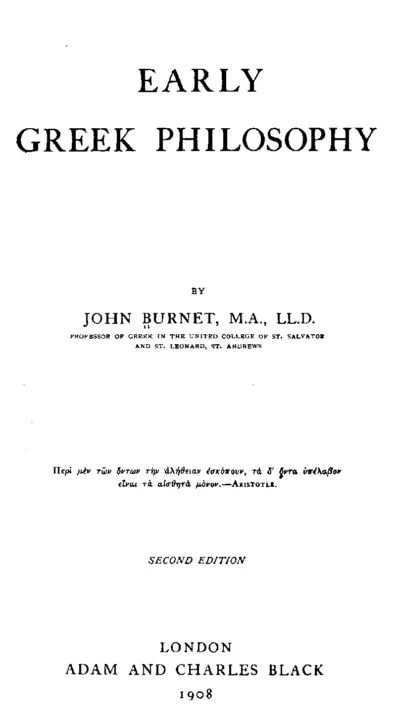
"Early Greek Philosophy" by John Burnet is a scholarly account of ancient Greek philosophical thought written in the late 19th century. The work explores the evolution of philosophical ideas and cosmological theories from the early Greek thinkers, particularly focusing on how their inquiries laid the groundwork for subsequent philosophical developments. The opening of the text introduces the cosmological character of early Greek philosophy, emphasizing that it arose from the breakdown of traditional views of the world and life. Burnet explains that the earliest philosophers were preoccupied with understanding nature and existence, as old maxims were challenged and replaced by rigorous inquiry. He sets the stage for a detailed examination of various schools of thought, beginning with the Milesian school and its notable figures, such as Thales, who began to systematize knowledge in an attempt to explain the universe's order and structure. Overall, the initial chapters highlight the shift from mythological explanations to rational inquiry that characterized this formative period of philosophical history.
Introduction adapted from the source catalogue; source summaries may be automatically generated.
Free to read · English · 137,668 words · No account needed
MAKE TIME FOR A GOOD BOOK
On by default. Untick to stop anonymous reading totals. Each page counts after 10 seconds in view. How this works.
Anonymous counting is on unless you have switched it off.
The subject of fr. 23 is γῆ, as we see from Diog. ix. 9 (R. P. 36), πάλιν τε αὖ τὴν γὴν χεῖσθαι; and Aet. i. 3, 11 (Dox. p. 284 a 1; b 5), ἔπειτα ἀναχαλωμένην τὴν γῆν ὑπὸ τοῦ τυρὸς χύσει (Dübner: φύσει, libri) ὕδωρ ἀποτελεῖσθαι. Herakleitos might quite well say γῆ θάλασσα διαχέεται, and the context in Clement (Strom. v. p. 712) seems to imply this. The phrase μετρέεται εἰς τὸν αὐτὸν λόγον can only mean that the proportion of the measures remains constant. So practically Zeller (p. 690, n. 1), zu derselben Grösse.
Footnote 340:
With Diels I adopt the transposition (proposed by Tocco) of ἀέρος and
γῆς.
Footnote 341:
I understand ἐπελθόν of the πυρὸς ἔφοδος, for which see below, p. 168. Diels has pointed out that καταλαμβάνειν is the old word for “to convict.” It is, literally, “to overtake,” just as αἱρεῖν is “to catch.”
Footnote 342:
In this fragment it is clear that οὖρος = τέρματα, and therefore means “boundary,” not “hill.” As αἴθριος Ζεύς means the bright blue sky, I do not think its οὖρος can be the South Pole, as Diels says. It is more likely the horizon. I am inclined to take the fragment as a protest against the Pythagorean theory of a southern hemisphere.
Footnote 343:
We learn from Diog. ix. 10 (quoted below, p. 164) that Herakleitos explained why the sun was warmer and brighter than the moon, and this is doubtless a fragment of that passage. I now think the words ἕνεκα τῶν ἄλλων ἄστρων are from Herakleitos. So Diels.
Footnote 344:
Hesiod said Day was the child of Night (Theog. 124).
Footnote 345:
Reading ὅκωσπερ πῦρ for ὅκωσπερ with Diels.
Footnote 346:
Il. xviii. 107. I add the words οἰχήσεσθαι γὰρ πάντα from Simpl. in Cat. (88 b 30 schol. Br.). They seem to me at least to represent something that was in the original.
Footnote 347:
I cannot think it likely that Herakleitos said both παλίντονος and παλίντροπος ἁρμονίη, and I prefer Plutarch’s παλίντονος (R. P. 34 b) to the παλίντροπος of Hippolytos. Diels thinks that the polemic of Parmenides decides the question in favour of παλίντροπος; but see below, p. 184, n. 415, and Chap. IV. p. 198, n. 438.
Footnote 348:
This, I now think, is the medical rule αἱ ἰατρεῖαι διὰ τῶν ἐναντίων, e.g. βοηθεῖν τῷ θερμῷ ἐπὶ τὸ ψυχρόν (Stewart on Arist. Eth. 1104 b 16).
Footnote 349:
Fr. 51a was recovered by Bywater from Albertus Magnus. See Journ.
Phil. ix. p. 230.
Footnote 350:
On fr. 55 see Diels in Berl. Sitzb. 1901, p. 188.
Footnote 351:
I now read ἐπαιτέονται with Bernays and Diels.
Footnote 352:
On fr. 59 see Diels in Berl. Sitzb. 1901, p. 188. The reading συνάψιες seems to be well attested and gives an excellent sense. It is not, however, correct to say that the optative could not be used in an imperative sense.
Footnote 353:
By “these things,” he probably meant all kinds of injustice.
Footnote 354:
Diels supposes that fr. 64 went on ὁκόσα δὲ τεθνηκότες ζωή. “Life, Sleep, Death is the threefold ladder in psychology, as in physics Fire, Water, Earth.”
Footnote 355:
I think now with Diels that the words οὕτω βαθὺν λόγον ἔχει are probably genuine. They present no difficulty if we remember that λόγος means “measurement,” as in fr. 23.
Footnote 356:
Your reading position is saved on this browser. Take it to another device with a library code. Reading pages adapt to text, rather than matching a printed edition.
BEHIND THE BOOK
This eBook is for the use of anyone anywhere in the United States and most other parts of the world at no cost and with almost no restrictions whatsoever. You may copy it, give it away or re-use it under the terms of the Project Gutenberg License included with this eBook or online at www.gutenberg.org. If you are not located in the United States, you will have to check the laws of the country where you are located before using this eBook. Read the source licence.
The original source file, including credits and licence, is retained by this library. Request an original-format copy at no charge. Please include the book title and Project Gutenberg identifier #67097.
KEEP YOUR CURIOSITY GOING
David Patterson (Spirit) Hatch
Cécile Tormay

Moritz Busch
Coulson Kernahan
John L. Ransom

Ralph Waldo Emerson