
Life of Harriet Beecher Stowe Compiled From Her Letters and Journals by Her Son Charles Edward Stowe
Harriet Beecher Stowe
THE CLASSIC COLLECTION · 1856
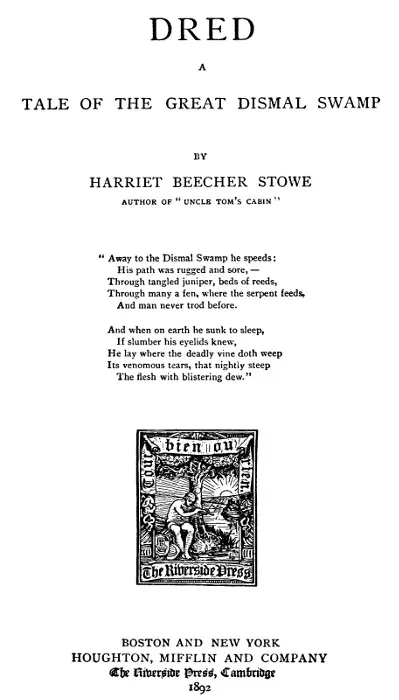
"Dred: A Tale of the Great Dismal Swamp" by Harriet Beecher Stowe is a novel published in 1856. The story follows Nina Gordon, a young plantation heiress, and the enslaved people on her failing estate, including her capable administrator Harry and the devout Milly. At its center stands Dred, a revolutionary maroon leader hiding in the Great Dismal Swamp, who preaches violent retribution against slavery. Stowe's second anti-slavery novel presents a more radical vision than "Uncle Tom's Cabin," featuring a black revolutionary inspired by real slave insurrection leaders.
Introduction adapted from the source catalogue; source summaries may be automatically generated.
Free to read · English · 231,856 words · No account needed
MAKE TIME FOR A GOOD BOOK
On by default. Untick to stop anonymous reading totals. Each page counts after 10 seconds in view. How this works.
Anonymous counting is on unless you have switched it off.
"Yes it does make me feel better! I had to speak to somebody, Milly, or else I should have burst; and now I wonder where Harry is. He always could find a way for me out of anything."
"He is gone over to see his wife, I think, Miss Nina."
"Oh, too bad! Do sent Tomtit after him, right away. Tell him that I want him to come right home, this very minute--something very particular. And, Milly, you just go and tell Old Hundred to get out the carriage and horses, and I'll go over and drop a note in the post-office, myself. I won't trust it to Tomtit; for I know he'll lose it."
"Miss Nina," said Milly, looking hesitatingly, "I 'spect you don't know how things go about round here; but the fact is, Old Hundred has got so kind of cur'ous, lately, there can't nobody do nothing with him, except Harry. Don't 'tend to do nothing Miss Loo tells him to. I's feared he'll make up some story or other about the horses; but he won't get 'em out--now, mind, I tell you, chile!"
"He won't! I should like to know if he won't, when I tell him to! A pretty story that would be! I'll soon teach him that he has a live mistress--somebody quite different from Aunt Loo!"
"Well, well, chile, perhaps you'd better go. He wouldn't mind me, I know. Maybe he'll do it for you."
"Oh, yes; I'll just run down to his house, and hurry him up." And Nina, quite restored to her usual good-humor, tripped gayly across to the cabin of Old Hundred, that stood the other side of the house.
Old Hundred's true name was, in fact, John. But he had derived the appellation, by which he was always known, from the extreme moderation of all his movements. Old Hundred had a double share of that profound sense of the dignity of his office which is an attribute of the tribe of coachmen in general. He seemed to consider the horses and carriage as a sort of family ark, of which he was the high priest, and which it was his business to save from desecration. According to his own showing, all the people on the plantation, and indeed the whole world in general, were in a state of habitual conspiracy against the family carriage and horses, and he was standing for them, single-handed, at the risk of his life. It was as much part of his duty, in virtue of his office, to show cause, on every occasion, why the carriage should not be used, as it is for state attorneys to undertake prosecutions. And it was also a part of the accomplishment of his situation to conduct his refusal in the most decorous manner; always showing that it was only the utter impossibility of the case which prevented. The available grounds of refusal Old Hundred had made a life-study, and had always a store of them cut and dried for use, all ready at a moment's notice. In the first place, there were always a number of impossibilities with regard to the carriage. Either "it was muddy, and he was laying out to wash it;" or else "he had washed it, and couldn't have it splashed;" or "he had taken out the back curtain, and had laid out to put a stitch in it, one of dese yer days;" or there was something the matter with the irons. "He reckoned they was a little bit sprung." He "'lowed he'd ask the blacksmith about it, some of dese yer times." And then as to the horses the possibilities were rich and abundant. What with strains, and loose shoes, and stones getting in at the hoofs, dangers of all sorts of complaints, for which he had his own vocabulary of names, it was next to an impossibility, according to any ordinary rule of computing chances, that the two should be in complete order together.
Your reading position is saved on this browser. Take it to another device with a library code. Reading pages adapt to text, rather than matching a printed edition.
Harriet Beecher Stowe

Harriet Beecher Stowe
Harriet Beecher Stowe

Harriet Beecher Stowe
BEHIND THE BOOK
This eBook is for the use of anyone anywhere in the United States and most other parts of the world at no cost and with almost no restrictions whatsoever. You may copy it, give it away or re-use it under the terms of the Project Gutenberg License included with this eBook or online at www.gutenberg.org. If you are not located in the United States, you will have to check the laws of the country where you are located before using this eBook. Read the source licence.
The original source file, including credits and licence, is retained by this library. Request an original-format copy at no charge. Please include the book title and Project Gutenberg identifier #55012.
KEEP YOUR CURIOSITY GOING
Cécile Tormay

Moritz Busch
Coulson Kernahan
John L. Ransom

Maurice Baring
Frances Wright