
Life of Harriet Beecher Stowe Compiled From Her Letters and Journals by Her Son Charles Edward Stowe
Harriet Beecher Stowe
THE CLASSIC COLLECTION · 1856
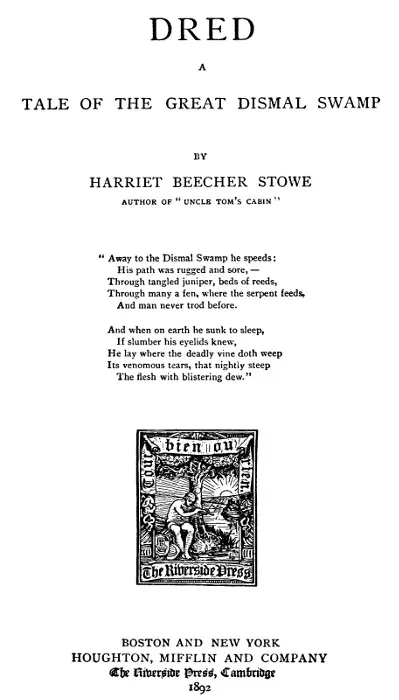
"Dred: A Tale of the Great Dismal Swamp" by Harriet Beecher Stowe is a novel published in 1856. The story follows Nina Gordon, a young plantation heiress, and the enslaved people on her failing estate, including her capable administrator Harry and the devout Milly. At its center stands Dred, a revolutionary maroon leader hiding in the Great Dismal Swamp, who preaches violent retribution against slavery. Stowe's second anti-slavery novel presents a more radical vision than "Uncle Tom's Cabin," featuring a black revolutionary inspired by real slave insurrection leaders.
Introduction adapted from the source catalogue; source summaries may be automatically generated.
Free to read · English · 231,856 words · No account needed
MAKE TIME FOR A GOOD BOOK
On by default. Untick to stop anonymous reading totals. Each page counts after 10 seconds in view. How this works.
Anonymous counting is on unless you have switched it off.
The time for the session of the Supreme Court had now arrived, and Clayton's cause was to be reconsidered. Judge Clayton felt exceedingly chagrined, as the time drew near. Being himself the leading judge of the Supreme Court, the declaration of the bench would necessarily be made known through him.
"It is extremely painful to me," he said, to Mrs. Clayton, "to have this case referred to me; for I shall be obliged to reverse the decision."
"Well," said Mrs. Clayton, "Edward must have fortitude to encounter the usual reverses of his profession. He made a gallant defence, and received a great deal of admiration, which will not be at all lessened by this."
"You do not understand me," said Judge Clayton. "It is not the coming out in opposition to Edward which principally annoys me. It is the nature of the decision that I am obliged to make--the doctrine that I feel myself forced to announce."
"And must you, then?" said Mrs. Clayton.
"Yes, I must," said Judge Clayton. "A judge can only perceive and declare. What I see, I must speak, though it go against all my feelings and all my sense of right."
"I don't see, for my part," said Mrs. Clayton, "how that decision can possibly be reversed, without allowing the most monstrous injustice."
"Such is the case," said Judge Clayton; "but I sit in my seat, not to make laws, nor to alter them, but simply to declare what they are. However bad the principle declared, it is not so bad as the proclamation of a falsehood would be. I have sworn truly to declare the laws, and I must keep my oath."
"And have you talked with Edward about it?"
"Not particularly. He understands, in general, the manner in which the
thing lies in my mind."
This conversation took place just before it was time for Judge Clayton to go to his official duties.
The court-room, on this occasion, was somewhat crowded. Barker, being an active, resolute, and popular man, with a certain class, had talked up a considerable excitement with regard to his case. Clayton's friends were interested in it on his account; lawyers were, for the sake of the principle; so that, upon the whole, there was a good deal of attention drawn towards this decision.
Among the spectators on the morning of the court, Clayton remarked Harry. For reasons which our readers may appreciate, his presence there was a matter of interest to Clayton. He made his way towards him.
"Harry," he said, "how came you here?"
Your reading position is saved on this browser. Take it to another device with a library code. Reading pages adapt to text, rather than matching a printed edition.
Harriet Beecher Stowe

Harriet Beecher Stowe
Harriet Beecher Stowe

Harriet Beecher Stowe
BEHIND THE BOOK
This eBook is for the use of anyone anywhere in the United States and most other parts of the world at no cost and with almost no restrictions whatsoever. You may copy it, give it away or re-use it under the terms of the Project Gutenberg License included with this eBook or online at www.gutenberg.org. If you are not located in the United States, you will have to check the laws of the country where you are located before using this eBook. Read the source licence.
The original source file, including credits and licence, is retained by this library. Request an original-format copy at no charge. Please include the book title and Project Gutenberg identifier #55012.
KEEP YOUR CURIOSITY GOING
Cécile Tormay

Moritz Busch
Coulson Kernahan
John L. Ransom

Maurice Baring
Frances Wright