
Life of Harriet Beecher Stowe Compiled From Her Letters and Journals by Her Son Charles Edward Stowe
Harriet Beecher Stowe
THE CLASSIC COLLECTION · 1856
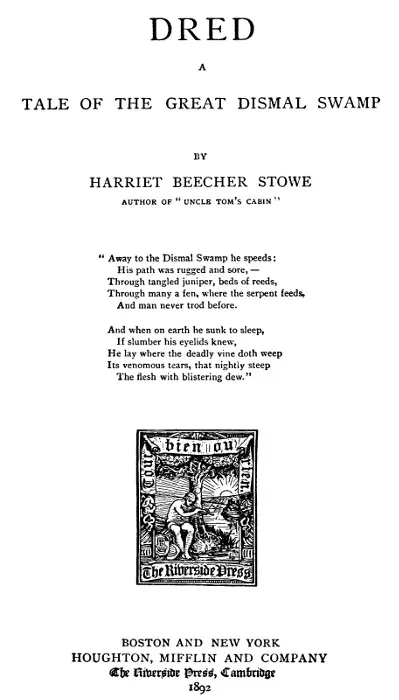
"Dred: A Tale of the Great Dismal Swamp" by Harriet Beecher Stowe is a novel published in 1856. The story follows Nina Gordon, a young plantation heiress, and the enslaved people on her failing estate, including her capable administrator Harry and the devout Milly. At its center stands Dred, a revolutionary maroon leader hiding in the Great Dismal Swamp, who preaches violent retribution against slavery. Stowe's second anti-slavery novel presents a more radical vision than "Uncle Tom's Cabin," featuring a black revolutionary inspired by real slave insurrection leaders.
Introduction adapted from the source catalogue; source summaries may be automatically generated.
Free to read · English · 231,856 words · No account needed
MAKE TIME FOR A GOOD BOOK
On by default. Untick to stop anonymous reading totals. Each page counts after 10 seconds in view. How this works.
Anonymous counting is on unless you have switched it off.
After the return of the gentlemen to the drawing-room, Nina, at the request of Tom, followed him and Mr. Jekyl into the library.
"Mr. Jekyl is going to make some statements to us, Nina, about our property in Mississippi, which, if they turn out as he expects, will set us up in the world," said Tom.
Nina threw herself carelessly into the leather arm-chair by the window,
and looked out of it.
"You see," said Mr. Jekyl, also seating himself, and pulling out the stiff points of his collar, "having done law business for your father, and known, in that way, a good deal about the family property, I have naturally always felt a good deal of interest in it; and you remember your father's sister, Mrs. Stewart, inherited, on the death of her husband, a fine estate in Mississippi."
"I remember," said Tom,--"well, go on."
"Well, she died, and left it all to her son. Well, he, it seems, like some other young men, lived in a very reprehensible union with a handsome quadroon girl, who was his mother's maid; and she, being an artful creature, I suppose, as a great many of them are, got such an ascendency over him, that he took her up to Ohio, and married her, and lived there with her some years, and had two children by her. Well, you see, he had a deed of emancipation recorded for her in Mississippi, and just taking her into Ohio, set her free by the laws of that state. Well, you see, he thought he'd fixed it so that the thing couldn't be undone, and she thought so too; and I understand she's a pretty shrewd woman--has a considerable share of character, or else she wouldn't have done just what she has; for, you see, he died about six months ago, and left the plantation and all the property to her and her children, and she has been so secure that she has actually gone and taken possession. You see, she is so near white, you must know that there isn't one in twenty would think what she was,--and the people round there, actually, some of them, had forgotten all about it, and didn't know but what she was a white woman from Ohio; and so, you see, the thing never would have been looked into at all, if I hadn't happened to have been down there. But, you see, she turned off an overseer that had managed the place, because the people complained of him; and I happened to fall in with the man, and he began telling me his story, and, after a little inquiry, I found who these people were. Well, sir, I just went to one of the first lawyers, for I suspected there was false play; and we looked over the emancipation laws together, and we found out that, as the law stood, the deed of emancipation was no more than so much waste paper. And so, you see, she and her children are just as much slaves as any on her plantation; and the whole property, which is worth a hundred thousand dollars, belongs to your family. I rode out with him, and looked over the place, and got introduced to her and her children, and looked them over. Considered as property, I should call them a valuable lot. She is past forty, but she don't look older than twenty-seven or twenty-eight, I should say. She is a very good-looking woman, and then, I'm told, a very capable woman. Well, her price in the market might range between one thousand and fifteen hundred dollars. Smalley said he had seen no better article sold for two thousand dollars; but, then, he said, they had to give a false certificate as to the age,--and that I couldn't hear of, for I never countenance anything like untruth. Then, the woman's children: she has got two fine-looking children as I have ever seen--almost white. The boy is about ten years old; the little girl, about four. You may be sure I was pretty careful not to let on, because I consider the woman and children are an important part of the property, and, of course, nothing had better be said about it, lest she should be off before we are ready to come down on them. Now, you see, you Gordons are the proper owners of this whole property; there isn't the slightest doubt in my mind that you ought to put in your claim immediately. The act of emancipation was contrary to law, and, though the man meant well, yet it amounted to a robbery of the heirs. I declare, it rather raised my indignation to see that creature so easy in the possession of property which of right belongs to you. Now, if I have only the consent of the heirs, I can go on and commence operations immediately."
Your reading position is saved on this browser. Take it to another device with a library code. Reading pages adapt to text, rather than matching a printed edition.
Harriet Beecher Stowe

Harriet Beecher Stowe
Harriet Beecher Stowe

Harriet Beecher Stowe
BEHIND THE BOOK
This eBook is for the use of anyone anywhere in the United States and most other parts of the world at no cost and with almost no restrictions whatsoever. You may copy it, give it away or re-use it under the terms of the Project Gutenberg License included with this eBook or online at www.gutenberg.org. If you are not located in the United States, you will have to check the laws of the country where you are located before using this eBook. Read the source licence.
The original source file, including credits and licence, is retained by this library. Request an original-format copy at no charge. Please include the book title and Project Gutenberg identifier #55012.
KEEP YOUR CURIOSITY GOING
Cécile Tormay

Moritz Busch
Coulson Kernahan
John L. Ransom

Maurice Baring
Frances Wright