
Life of Harriet Beecher Stowe Compiled From Her Letters and Journals by Her Son Charles Edward Stowe
Harriet Beecher Stowe
THE CLASSIC COLLECTION · 1856
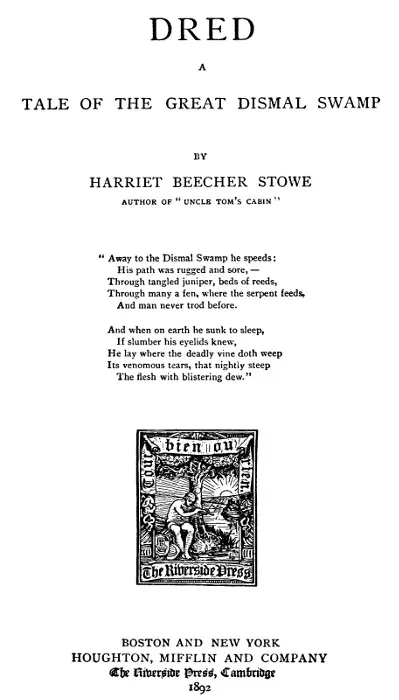
"Dred: A Tale of the Great Dismal Swamp" by Harriet Beecher Stowe is a novel published in 1856. The story follows Nina Gordon, a young plantation heiress, and the enslaved people on her failing estate, including her capable administrator Harry and the devout Milly. At its center stands Dred, a revolutionary maroon leader hiding in the Great Dismal Swamp, who preaches violent retribution against slavery. Stowe's second anti-slavery novel presents a more radical vision than "Uncle Tom's Cabin," featuring a black revolutionary inspired by real slave insurrection leaders.
Introduction adapted from the source catalogue; source summaries may be automatically generated.
Free to read · English · 231,856 words · No account needed
MAKE TIME FOR A GOOD BOOK
On by default. Untick to stop anonymous reading totals. Each page counts after 10 seconds in view. How this works.
Anonymous counting is on unless you have switched it off.
"Well, they are to remain slaves," said Mr. Knapp, speaking with excitement. "Their condition is a finality; we will not allow the subject of emancipation to be discussed, even."
"Then, God have mercy on you!" said Clayton, solemnly; "for it is my firm belief that, in resisting the progress of human freedom, you will be found fighting against God."
"It isn't the cause of human freedom," said Mr. Knapp, hastily. "They are not human; they are an inferior race, made expressly for subjection and servitude. The Bible teaches this plainly."
"Why don't you teach them to read it, then?" said Clayton, coolly.
"The long and the short of the matter is, Mr. Clayton," said Mr. Knapp, walking nervously up and down the room, "you'll find this is not a matter to be trifled with. We come, as your friends, to warn you; and, if you don't listen to our warnings, we shall not hold ourselves responsible for what may follow. You ought to have some consideration for your sister, if not for yourself."
"I confess," said Clayton, "I had done the chivalry of South Carolina the honor to think that a lady could have nothing to fear."
"It is so generally," said Judge Oliver, "but on this subject there is such a dreadful excitability in the public mind, that we cannot control it. You remember, when the commissioner was sent by the Legislature of Massachusetts to Charleston, he came with his daughter, a very cultivated and elegant young lady; but the mob was rising, and we could not control it, and we had to go and beg them to leave the city. I, for one, wouldn't have been at all answerable for the consequences, if they had remained."
"I must confess, Judge Oliver," said Clayton, "that I have been surprised, this morning, to hear South Carolinians palliating two such events in your history, resulting from mob violence, as the breaking open of the post-office, and the insult to the representative of a sister state, who came in the most peaceable and friendly spirit, and to womanhood in the person of an accomplished lady. Is this hydra-headed monster, the mob, to be our governor?"
"Oh, it is only upon this subject," said all three of the gentlemen, at once; "this subject is exceptional."
"And do you think," said Clayton, "that
'you can set the land on fire,
To burn just so high, and no higher?'
"You may depend upon it you will find that you cannot. The mob that you smile on and encourage when it does work that suits you, will one day prove itself your master in a manner that you will not like."
Your reading position is saved on this browser. Take it to another device with a library code. Reading pages adapt to text, rather than matching a printed edition.
Harriet Beecher Stowe

Harriet Beecher Stowe
Harriet Beecher Stowe

Harriet Beecher Stowe
BEHIND THE BOOK
This eBook is for the use of anyone anywhere in the United States and most other parts of the world at no cost and with almost no restrictions whatsoever. You may copy it, give it away or re-use it under the terms of the Project Gutenberg License included with this eBook or online at www.gutenberg.org. If you are not located in the United States, you will have to check the laws of the country where you are located before using this eBook. Read the source licence.
The original source file, including credits and licence, is retained by this library. Request an original-format copy at no charge. Please include the book title and Project Gutenberg identifier #55012.
KEEP YOUR CURIOSITY GOING
Cécile Tormay

Moritz Busch
Coulson Kernahan
John L. Ransom

Maurice Baring
Frances Wright