
Life of Harriet Beecher Stowe Compiled From Her Letters and Journals by Her Son Charles Edward Stowe
Harriet Beecher Stowe
THE CLASSIC COLLECTION · 1856
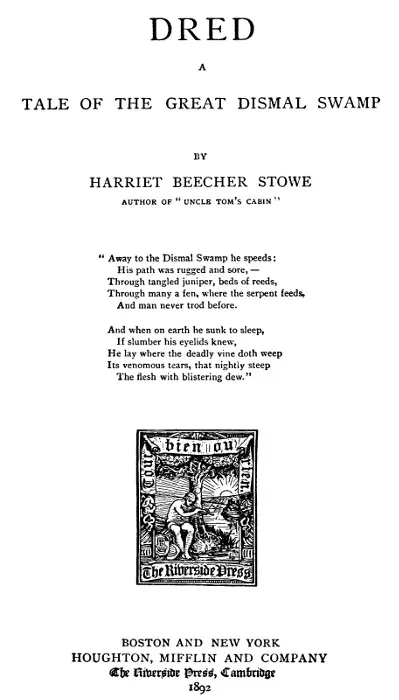
"Dred: A Tale of the Great Dismal Swamp" by Harriet Beecher Stowe is a novel published in 1856. The story follows Nina Gordon, a young plantation heiress, and the enslaved people on her failing estate, including her capable administrator Harry and the devout Milly. At its center stands Dred, a revolutionary maroon leader hiding in the Great Dismal Swamp, who preaches violent retribution against slavery. Stowe's second anti-slavery novel presents a more radical vision than "Uncle Tom's Cabin," featuring a black revolutionary inspired by real slave insurrection leaders.
Introduction adapted from the source catalogue; source summaries may be automatically generated.
Free to read · English · 231,856 words · No account needed
MAKE TIME FOR A GOOD BOOK
On by default. Untick to stop anonymous reading totals. Each page counts after 10 seconds in view. How this works.
Anonymous counting is on unless you have switched it off.
She was remanded to jail for trial. Clayton determined, in his own mind, to do what he could for her. Her own declaration seemed to make the form of a trial unnecessary. He resolved, however, to do what he could to enlist for her the sympathy of some friends of his in the city.
The next day he called with a clergyman, and requested permission to see her. When they entered her cell, she rose to receive them with the most perfect composure, as if they had called upon her in a drawing-room. Clayton introduced his companion as the Rev. Mr. Denton. There was an excited flash in her eyes, but she said, calmly,--
"Have the gentlemen business with me?"
"We called," said the clergyman, "to see if we could render you any
assistance."
"No, sir, you cannot!" was the prompt reply.
"My dear friend," said the clergyman, in a very kind tone, "I wish it were in my power to administer to you the consolations of the Gospel."
"I have nothing to do," she answered, firmly, "with ministers who pretend to preach the Gospel, and support oppression and robbery! Your hands are defiled with blood!--so don't come to me! I am a prisoner, here, and cannot resist. But, when I tell you that I prefer to be left alone, perhaps it may have some effect, even if I am a slave!"
Clayton took out Harry's letter, handed it to her, and said:--
"After you have read this, you will, perhaps, receive me, if I should call again to-morrow, at this hour."
The next day when Clayton called, he was conducted by the jailer to the
door of the cell.
"There is a lady with her now, reading to her."
"Then I ought not to interrupt her," said Clayton, hesitating.
"Oh, I suspect it would make no odds," said the jailer.
Clayton laid his hand on his to stop him. The sound that came indistinctly through the door was the voice of prayer. Some woman was interceding, in the presence of eternal pity, for an oppressed and broken-hearted sister. After a few moments the door was partly opened, and he heard a sweet voice, saying:--
"Let me come to you every day, may I? I know what it is to suffer."
Your reading position is saved on this browser. Take it to another device with a library code. Reading pages adapt to text, rather than matching a printed edition.
Harriet Beecher Stowe

Harriet Beecher Stowe
Harriet Beecher Stowe

Harriet Beecher Stowe
BEHIND THE BOOK
This eBook is for the use of anyone anywhere in the United States and most other parts of the world at no cost and with almost no restrictions whatsoever. You may copy it, give it away or re-use it under the terms of the Project Gutenberg License included with this eBook or online at www.gutenberg.org. If you are not located in the United States, you will have to check the laws of the country where you are located before using this eBook. Read the source licence.
The original source file, including credits and licence, is retained by this library. Request an original-format copy at no charge. Please include the book title and Project Gutenberg identifier #55012.
KEEP YOUR CURIOSITY GOING
Cécile Tormay

Moritz Busch
Coulson Kernahan
John L. Ransom

Maurice Baring
Frances Wright