
Life of Harriet Beecher Stowe Compiled From Her Letters and Journals by Her Son Charles Edward Stowe
Harriet Beecher Stowe
THE CLASSIC COLLECTION · 1856
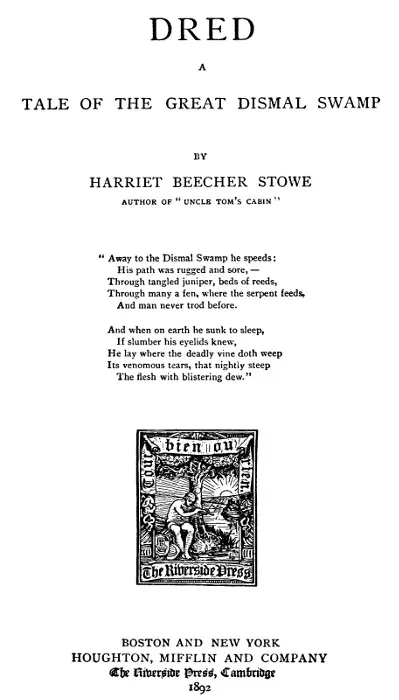
"Dred: A Tale of the Great Dismal Swamp" by Harriet Beecher Stowe is a novel published in 1856. The story follows Nina Gordon, a young plantation heiress, and the enslaved people on her failing estate, including her capable administrator Harry and the devout Milly. At its center stands Dred, a revolutionary maroon leader hiding in the Great Dismal Swamp, who preaches violent retribution against slavery. Stowe's second anti-slavery novel presents a more radical vision than "Uncle Tom's Cabin," featuring a black revolutionary inspired by real slave insurrection leaders.
Introduction adapted from the source catalogue; source summaries may be automatically generated.
Free to read · English · 231,856 words · No account needed
MAKE TIME FOR A GOOD BOOK
On by default. Untick to stop anonymous reading totals. Each page counts after 10 seconds in view. How this works.
Anonymous counting is on unless you have switched it off.
Clayton's sorrow could only be measured by the eagerness and energy with which, in conversation, he pursued the object with which he endeavored to fill his mind.
"I am far from looking forward with hope to any success from your efforts," said Judge Clayton, "the evil is so radical."
"I sometimes think," said Mrs. Clayton, "that I regret that Edward began as he did. It was such a shock to the prejudices of people!"
"People have got to be shocked," said Clayton, "in order to wake them up out of old absurd routine. Use paralyzes us to almost every injustice; when people are shocked, they begin to think and to inquire."
"But would it not have been better," said Mrs. Clayton, "to have preserved your personal influence, and thus have insinuated your opinions more gradually? There is such a prejudice against abolitionists; and, when a man makes any sudden demonstration on this subject, people are apt to call him an abolitionist, and then his influence is all gone, and he can do nothing."
"I suspect," said Clayton, "there are multitudes now in every part of our state who are kept from expressing what they really think, and doing what they ought to do, by this fear. Somebody must brave this mad-dog cry; somebody must be willing to be odious; and I shall answer the purpose as well as anybody."
"Have you any definite plan of what is to be attempted?" said his
father.
"Of course," said Clayton, "a man's first notions on such a subject must be crude; but it occurred to me, first, to endeavor to excite the public mind on the injustice of the present slave-law, with a view to altering it."
"And what points would you alter?" said Judge Clayton.
"I would give to the slave the right to bring suit for injury, and to be a legal witness in court. I would repeal the law forbidding their education, and I would forbid the separation of families."
Judge Clayton sat pondering. At length he said, "And how will you endeavor to excite the public mind?"
"I shall appeal first," said Clayton, "to the church and the ministry."
"You can try it," said his father.
"Why," said Mrs. Clayton, "these reforms are so evidently called for, by justice and humanity, and the spirit of the age, that I can have no doubt that there will be a general movement among all good people in their favor."
Judge Clayton made no reply. There are some cases where silence is the most disagreeable kind of dissent, because it admits of no argument in reply.
Your reading position is saved on this browser. Take it to another device with a library code. Reading pages adapt to text, rather than matching a printed edition.
Harriet Beecher Stowe

Harriet Beecher Stowe
Harriet Beecher Stowe

Harriet Beecher Stowe
BEHIND THE BOOK
This eBook is for the use of anyone anywhere in the United States and most other parts of the world at no cost and with almost no restrictions whatsoever. You may copy it, give it away or re-use it under the terms of the Project Gutenberg License included with this eBook or online at www.gutenberg.org. If you are not located in the United States, you will have to check the laws of the country where you are located before using this eBook. Read the source licence.
The original source file, including credits and licence, is retained by this library. Request an original-format copy at no charge. Please include the book title and Project Gutenberg identifier #55012.
KEEP YOUR CURIOSITY GOING
Cécile Tormay

Moritz Busch
Coulson Kernahan
John L. Ransom

Maurice Baring
Frances Wright