
Life of Harriet Beecher Stowe Compiled From Her Letters and Journals by Her Son Charles Edward Stowe
Harriet Beecher Stowe
THE CLASSIC COLLECTION · 1856
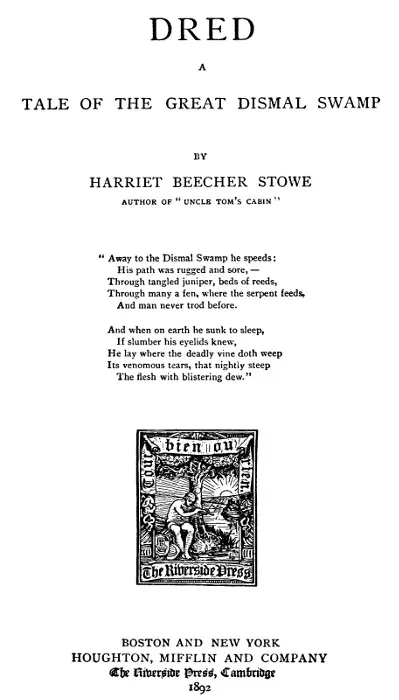
"Dred: A Tale of the Great Dismal Swamp" by Harriet Beecher Stowe is a novel published in 1856. The story follows Nina Gordon, a young plantation heiress, and the enslaved people on her failing estate, including her capable administrator Harry and the devout Milly. At its center stands Dred, a revolutionary maroon leader hiding in the Great Dismal Swamp, who preaches violent retribution against slavery. Stowe's second anti-slavery novel presents a more radical vision than "Uncle Tom's Cabin," featuring a black revolutionary inspired by real slave insurrection leaders.
Introduction adapted from the source catalogue; source summaries may be automatically generated.
Free to read · English · 231,856 words · No account needed
MAKE TIME FOR A GOOD BOOK
On by default. Untick to stop anonymous reading totals. Each page counts after 10 seconds in view. How this works.
Anonymous counting is on unless you have switched it off.
"Lord bress yer sweet face, Miss Nina!" he said, while the breezes flapped and fluttered his red and blue sails, "Old Tiff's 'mazin' happy to see you. Miss Fanny's well, thank ye; and Mas'r Teddy and the baby all doing nicely. Bress de Lord, Miss Nina, be so good as to get down and come in. I's got some nice berries dat I picked in de swamp, and Miss Fanny'll be proud to have you take some. You see," he said, laughing heartily, and regarding his peculiar costume, "I wasn't looking for any quality long dis yer time o' day, so I just got on my old clothes."
"Why, Uncle Tiff, I think they become you immensely!" said Nina. "Your outfit is really original and picturesque. You're not one of the people that are ashamed of their work, are you, Uncle Tiff? So, if you just lead my horse to that stump, I'll get down."
"Laws, no, Miss Nina!" said Tiff, as with alacrity he obeyed her orders. "Spects, if Old Tiff was 'shamed of work, he'd have a heap to be 'shamed of; 'cause it's pretty much all work with him. 'Tis so!"
"Tomtit pretended to come with me," said Nina, as she looked round; "but he lagged behind by the brook to get some of those green grapes, and I suspect it's the last I shall see of him. So, Tiff, if you please to tie Sylphine in the shade, I'll go in to see Miss Fanny."
And Nina tripped lightly up the walk, now bordered on either side by china asters and marigolds, to where Fanny was standing bashfully in the door waiting for her. In her own native woods this child was one of the boldest, freest, and happiest of romps. There was scarce an eligible tree which she could not climb, or a thicket she had not explored. She was familiar with every flower, every bird, every butterfly, of the vicinity. She knew precisely when every kind of fruit would ripen, and flower would blossom; and was so au fait in the language of birds and squirrels, that she might almost have been considered one of the fraternity. Her only companion and attendant, Old Tiff, had that quaint, fanciful, grotesque nature which is the furthest possible removed from vulgarity; and his frequent lectures on proprieties and conventionalities, his long and prolix narrations of her ancestral glories and distinctions, had succeeded in infusing into her a sort of childish consciousness of dignity, while at the same time it inspired her with a bashful awe of those whom she saw surrounded with the actual insignia and circumstances of position and fortune. After all, Tiff's method of education, instinctive as it was, was highly philosophical, since a certain degree of self-respect is the nurse of many virtues, and a shield from many temptations. There is also something, perhaps, in the influence of descent. Fanny certainly inherited from her mother a more delicate organization than generally attends her apparent station in life. She had, also, what perhaps belongs to the sex, a capability of receiving the mysteries and proprieties of dress; and Nina, as she stood on the threshold of the single low room, could not but be struck with the general air of refinement which characterized both it and its little mistress. There were flowers from the swamps and hedges arranged with care and taste; feathers of birds, strings of eggs of different color, dried grasses, and various little woodland curiosities, which showed a taste refined by daily intercourse with nature. Fanny herself was arrayed in a very pretty print dress, which her father had brought home in a recent visit, with a cape of white muslin. Her brown hair was brushed smoothly from her forehead, and her clear blue eyes, and fair, rosy complexion, gave her a pleasing air of intelligence and refinement.
Your reading position is saved on this browser. Take it to another device with a library code. Reading pages adapt to text, rather than matching a printed edition.
Harriet Beecher Stowe

Harriet Beecher Stowe
Harriet Beecher Stowe

Harriet Beecher Stowe
BEHIND THE BOOK
This eBook is for the use of anyone anywhere in the United States and most other parts of the world at no cost and with almost no restrictions whatsoever. You may copy it, give it away or re-use it under the terms of the Project Gutenberg License included with this eBook or online at www.gutenberg.org. If you are not located in the United States, you will have to check the laws of the country where you are located before using this eBook. Read the source licence.
The original source file, including credits and licence, is retained by this library. Request an original-format copy at no charge. Please include the book title and Project Gutenberg identifier #55012.
KEEP YOUR CURIOSITY GOING
Cécile Tormay

Moritz Busch
Coulson Kernahan
John L. Ransom

Maurice Baring
Frances Wright