
Life of Harriet Beecher Stowe Compiled From Her Letters and Journals by Her Son Charles Edward Stowe
Harriet Beecher Stowe
THE CLASSIC COLLECTION · 1856
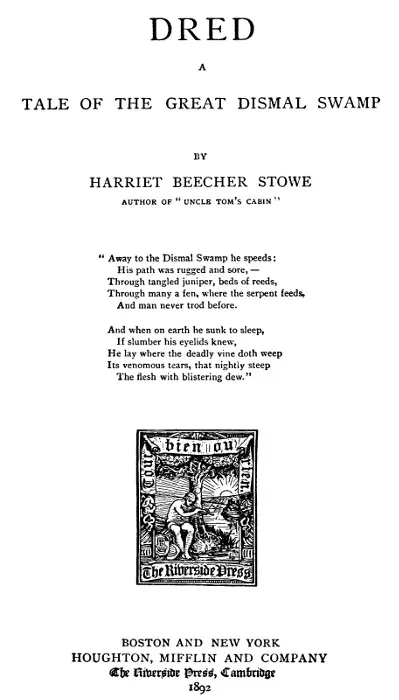
"Dred: A Tale of the Great Dismal Swamp" by Harriet Beecher Stowe is a novel published in 1856. The story follows Nina Gordon, a young plantation heiress, and the enslaved people on her failing estate, including her capable administrator Harry and the devout Milly. At its center stands Dred, a revolutionary maroon leader hiding in the Great Dismal Swamp, who preaches violent retribution against slavery. Stowe's second anti-slavery novel presents a more radical vision than "Uncle Tom's Cabin," featuring a black revolutionary inspired by real slave insurrection leaders.
Introduction adapted from the source catalogue; source summaries may be automatically generated.
Free to read · English · 231,856 words · No account needed
MAKE TIME FOR A GOOD BOOK
On by default. Untick to stop anonymous reading totals. Each page counts after 10 seconds in view. How this works.
Anonymous counting is on unless you have switched it off.
"You must think the Gospel a better trade than it is," said father Bonnie, "if you think a minister can afford to pay at that figure!"
"Why," said the trader, "you haven't seen her; it's dirt cheap for her, I can tell you! A sound, strong, hearty woman; a prudent, careful housekeeper; a real pious Methodist, a member of a class-meeting! Why, eight hundred dollars an't anything! I ought to get a thousand for her; but I don't hear preaching for nothing,--always think right to make a discount to ministers!"
"Why couldn't you bring her in?" said father Bonnie. "Maybe I'll give you seven hundred and fifty for her."
"Couldn't do that, no way!" said the trader. "Couldn't, indeed!"
"Well, after the meetings are over I'll talk about it."
"She's got a child, four years old," said the trader, with a little cough; "healthy, likely child; I suppose I shall want a hundred dollars for him!"
"Oh, that won't do!" said father Bonnie. "I don't want any more children round my place than I've got now!"
"But, I tell you," said the trader, "it's a likely boy. Why, the keeping of him won't cost you anything, and before you think of it you'll have a thousand-dollar hand grown on your own place."
"Well," said father Bonnie, "I'll think of it!"
In the evening the scene on the camp-ground was still more picturesque and impressive. Those who conduct camp-meetings are generally men who, without much reasoning upon the subject, fall into a sort of tact, in influencing masses of mind, and pressing into the service all the great life forces and influences of nature. A kind of rude poetry pervades their minds, colors their dialect, and influences their arrangements. The solemn and harmonious grandeur of night, with all its mysterious power of exalting the passions and intensifying the emotions, has ever been appreciated, and used by them with even poetic skill. The day had been a glorious one in June; the sky of that firm, clear blue, the atmosphere of that crystalline clearness, which often gives to the American landscape such a sharply-defined outline, and to the human system such an intense consciousness of life. The evening sun went down in a broad sea of light, and even after it had sunk below the purple horizon, flashed back a flood of tremulous rose-colored radiance, which, taken up by a thousand filmy clouds, made the whole sky above like a glowing tent of the most ethereal brightness. The shadows of the forest aisles were pierced by the rose-colored rays; and, as they gradually faded, star after star twinkled out, and a broad moon, ample and round, rose in the purple zone of the sky. When she had risen above the horizon but a short space, her light was so resplendent and so profuse, that it was decided to conduct the evening service by that alone; and when, at the sound of the hymn, the assembly poured in and arranged themselves before the preaching-stand, it is probable that the rudest heart present was somewhat impressed with the silent magnificence by which God was speaking to them through his works. As the hymn closed, father Bonnie, advancing to the front of the stage, lifted his hands, and pointing to the purple sky, and in a deep and not unmelodious voice, repeated the words of the Psalmist:--
Your reading position is saved on this browser. Take it to another device with a library code. Reading pages adapt to text, rather than matching a printed edition.
Harriet Beecher Stowe

Harriet Beecher Stowe
Harriet Beecher Stowe

Harriet Beecher Stowe
BEHIND THE BOOK
This eBook is for the use of anyone anywhere in the United States and most other parts of the world at no cost and with almost no restrictions whatsoever. You may copy it, give it away or re-use it under the terms of the Project Gutenberg License included with this eBook or online at www.gutenberg.org. If you are not located in the United States, you will have to check the laws of the country where you are located before using this eBook. Read the source licence.
The original source file, including credits and licence, is retained by this library. Request an original-format copy at no charge. Please include the book title and Project Gutenberg identifier #55012.
KEEP YOUR CURIOSITY GOING
Cécile Tormay

Moritz Busch
Coulson Kernahan
John L. Ransom

Maurice Baring
Frances Wright