THE CLASSIC COLLECTION✦An outlaw’s diary: the CommuneCLASSIC FREE BOOKS
An outlaw’s diary: the Commune
Cécile Tormay
THE CLASSIC COLLECTION · 1912
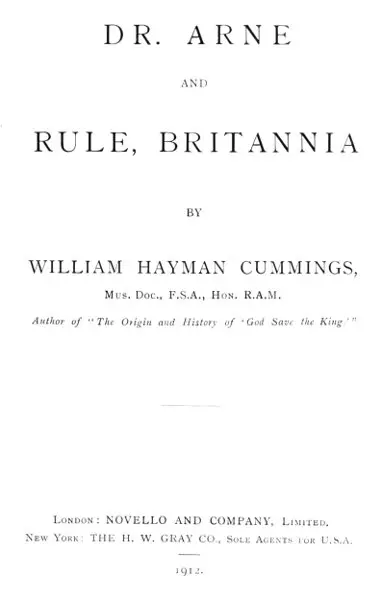
"Dr. Arne and Rule, Britannia" by William Hayman Cummings is a historical account written in the early 20th century. This work chronicles the life and influential career of Thomas Augustine Arne, a prominent composer of the 18th century, most notably known for the national song "Rule, Britannia." Cummings explores not only Arne's compositions but also the personal and sociocultural circumstances that shaped his musical legacy, providing insight into his struggles and triumphs. The opening of the book establishes the context for Arne's life by detailing his lineage, sociopolitical environment, and initial musical education. It describes his family background and the early indicators of his musical talent, including his secretive practice of music while adhering to his father’s wishes for him to pursue a legal career. The author sets the stage for a more comprehensive exploration of Arne’s career development, challenges, and the eventual recognition he gained within the British musical scene. This section hints at a narrative that is both educational for music students and enchanting for readers interested in the history behind one of Britain’s cherished national songs.
Introduction adapted from the source catalogue; source summaries may be automatically generated.
Free to read · English · 37,165 words · No account needed
MAKE TIME FOR A GOOD BOOK
On by default. Untick to stop anonymous reading totals. Each page counts after 10 seconds in view. How this works.
Anonymous counting is on unless you have switched it off.
[13] Lampe died at Edinburgh in 1751. His wife was sister to Mrs. Arne.
[14] Miss Polly Young was the daughter of Charles Young, Mrs. Arne's
brother.
[15] Polly Young.
[16] He had been studying the science of music under the learned Dr.
Pepusch.
[17] The Crown and Anchor, in the Strand, was a favourite resort for concert-givers. In my youthful days the "Abbey Glee Club" and other Musical Societies met there.--W. H. C.
[18] The name of Madame Tenducci was not publicly announced.
[19] Master Norris had been a chorister in Salisbury Cathedral; he was born in 1741, and seems to have continued singing soprano up to 1762. His voice must have been in a transition state. He sang at the Gloucester Festival of 1766 as a tenor. He became organist of Christ Church Cathedral, Oxford; a Mus. Bac., and a singer of good repute.
[20] The audience was much incommoded by the wet; incessant September rain poured through the roof, and converted the floor into a swamp. Eventually the four hundred people who were present, wet through, took refuge on the benches and orchestra.
[21] Mr. William Mawhood, born in 1723, died in 1797, was a merchant, residing in West Smithfield, and an accomplished musical amateur. An account of him will be found in the Musical Times of January, 1910, written by Mr. Barclay Squire.
[22] Michael Arne, his son.
[23] Mrs. Michael Arne, the popular vocalist, Elizabeth Wright.
[24] Miss Abrams.
[25] Miss Weller and her sister.
[26] David Garrick's brother.
[27] Mary Barthelemon, née Young.
[28] Proved. 16 March, 1778, by Cecilia Arne, widow, relict of the deceased, one of the executors with power reserved, 21 March, 1778, by Michael Arne, son of the deceased, the other executor named in the will.
[29] nephew by marriage of Mrs. Arne.
[30] The date of production is uncertain.
[31] The autograph in my possession.--W. H. C.
[32] Cliefden House, originally erected for George Villiers, second Duke of Buckingham, was built of red brick with stone dressings, having at each end a square wing connected with the main building by a colonnade, and fronted by a magnificent terrace four hundred and forty feet long. The Duke expended large sums on the house and grounds; for the latter, consisting of about one hundred and thirty-six acres, he procured, regardless of cost, the choicest specimens of trees, shrubs and flowers, native and foreign, and so enhanced the natural beauties of the site that it was reputed to surpass all other estates in England. At the death of the Duke, Cliefden was purchased by Lord George Hamilton, afterwards Earl of Orkney; he died without male issue, and the property and title passed to his daughter. She leased the estate to the Prince of Wales, who regularly resided there until his death in 1751. The splendid mansion was destroyed by fire on the 20th of May, 1795, owing to the carelessness of a maidservant, who, whilst reading in bed, was startled by the curtains bursting into flame. With the exception of the wings, the building was entirely burnt, together with valuable furniture, tapestry and paintings. Sir George Warrender bought the estate and rebuilt the house in 1830. At his death it was sold to the Duke of Sutherland, and on the 15th of March, 1849, fire again destroyed the building, which was afterwards rebuilt from designs by Barry.
Your reading position is saved on this browser. Take it to another device with a library code. Reading pages adapt to text, rather than matching a printed edition.
BEHIND THE BOOK
This eBook is for the use of anyone anywhere in the United States and most other parts of the world at no cost and with almost no restrictions whatsoever. You may copy it, give it away or re-use it under the terms of the Project Gutenberg License included with this eBook or online at www.gutenberg.org. If you are not located in the United States, you will have to check the laws of the country where you are located before using this eBook. Read the source licence.
The original source file, including credits and licence, is retained by this library. Request an original-format copy at no charge. Please include the book title and Project Gutenberg identifier #43214.
KEEP YOUR CURIOSITY GOING
Cécile Tormay

Moritz Busch
John L. Ransom
Frances Wright
Cécile Tormay

Mabel Potter Daggett