THE CLASSIC COLLECTION✦An outlaw’s diary: the CommuneCLASSIC FREE BOOKS
An outlaw’s diary: the Commune
Cécile Tormay
THE CLASSIC COLLECTION · 1912
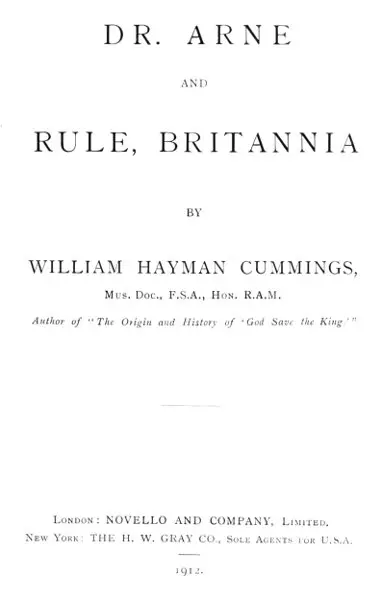
"Dr. Arne and Rule, Britannia" by William Hayman Cummings is a historical account written in the early 20th century. This work chronicles the life and influential career of Thomas Augustine Arne, a prominent composer of the 18th century, most notably known for the national song "Rule, Britannia." Cummings explores not only Arne's compositions but also the personal and sociocultural circumstances that shaped his musical legacy, providing insight into his struggles and triumphs. The opening of the book establishes the context for Arne's life by detailing his lineage, sociopolitical environment, and initial musical education. It describes his family background and the early indicators of his musical talent, including his secretive practice of music while adhering to his father’s wishes for him to pursue a legal career. The author sets the stage for a more comprehensive exploration of Arne’s career development, challenges, and the eventual recognition he gained within the British musical scene. This section hints at a narrative that is both educational for music students and enchanting for readers interested in the history behind one of Britain’s cherished national songs.
Introduction adapted from the source catalogue; source summaries may be automatically generated.
Free to read · English · 37,165 words · No account needed
MAKE TIME FOR A GOOD BOOK
On by default. Untick to stop anonymous reading totals. Each page counts after 10 seconds in view. How this works.
Anonymous counting is on unless you have switched it off.
Passing notice is all that is necessary of the gross want of reverence and good taste exhibited by the Rev. Rowland Hill, of Surrey Chapel, who wrote a hymn for the music of "Rule, Britannia," which was sung on the 4th of December, 1803, by a crowded congregation of Volunteers, and printed in a collection of hymns sung at Surrey Chapel.
At the Coronation of William IV., the Sailor King, at Westminster Abbey, September 8th, 1831, an anthem, "O Lord, grant the King a long life," was sung, having been composed by Thomas Attwood. The introductory symphony and the concluding chorus have quotations from the melody of "Rule, Britannia," introduced in a very ingenious and admirable manner.
Sir Alexander Mackenzie has also made masterly use of the tune in his brilliant "Britannia" Overture.
[1] The register does not specify the day of the month.
[2] The autograph in my possession.--W. H. C.
[3] On the Report of this Committee, John Huggins, the Warden of the Fleet was tried for murder, but acquitted. James Barnes, his agent, by whom this outrage was committed, fled, and was never tried. However, Lord Chief Justice Raymond was of opinion, that had he been on his trial, and the fact proved against him, he would undoubtedly have been found guilty of murder.
[4] Mrs. Arne rode on a pillion, behind Burney, on horse-back, from
Chester to London.
[5] In October, 1758, Cibber was crossing the sea to fulfil an engagement with Sheridan in Dublin, when the vessel was shipwrecked, and he with nearly all the passengers drowned.
[6] Mrs. Arne soon became a convert to the Roman Church.
[7] These are published by Novello & Co., Ltd.
[8] The Choir of Christ Church Cathedral, in 1742, consisted of six Vicars Choral, Messrs. John Warrall, Charles Taylor, William Jones, John Eusebius Smith, John Mason and Mr. John Church; there were also six Stipendiaries, Messrs. John Phipps, James Baily, William Lamb, Joseph Ward, Timothy Carter, John Hill; with six chorister boys. The Choir of St. Patrick's Cathedral at the same date included nine Vicars Choral, Messrs. James Baily, William Tavernor, Robert Hall, Robert Woffington, William Lambe, John Eusebius Smith, Joseph Ward, John Hill, James Colgan. There were also six chorister boys, five of these being the same in both Cathedrals. The organist of both Cathedrals was Ralph Rosengrave.
[9] "Twelve Duettos for Two French Horns, or Two German Flutes, composed by Mr. Charles." A rare publication.
[10] Written by Fielding, produced in 1742.
[11] Dubourg a fine violinist and pupil of Geminiani, was noted for his brilliant technique; on one occasion he indulged in a Cadenza of such length and diffuseness, that at its close Handel, who was conducting, called out "Welcome home, Mr. Dubourg."
[12] In the King's Library, Buckingham Palace.
Your reading position is saved on this browser. Take it to another device with a library code. Reading pages adapt to text, rather than matching a printed edition.
BEHIND THE BOOK
This eBook is for the use of anyone anywhere in the United States and most other parts of the world at no cost and with almost no restrictions whatsoever. You may copy it, give it away or re-use it under the terms of the Project Gutenberg License included with this eBook or online at www.gutenberg.org. If you are not located in the United States, you will have to check the laws of the country where you are located before using this eBook. Read the source licence.
The original source file, including credits and licence, is retained by this library. Request an original-format copy at no charge. Please include the book title and Project Gutenberg identifier #43214.
KEEP YOUR CURIOSITY GOING
Cécile Tormay

Moritz Busch
John L. Ransom
Frances Wright
Cécile Tormay

Mabel Potter Daggett