THE CLASSIC COLLECTION✦An outlaw’s diary: the CommuneCLASSIC FREE BOOKS
An outlaw’s diary: the Commune
Cécile Tormay
THE CLASSIC COLLECTION · 1912
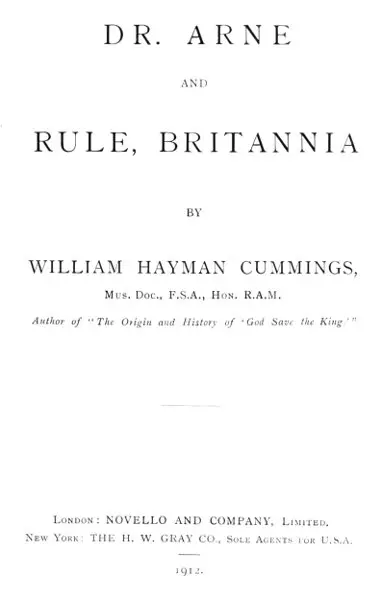
"Dr. Arne and Rule, Britannia" by William Hayman Cummings is a historical account written in the early 20th century. This work chronicles the life and influential career of Thomas Augustine Arne, a prominent composer of the 18th century, most notably known for the national song "Rule, Britannia." Cummings explores not only Arne's compositions but also the personal and sociocultural circumstances that shaped his musical legacy, providing insight into his struggles and triumphs. The opening of the book establishes the context for Arne's life by detailing his lineage, sociopolitical environment, and initial musical education. It describes his family background and the early indicators of his musical talent, including his secretive practice of music while adhering to his father’s wishes for him to pursue a legal career. The author sets the stage for a more comprehensive exploration of Arne’s career development, challenges, and the eventual recognition he gained within the British musical scene. This section hints at a narrative that is both educational for music students and enchanting for readers interested in the history behind one of Britain’s cherished national songs.
Introduction adapted from the source catalogue; source summaries may be automatically generated.
Free to read · English · 37,165 words · No account needed
MAKE TIME FOR A GOOD BOOK
On by default. Untick to stop anonymous reading totals. Each page counts after 10 seconds in view. How this works.
Anonymous counting is on unless you have switched it off.
[33] A mistake; the "Judgement of Paris" was written by Congreve.
[34] Arquebusade water was a concoction of spirits and herbs commonly
applied to gunshot wounds.
[35] Dr. Burney observes, "Lowe had the finest tenor voice I ever heard
in my life."
[36] "This day was rehears'd at Drury-Lane Theatre a Masque entitled 'Alfred,' in order to be represented before the Prince and Princess, at Cliefden House on the first of August."--(Gent. Mag., July 28th, 1740.)
[37] When "Alfred" was performed at Drury Lane Theatre, in 1751, the part for the Hermit was deleted and the drama concluded with the Ode, which was cut down to four verses. The solos were sung alternately by Alfred and Eltruda (Mr. Beard and Signora Frasi).
[38] Commentary on the practice of securing seats at Drury Lane Theatre is to be found in the "Private correspondence" addressed to David Garrick: "SIR.--The many proofs you have given the town of your desire to oblige them, encourage me to propose to you a scheme no less advantageous than useful to the public, especially the polite part of it. The alterations lately made in your theatre for the convenience of the spectators, naturally suggested to me an inconvenience arising from the servants who are sent to keep places. I have, with concern, seen a lady finely dressed forced to sit down by a servant whose clothes and feet have been very dirty, and behaviour extremely offensive; it has happened, to my knowledge, that some servants, in order to follow their own pleasures, have hired common porters of the street to keep their places, whose company better suited a prison than a place of polite entertainment."
Signed T. B. Nov. 25, 1762.
[39] Handel gave a performance of his Oratorio "Joseph" at the King's Theatre, Haymarket, on the 21st of March, 1745.
[40] The singers in 1751 were Mrs. Arne, Signora Galli' Signora Frasi, Miss Young, Mr. Beard, Mr. Baker, Signor Guadagni.
Abbey Glee Club, 53
Abrams, 81, 91
Acis and Galatea, 8, 23, 28
Addison, 3, 4, 9
Ah me, what fears, 132
Alas, the horrors, 70
Aldrich, 66
Alexander's Feast, 93
Alfred, 15, 20, 33, 41, 46, 114, 116, 122, 124
Alfred, go forth, 121
Allegro, 20
Amelia, Princess, 10
Amphitryon, 29
Anderson, 134
Angels ever bright, 132
Arcadian nuptials, 62
ARNE--
Actor, 30
At Cliefden, 114
At Eton, 3, 6
At Stratford-on-Avon, 67
Birth of composer, 1
Burial, 101
Conductor, 35
Death, 96
Employs ladies in Choir, 51
Father of composer, 1
First composition, 9
Flautist, 7
Grandfather of composer, 1, 4
Harpsichordist, 22
His will, 98
In Dublin, 19
In Edinburgh, 40
Introduces P.F. accomp., 51
Leaves wife in Dublin, 46
Marriage, 21
Member Soc. of Mus., 14
Mother of composer, 2, 11, 13, 15
Mus. Doc. Oxon, 49
Reunited to wife, 94
Son Michael born, 38
Violinist, 8, 22, 125
Wife of composer, 2, 11, 13, 15, 20, 22, 24, 46, 57, 72, 94, 102,
115, 125, 127
Arne, Edward, 4
Arne, Michael, bro. of composer, 9
Arne, Michael, Mrs., 79
Arne, Michael, son of composer, 38, 62, 77, 92, 97, 101
Arne, Susanna, sis. of composer, 9
Arnold, 92, 102
Artaxerxes, 54, 61
As you like it, 17, 28
Attwood, 136
Augusta, Princess, 12, 112
Baddely, 67, 70
Baildon, 24, 27, 66, 127
Baker, 127, 129
Banks, 2
Barbarini, 114
Barbatielli, 29
Barbier, 9
Barnes, 4
Barry, 34, 84
Barthelemon, 50, 74
Your reading position is saved on this browser. Take it to another device with a library code. Reading pages adapt to text, rather than matching a printed edition.
BEHIND THE BOOK
This eBook is for the use of anyone anywhere in the United States and most other parts of the world at no cost and with almost no restrictions whatsoever. You may copy it, give it away or re-use it under the terms of the Project Gutenberg License included with this eBook or online at www.gutenberg.org. If you are not located in the United States, you will have to check the laws of the country where you are located before using this eBook. Read the source licence.
The original source file, including credits and licence, is retained by this library. Request an original-format copy at no charge. Please include the book title and Project Gutenberg identifier #43214.
KEEP YOUR CURIOSITY GOING
Cécile Tormay

Moritz Busch
John L. Ransom
Frances Wright
Cécile Tormay

Mabel Potter Daggett