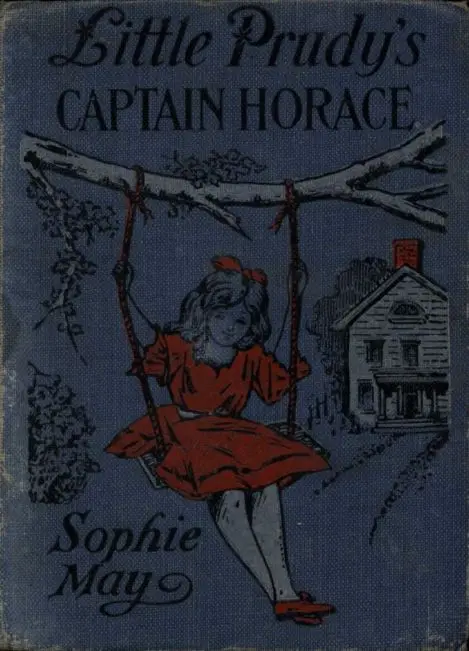
Little Prudy’s Captain Horace
Sophie May
THE CLASSIC COLLECTION · 1868
"Dotty Dimple at Her Grandmother's" by Sophie May is a children's fiction book, likely written in the late 19th century. The story follows a young girl named Dotty, or Alice, as she navigates life with her siblings while spending time at her grandmother's home. The narrative captures the innocence and curiosities of childhood, focusing on Dotty's adventures, interactions with other children, and her moral lessons learned throughout. At the start of the book, the three Parlin siblings are introduced as they arrive at their grandmother's house on a lovely Sunday morning. Dotty Dimple observes the beauty of nature and finds herself grappling with feelings of envy and admiration as she compares herself to another girl, Jennie. The opening reveals Dotty’s innocence and her childlike misunderstanding of social status, wealth, and virtue, particularly as she contemplates the act of giving and the lessons learned in Sunday school. The interactions and discussions amongst the children set the stage for Dotty's adventures and moral growth throughout the story, indicating that themes of generosity, honesty, and childhood imagination will be central to the narrative.
Introduction adapted from the source catalogue; source summaries may be automatically generated.
Free to read · English · 24,521 words · No account needed
MAKE TIME FOR A GOOD BOOK
On by default. Untick to stop anonymous reading totals. Each page counts after 10 seconds in view. How this works.
Anonymous counting is on unless you have switched it off.
"I never had a husband or anybody else to take care of me," said Polly. "Come, children, we must go into the house."
They all three entered the parlor, and Miss Whiting fastened the window tightly to exclude the air, for it was one of her afflictions that she was "easy to take cold."
"I don't see," queried Dotty, "why your husband didn't marry you. I should have thought he would."
"He didn't want to, I suppose," said Polly, grimly.
Dotty fell into a brown study. It was certainly very unkind in some man that he hadn't married Miss Polly and taken care of her, so she need not have wandered around the world with a double-covered basket and a snuff-box. It was a great pity; still Dotty could not see that just now it had anything to do with Polly's forgetting to set the table. "I'm so hungry," said she; "isn't it 'most supper time?"
"It's only five; but you appear to be so lonesome that I'll make a fire this minute and put on the tea-kettle," replied the kind-hearted Polly. "What does your grandmother generally have for supper?"
"Cake sometimes," answered Dotty, her eyes brightening; "and tarts."
"And perjerves," added Katie; "and--and--yice puddin'."
"She keeps the cake in a stone jar," said Dotty, eagerly; "and the strawberries are down cellar in a glass dish--cost a cent apiece."
"The slips they grew from cost a cent apiece; that is what you mean," said Polly; "you hear things rather hap-hazard sometimes, Dotty, and you ought to be more careful."
The tea-kettle was soon singing on the stove, and Dotty forgot her peculiar trials when she saw the table covered with dainties. She was not sure grandma would have approved of the cake and tarts, but they were certainly very nice, and it was a pleasure to see how Polly enjoyed them. Dotty presumed she had never had such things when she lived with the "hard-faced woman."
"It wasn't everywhere," she said, "that she saw such thick cream as rose to the tops of Mrs. Parlin's pans."
She poured it freely over the strawberries and into her own tea, which it made so delicious that she drank three cups. Then after supper she seemed to feel quite cheery for her, and, taking Katie in her arms, rocked her to sleep to the tune of "China," which is not very lively music, it must be confessed.
"Aunt 'Ria puts her to bed awake," said Dotty. "She's going to sleep in
my bed to-night."
"Very well," said Polly, "but you will sleep with me."
"Why, Miss Polly! what if Katie should wake up?"
Your reading position is saved on this browser. Take it to another device with a library code. Reading pages adapt to text, rather than matching a printed edition.
BEHIND THE BOOK
This eBook is for the use of anyone anywhere in the United States and most other parts of the world at no cost and with almost no restrictions whatsoever. You may copy it, give it away or re-use it under the terms of the Project Gutenberg License included with this eBook or online at www.gutenberg.org. If you are not located in the United States, you will have to check the laws of the country where you are located before using this eBook. Read the source licence.
The original source file, including credits and licence, is retained by this library. Request an original-format copy at no charge. Please include the book title and Project Gutenberg identifier #20699.
KEEP YOUR CURIOSITY GOING
Coulson Kernahan

Maurice Baring
Frances Wright
Cécile Tormay

Frederic Jesup Stimson

W. H. P. (William Henry Pope) Jarvis