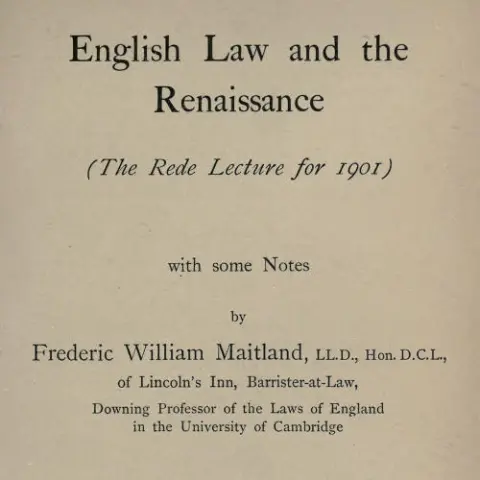
English Law and the Renaissance The Rede Lecture for 1901
Frederic William Maitland
THE CLASSIC COLLECTION · 1897
"Domesday Book and Beyond: Three Essays in the Early History of England" by Frederic William Maitland is a historical account written in the late 19th century. The work explores key themes and documents related to early English law and society, particularly focusing on the significance and implications of the Domesday Book—a comprehensive survey commissioned by William the Conqueror in 1085. The opening of the book presents a detailed introduction to the Domesday Book, describing its creation and its purpose as a tax record rather than a comprehensive legal document. Maitland discusses the methods used by royal commissioners to gather data regarding landholdings and the various classes of people that inhabited England during this period. He highlights the complexities of understanding the legal relationships and historical context of the land and its occupants, setting the stage for a deeper examination of feudalism and its societal ramifications in England.
Introduction adapted from the source catalogue; source summaries may be automatically generated.
Free to read · English · 233,138 words · No account needed
MAKE TIME FOR A GOOD BOOK
On by default. Untick to stop anonymous reading totals. Each page counts after 10 seconds in view. How this works.
Anonymous counting is on unless you have switched it off.
Borough and market, 192. Establishment of markets, 193. Moneyers in the burh, 195. Burh and port, 195. Military and commercial elements in the borough, 196. The borough and agriculture, 196. Burgesses as cultivators, 197. Burgage tenure, 198. Eastern and western boroughs, 199. Common property of the burgesses, 200. The community as landholders, 200. Rights of common, 202. Absence of communalism in the borough, 202. The borough community and its lord, 203. The farm of the borough, 204. The sheriff and the farm of the borough, 205. The community and the geld, 206. Partition of taxes, 207. No corporation farming the borough, 208. Borough and county organization, 209. Government of the boroughs, 209. The borough court, 210. The law-men, 211. Definition of the borough, 212. Mediatized boroughs, 212. Boroughs on the king's land and other boroughs, 215. Attributes of the borough, 216. Classification of the boroughs, 217. National element in the boroughs, 219.
Object of this essay, 220. Fundamental controversies over Anglo-Saxon history, 221. The Romanesque theory unacceptable, 222. Feudalism as a normal stage, 223. Feudalism as progress and retrogress, 224. Progress and retrogress in the history of legal ideas, 224. The contact of barbarism and civilization, 225. Our materials, 226.
§ 1. Book-land and the Land-book, pp. 226-244.
The lands of the churches, 226. How the churches acquired their lands, 227. The earliest land-books, 229. Exotic character of the book, 230. The book purports to convey ownership, 230. The book conveys a superiority, 231. A modern analogy, 232. Conveyance of superiorities in early times, 233. What had the king to give? 234. The king's alienable rights, 234. Royal rights in land, 235. The king's feorm, 236. Nature of the feorm, 237. Tribute and rent, 239. Mixture of ownership and superiority, 240. Growth of the seignory, 241. Book-land and church-right, 242. Book-land and testament, 243.
§ 2. Book-land and Folk-land, pp. 244-258.
What is folk-land? 244. Folk-land in the laws, 244. Folk-land in the charters, 245. Land booked by the king to himself, 246. The consent of the witan, 247. Consent and witness in the land-books, 247. Attestation of the earliest books, 248, Confirmation and attestation, 250. Function of the witan, 251. The king and the people's land, 252. King's land and crown land, 253. Fate of the king's land on his death, 253. The new king and the old king's heir, 254. Immunity of the ancient demesne, 255. Rights of individuals in national land, 255. The alod, 256. Book-land and privilege, 257. Kinds of land and kinds of right, 257.
§ 3. Sake and Soke, pp. 258-292.
Your reading position is saved on this browser. Take it to another device with a library code. Reading pages adapt to text, rather than matching a printed edition.
Frederic William Maitland
BEHIND THE BOOK
This eBook is for the use of anyone anywhere in the United States and most other parts of the world at no cost and with almost no restrictions whatsoever. You may copy it, give it away or re-use it under the terms of the Project Gutenberg License included with this eBook or online at www.gutenberg.org. If you are not located in the United States, you will have to check the laws of the country where you are located before using this eBook. Read the source licence.
The original source file, including credits and licence, is retained by this library. Request an original-format copy at no charge. Please include the book title and Project Gutenberg identifier #43255.
KEEP YOUR CURIOSITY GOING
Cécile Tormay

Moritz Busch
John L. Ransom
Frances Wright
Cécile Tormay

Mabel Potter Daggett