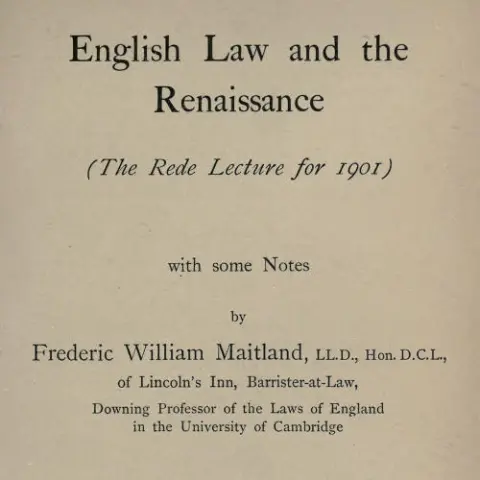
English Law and the Renaissance The Rede Lecture for 1901
Frederic William Maitland
THE CLASSIC COLLECTION · 1897
"Domesday Book and Beyond: Three Essays in the Early History of England" by Frederic William Maitland is a historical account written in the late 19th century. The work explores key themes and documents related to early English law and society, particularly focusing on the significance and implications of the Domesday Book—a comprehensive survey commissioned by William the Conqueror in 1085. The opening of the book presents a detailed introduction to the Domesday Book, describing its creation and its purpose as a tax record rather than a comprehensive legal document. Maitland discusses the methods used by royal commissioners to gather data regarding landholdings and the various classes of people that inhabited England during this period. He highlights the complexities of understanding the legal relationships and historical context of the land and its occupants, setting the stage for a deeper examination of feudalism and its societal ramifications in England.
Introduction adapted from the source catalogue; source summaries may be automatically generated.
Free to read · English · 233,138 words · No account needed
MAKE TIME FOR A GOOD BOOK
On by default. Untick to stop anonymous reading totals. Each page counts after 10 seconds in view. How this works.
Anonymous counting is on unless you have switched it off.
Importance of seignorial justice, 258. Theory of the modern origin of seignorial justice, 258. Sake and soke in the Norman age, 259. The Confessor's writs, 259. Cnut's writs, 260. Cnut's law, 261. The book and the writ, 261. Diplomatics, 262. The Anglo-Saxon writ, 264. Sake and soke appear when writs appear, 265. Traditional evidence of sake and soke, 267. Altitonantis, 268. Criticism of the earlier books, 269. The clause of immunity, 270. Dissection of the words of immunity, 272. The trinoda necessitas, 273. The ángild, 274. The right to wites and the right to a court, 275. The Taunton book, 276. The immunists and the wite, 277. Justice and jurisdiction, 277. The Frankish immunity, 278. Seignorial and ecclesiastical jurisdiction, 279. Criminal justice of the church, 281. Antiquity of seignorial courts, 282. Justice, vassalage and tenure, 283. The lord and the accused vassal, 284. The state, the lord and the vassal, 285. The landríca as immunist, 286. The immunist's rights over free men, 288. Sub-delegation of justiciary rights, 289. Number of the immunists, 289.
Note: The Ángild Clause, 290.
§ 4. Book-land and Loan-land, pp. 293-318.
The book and the gift, 293. Book-land and service, 294. Military service, 295. Escheat of book-land, 295. Alienation of book-land, 297. The heriot and the testament, 298. The gift and the loan, 299. The precarium, 300. The English land-loan, 301. Loans of church land to the great, 302. The consideration for the loan, 303. St. Oswald's loans, 303. Oswald's letter to Edgar, 304. Feudalism in Oswald's law, 307. Oswald's riding-men, 308. Heritable loans, 309. Wardship and marriage, 310. Seignorial jurisdiction, 310. Oswald's law and England at large, 311. Inferences from Oswald's loans, 312. Economic position of Oswald's tenants, 312. Loan-land and book-land, 313. Book-land in the dooms, 314. Royal and other books, 315. The gift and the loan, 317. Dependent tenure, 317.
§ 5. The Growth of Seignorial Power, pp. 318-340.
Subjection of free men, 318. The royal grantee and the land, 318. Provender rents and the manorial economy, 319. The church and the peasants, 320. Growth of the manorial system, 321. Church-scot and tithes, 321. Jurisdictional rights of the lord, 322. The lord and the man's taxes, 323. Depression of the free ceorl, 324. The slaves, 325. Growth of manors from below, 325.
Theories which connect the manor with the Roman villa, 326. The Rectitudines, 327. Discussion of the Rectitudines, 328. The Tidenham case, 329. The Stoke case, 330. Inferences from these cases, 332. The villa and the vicus, 333. Manors in the land-books, 334. The mansus and the manens, 335. The hide, 336. The strip-holding and the villa, 337. The lord and the strips, 338. The ceorl and the slave, 339. The condition of the Danelaw, 339.
§ 6. The Village Community, pp. 340-356.
Free villages, 340. Ownership by communities and ownership by individuals, 341. Co-ownership and ownership by corporations, 341. Ownership and governmental power, 342. Ownership and subordinate governmental power, 343. Evolution of sovereignty and ownership, 343. Communal ownership as a stage, 344. The theory of normal stages, 345.
Your reading position is saved on this browser. Take it to another device with a library code. Reading pages adapt to text, rather than matching a printed edition.
Frederic William Maitland
BEHIND THE BOOK
This eBook is for the use of anyone anywhere in the United States and most other parts of the world at no cost and with almost no restrictions whatsoever. You may copy it, give it away or re-use it under the terms of the Project Gutenberg License included with this eBook or online at www.gutenberg.org. If you are not located in the United States, you will have to check the laws of the country where you are located before using this eBook. Read the source licence.
The original source file, including credits and licence, is retained by this library. Request an original-format copy at no charge. Please include the book title and Project Gutenberg identifier #43255.
KEEP YOUR CURIOSITY GOING
Cécile Tormay

Moritz Busch
John L. Ransom
Frances Wright
Cécile Tormay

Mabel Potter Daggett