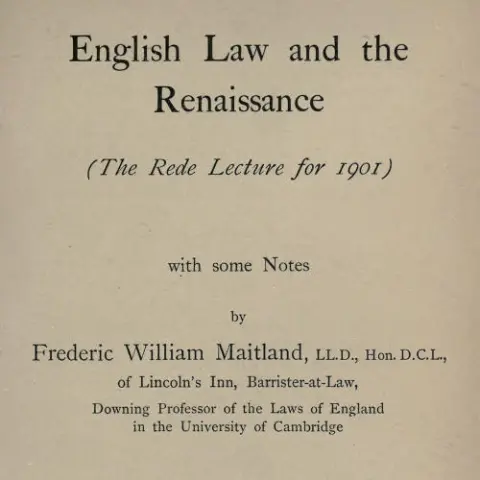
English Law and the Renaissance The Rede Lecture for 1901
Frederic William Maitland
THE CLASSIC COLLECTION · 1897
"Domesday Book and Beyond: Three Essays in the Early History of England" by Frederic William Maitland is a historical account written in the late 19th century. The work explores key themes and documents related to early English law and society, particularly focusing on the significance and implications of the Domesday Book—a comprehensive survey commissioned by William the Conqueror in 1085. The opening of the book presents a detailed introduction to the Domesday Book, describing its creation and its purpose as a tax record rather than a comprehensive legal document. Maitland discusses the methods used by royal commissioners to gather data regarding landholdings and the various classes of people that inhabited England during this period. He highlights the complexities of understanding the legal relationships and historical context of the land and its occupants, setting the stage for a deeper examination of feudalism and its societal ramifications in England.
Introduction adapted from the source catalogue; source summaries may be automatically generated.
Free to read · English · 233,138 words · No account needed
MAKE TIME FOR A GOOD BOOK
On by default. Untick to stop anonymous reading totals. Each page counts after 10 seconds in view. How this works.
Anonymous counting is on unless you have switched it off.
What is a manor? 107. Manerium a technical term, 107. Manor and hall, 109. Difference between manor and hall, 110. Size of the maneria, 110. A large manor, 111. Enormous manors--Leominster, Berkeley, Tewkesbury, Taunton, 112. Large manors in the Midlands, 114. Townhouses and berewicks attached to manors, 114. Manor and soke, 115. Minute manors in the west, 116. Minute manors in the east, 117. The manor as a peasant's holding, 118. Definition of a manor, 119. The manor and the geld, 120. Classification of men for the geld, 122. Proofs of connexion of the manor with the geld, 122. Land gelds in a manor, 124. Geld and hall, 124. The lord and the man's taxes, 125. Distinction between villeins and sokemen, 125. The lord's subsidiary liability, 126. Manors distributed to the Frenchmen, 127. Summary, 128.
§ 7. Manor and Vill, pp. 129-150.
Manorial and non-manorial vills, 129. The vill of Orwell, 129. The Wetherley hundred of Cambridgeshire, 131. The Wetherley sokemen, 134. The sokemen and seignorial justice, 135. Changes in the Wetherley hundred, 135. Manorialism in Cambridgeshire, 136. The sokemen and the manors, 137. Hertfordshire sokemen, 138. The small maneria, 138. The Danes and freedom, 139. The Danish counties, 139. The contrast between villeins and sokemen, 140. Free villages, 141. Village communities, 142. The villagers as co-owners, 142. The waste land of the vill, 143. Co-ownership of mills and churches, 144. The system of virgates in a free village, 144. The virgates and inheritance, 145. The farm of the vill, 146. Round sums raised from the villages, 147. The township and police law, 147. The free village and Norman government, 149. Organization of the free village, 149.
§ 8. The Feudal Superstructure, pp. 150-172.
The higher ranks of men, 150. Dependent tenure, 151. Feudum, 152. Alodium, 153. Application of the formula of dependent tenure, 154. Military tenure, 156. The army and the land, 157. Feudalism and army service, 158. Punishment for default of service, 159. The new military service, 160. The thegns, 161. Nature of thegnship, 163. The thegns of Domesday, 165. Greater and lesser thegns, 165. The great lords, 166. The king as landlord, 166. The ancient demesne, 167. The comital manors, 168. Private rights and governmental revenues, 168. The English state, 170.
§ 9. The Boroughs, pp. 172-219.
Borough and village, 172. The borough in century xiii., 173. The number of the boroughs, 173. The aid-paying boroughs of century xii, 174. List of aids, 175. The boroughs in Domesday, 176. The borough as a county town, 178. The borough on no man's land, 178. Heterogeneous tenures in the boroughs, 179. Burgages attached to rural manors, 180. The burgess and the rural manor, 181. Tenure of the borough and tenure of land within the borough, 181. The king and other landlords, 182.
The oldest burh, 183. The king's burh, 184. The special peace of the burh, 184. The town and the burh, 185. The building of boroughs, 186. The shire and its borough, 186. Military geography, 187. The Burghal Hidage, 187. The shire's wall-work, 188. Henry the Fowler and the German burgs, 189. The shire thegns and their borough houses, 189. The knights in the borough, 190. Burh-bót and castle-guard, 191.
Your reading position is saved on this browser. Take it to another device with a library code. Reading pages adapt to text, rather than matching a printed edition.
Frederic William Maitland
BEHIND THE BOOK
This eBook is for the use of anyone anywhere in the United States and most other parts of the world at no cost and with almost no restrictions whatsoever. You may copy it, give it away or re-use it under the terms of the Project Gutenberg License included with this eBook or online at www.gutenberg.org. If you are not located in the United States, you will have to check the laws of the country where you are located before using this eBook. Read the source licence.
The original source file, including credits and licence, is retained by this library. Request an original-format copy at no charge. Please include the book title and Project Gutenberg identifier #43255.
KEEP YOUR CURIOSITY GOING
Cécile Tormay

Moritz Busch
John L. Ransom
Frances Wright
Cécile Tormay

Mabel Potter Daggett