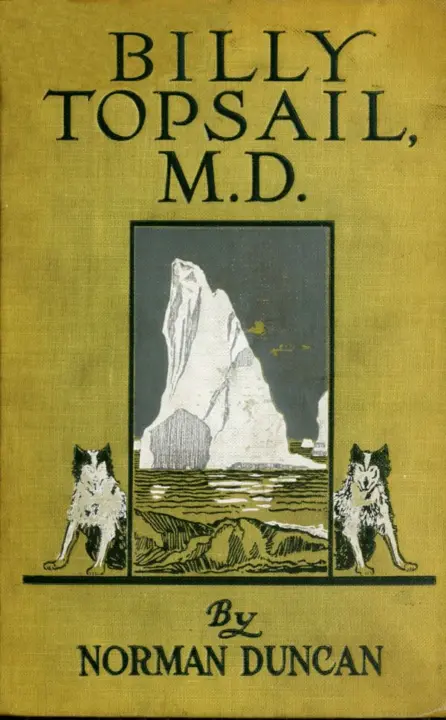
Billy Topsail, M.D.: A Tale of Adventure With Doctor Luke of the Labrador
Norman Duncan
THE CLASSIC COLLECTION · 1904
"Doctor Luke of the Labrador" by Norman Duncan is a novel written in the early 20th century. The story is set against the backdrop of the rugged and barren landscape of Labrador, focusing on the themes of love, resilience, and the bond between a mother and child. The opening chapters introduce the main character, Davy, a young boy, and his close relationship with his mother and father, highlighting the unique challenges of life in this remote and harsh environment. At the start of the novel, the narrative paints a vivid picture of Davy's home and the surrounding harbour, setting the stage for a life defined by the merciless sea and the beauty of familial love. Davy spends time exploring the landscape, enjoying adventures with his mother, and listening to the tales of local fishermen. As the story unfolds, a sense of unease emerges regarding his mother’s health, leading to a tense decision to call for a doctor amidst growing worries about her wellbeing. The dynamics between Davy, his loving but troubled mother, and the colorful characters of the community, including the eccentric Skipper Tommy, establish a poignant tone that draws readers into the challenges of love and the natural world in this isolated part of the world.
Introduction adapted from the source catalogue; source summaries may be automatically generated.
Free to read · English · 67,487 words · No account needed
MAKE TIME FOR A GOOD BOOK
On by default. Untick to stop anonymous reading totals. Each page counts after 10 seconds in view. How this works.
Anonymous counting is on unless you have switched it off.
I troubled no more. Here was a holy passion. Child that I was--ignorant of love and knowing little enough of evil--I still perceived that this love was surely of the good God Himself. I feared no more for my dear sister. She would be safe with him.
"You may love my sister," said I, "an you want to. You may have her."
He frowned in a troubled way.
"Ay," I repeated, convinced, "you may have my dear sister. I'm not
afraid."
"Davy," he said, now so grave that my heart jumped, "you give her to the
man I am."
"I'm not carin'," I replied, "what you was."
"You do not know."
Apprehension grappled with me. "I'm not wantin' t' know," I protested. "Come, zur," I pleaded, "leave us go home."
"Once, Davy," he said, "I told you that I had been wicked."
"You're not wicked now."
"I was."
"I'm not carin' what you was. Oh, zur," I cried, tugging at his hand,
"leave us go home!"
"And," said he, "a moment ago I told you that I had been a dissipated fellow. Do you know what that means?"
"I'm not wantin' t' know!"
"You must know."
I saw the peril of it all. "Oh, tell me not!" I begged. "Leave us go
home!"
"But I must tell you, Davy," said he, beginning, now in an agony of distress, to pace the hilltop. "It is not a matter of to-day. You are only a lad, now; but you will grow up--and learn--and know. Oh, God," he whispered, looking up to the frowning sky, laying, the while, his hand upon my head, "if only we could continue like this child! If only we need not know! I want you, Davy," he continued, once more addressing me, "when you grow up, to know, to recall, whatever happens, that I was fair, fair to you and fair to her, whom you love. You are not like other lads. It is your place, I think, in this little community, that makes you different. You can understand. I must tell you."
"I'm scared t' know," I gasped. "Take my sister, zur, an' say no more."
"Scared to know? And I to tell. But for your sister's sake--for the sake of her happiness--I'll tell you, Davy--let me put my arm around you--ay, I'll tell you, lad, God help me! what it means to be a dissipated fellow. O Christ," he sighed, "I pay for all I did! Merciful God, at this moment I pay the utmost price! Davy, lad," drawing me closer, "you will not judge me harshly?"
"I'll hearken," I answered, hardening.
Your reading position is saved on this browser. Take it to another device with a library code. Reading pages adapt to text, rather than matching a printed edition.
Norman Duncan
Norman Duncan
Norman Duncan
Norman Duncan
BEHIND THE BOOK
This eBook is for the use of anyone anywhere in the United States and most other parts of the world at no cost and with almost no restrictions whatsoever. You may copy it, give it away or re-use it under the terms of the Project Gutenberg License included with this eBook or online at www.gutenberg.org. If you are not located in the United States, you will have to check the laws of the country where you are located before using this eBook. Read the source licence.
The original source file, including credits and licence, is retained by this library. Request an original-format copy at no charge. Please include the book title and Project Gutenberg identifier #19981.
KEEP YOUR CURIOSITY GOING
Coulson Kernahan

Maurice Baring
Frances Wright
Cécile Tormay

Frederic Jesup Stimson

W. H. P. (William Henry Pope) Jarvis