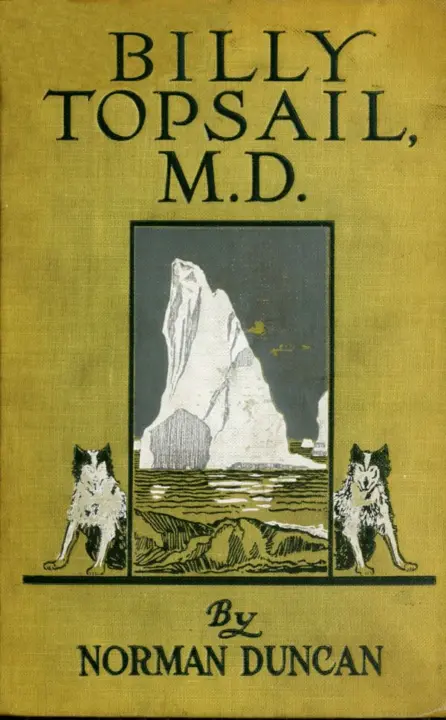
Billy Topsail, M.D.: A Tale of Adventure With Doctor Luke of the Labrador
Norman Duncan
THE CLASSIC COLLECTION · 1904
"Doctor Luke of the Labrador" by Norman Duncan is a novel written in the early 20th century. The story is set against the backdrop of the rugged and barren landscape of Labrador, focusing on the themes of love, resilience, and the bond between a mother and child. The opening chapters introduce the main character, Davy, a young boy, and his close relationship with his mother and father, highlighting the unique challenges of life in this remote and harsh environment. At the start of the novel, the narrative paints a vivid picture of Davy's home and the surrounding harbour, setting the stage for a life defined by the merciless sea and the beauty of familial love. Davy spends time exploring the landscape, enjoying adventures with his mother, and listening to the tales of local fishermen. As the story unfolds, a sense of unease emerges regarding his mother’s health, leading to a tense decision to call for a doctor amidst growing worries about her wellbeing. The dynamics between Davy, his loving but troubled mother, and the colorful characters of the community, including the eccentric Skipper Tommy, establish a poignant tone that draws readers into the challenges of love and the natural world in this isolated part of the world.
Introduction adapted from the source catalogue; source summaries may be automatically generated.
Free to read · English · 67,487 words · No account needed
MAKE TIME FOR A GOOD BOOK
On by default. Untick to stop anonymous reading totals. Each page counts after 10 seconds in view. How this works.
Anonymous counting is on unless you have switched it off.
By and by my sister put me in dry clothes, and bidding me be a good lad, sat me in the best room below, where the maids had laid a fire. And Skipper Tommy Lovejoy, finding me there disconsolate, took me to the seaward hills to watch the break of day: for the rain had ceased, the wind fallen away; and the gray light of dawn was in the eastern sky.
"I'm wantin' t' tell you, Davy," he said, in a confidential way, as we trudged along, "about the gate o' heaven."
I took his hand.
"An' I been wantin' t' tell you," he added, giving his nose a little tweak, "for a long, long time."
"Is you?"
"Ay, lad; an' about the women at the gate."
"Women, Skipper Tommy?" said I, puzzled. "An', pray, who is they?"
"Mothers," he answered. "Just mothers."
"What they doin' at the gate? No, no! They're not there. Sure, they're playin' harps at the foot o' the throne."
"No," said he, positively; "they're at the gate."
"What they doin' there?"
"Waitin'."
We were now come to the crest of a hill; and the sea was spread before us--breaking angrily under the low, black sky.
"What's they waitin' for?" I asked.
"Davy, lad," he answered, impressively, "they're waitin' for them they bore. That's what they're waitin' for."
"For their sons?"
"Ay; an' for their daughters, too."
While I watched the big seas break on the rocks below--and the clouds drift up from the edge of the world--I pondered upon this strange teaching. My mother had never told me of the women waiting at the gate.
"Ah, but," I said, at last, "I'm thinkin' God would never allow it t' go on. He'd want un all t' sing His praises. Sure, they'd just be wastin' His time--waitin' there at the gate."
Skipper Tommy shook his head--and smiled, and softly patted my shoulder.
"An' He'd gather un there, at the foot o' the throne," I went on, "an' tell un t' waste no more, but strike up their golden harps."
"No, no!"
"Why not?"
"They wouldn't go."
"But He'd make un go."
"He couldn't."
"Not make un!" I cried, amazed.
"Look you, lad," he explained, in a sage whisper, "they're all mothers, an' they'd be wantin' t' stay where they was, an', ecod! they'd find a way."
"Ah, well," I sighed, "'tis wearisome work--this waitin'."
"I'm thinkin' not," he answered, soberly, speaking rather to himself than to me. "'Tis not wearisome for such as know the good Lard's plan."
"'Tis wonderful hard," said I, "on the mothers o' wicked sons."
The old man smiled. "Who knows," he asked, "that 'tis wonderful hard on
they?"
Your reading position is saved on this browser. Take it to another device with a library code. Reading pages adapt to text, rather than matching a printed edition.
Norman Duncan
Norman Duncan
Norman Duncan
Norman Duncan
BEHIND THE BOOK
This eBook is for the use of anyone anywhere in the United States and most other parts of the world at no cost and with almost no restrictions whatsoever. You may copy it, give it away or re-use it under the terms of the Project Gutenberg License included with this eBook or online at www.gutenberg.org. If you are not located in the United States, you will have to check the laws of the country where you are located before using this eBook. Read the source licence.
The original source file, including credits and licence, is retained by this library. Request an original-format copy at no charge. Please include the book title and Project Gutenberg identifier #19981.
KEEP YOUR CURIOSITY GOING
Coulson Kernahan

Maurice Baring
Frances Wright
Cécile Tormay

Frederic Jesup Stimson

W. H. P. (William Henry Pope) Jarvis