
Life of Edwin Forrest, the American Tragedian. Volume 2 (of 2)
William Rounseville Alger & Horatio, Jr. Alger
THE CLASSIC COLLECTION · 1892
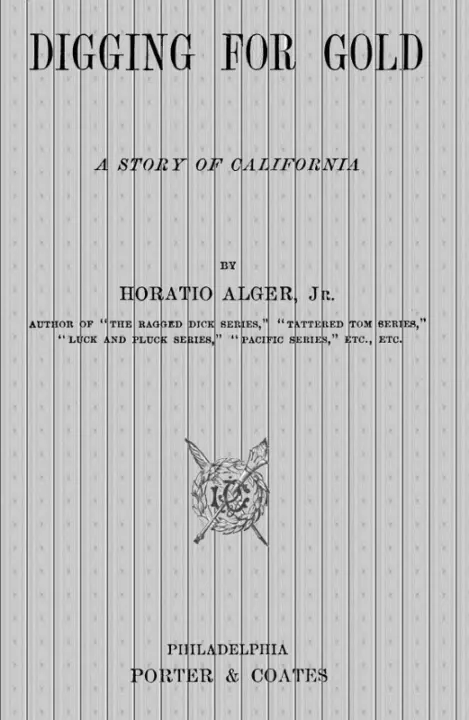
"Digging for Gold: A Story of California" by Horatio Alger, Jr. is a novel written in the late 19th century. The story centers around a young boy named Grant Colburn, whose life is filled with hardships as he works diligently on his stepfather's farm in Iowa. The narrative begins with Grant's longing for a decent suit of clothes for his sixteenth birthday and hints at his dreams of venturing to California during the Gold Rush, where he believes a better life awaits him. At the start of the novel, Grant is introduced as a hardworking and determined young man, struggling under the oppressive thumb of his miserly stepfather, Seth Tarbox. Despite the tough circumstances at home, Grant's aspirations are ignited when he learns about a local boy who struck it rich in California. He bravely confronts his stepfather about his need for new clothes, reveals his indignation at the lack of support from a man who possesses wealth, and dreams about finding fortune out West. The opening chapters set the stage for Grant's eventual journey towards California, emphasizing themes of ambition, social class disparities, and the quest for a better life.
Introduction adapted from the source catalogue; source summaries may be automatically generated.
Free to read · English · 59,065 words · No account needed
MAKE TIME FOR A GOOD BOOK
On by default. Untick to stop anonymous reading totals. Each page counts after 10 seconds in view. How this works.
Anonymous counting is on unless you have switched it off.
“He says he has seen you under the influence of liquor.”
“That also is false. He has invited me to go into a saloon and take a drink, but I always refused.”
“Oh, you are an angel!” sneered Benton.
“I don’t pretend to be an angel, but I am honest and temperate, and I
never drink.”
“I think, Mr. Smithson, if you will search the boy you will find a good sum of money in his pocket.”
“Is that true, Grant?” asked the restaurant keeper.
“Yes, sir. I have about a hundred dollars in my pocket.”
“I told you so,” said Benton triumphantly.
“I never knew there was anything wrong in saving money,” retorted Grant. “I am anxious to get together money enough to warrant me in going to the mines.”
“There is nothing wrong in that,” said Smithson kindly. “And now, Grant, that we have had Benton’s testimony against you, I want to ask you what you know against him.”
“I would rather not tell,” answered Grant.
“That is very creditable to you; but you must remember that you have a duty to me, your employer. Have you seen him enter a gambling-house?”
“Yes, sir,” answered Grant reluctantly.
“I told you, sir, that I had looked in once or twice,” said Benton, ill
at ease.
“Only once or twice?”
“Well, I won’t be precise as to the number of times.”
“Were you in a gambling-house last night?”
“Yes; I looked on.”
“How long did you stay?”
“A few minutes.”
“Did you play?”
“No,” answered Benton hesitatingly.
“I wish I knew how much he knows,” thought Benton. “Somebody must have been telling him about me.”
“What, then, was your object in going in?”
“I was wakeful, and thought I would while away a few minutes there. When I felt sleepy, I withdrew.”
Just then Vincent entered, as previously arranged between him and
Smithson.
“Mr. Vincent,” said the proprietor, “did you see either of my waiters in a gambling house last evening?”
“I saw him,” pointing to Benton.
“He admits that he went in, but says he did not play.”
“He seems to be forgetful,” said Vincent coolly. “He played for a considerable time, and had a great run of luck.”
Benton said nothing. He looked very much discomposed, but waited to see how much Vincent could tell.
“So he was a winner?”
“He won nearly five hundred dollars.”
“That doesn’t look as if he were the novice he claims to be.”
“But he didn’t keep his winnings. He kept on playing till he lost all he
had won.”
“You must remember, sir,” interrupted Benton, “that a green hand is often luckier than a practiced gambler.”
Your reading position is saved on this browser. Take it to another device with a library code. Reading pages adapt to text, rather than matching a printed edition.
William Rounseville Alger & Horatio, Jr. Alger

William Rounseville Alger & Horatio, Jr. Alger

Horatio, Jr. Alger

Horatio, Jr. Alger
BEHIND THE BOOK
This eBook is for the use of anyone anywhere in the United States and most other parts of the world at no cost and with almost no restrictions whatsoever. You may copy it, give it away or re-use it under the terms of the Project Gutenberg License included with this eBook or online at www.gutenberg.org. If you are not located in the United States, you will have to check the laws of the country where you are located before using this eBook. Read the source licence.
The original source file, including credits and licence, is retained by this library. Request an original-format copy at no charge. Please include the book title and Project Gutenberg identifier #53095.
KEEP YOUR CURIOSITY GOING
Wilfrid Scawen Blunt
Wilfrid Scawen Blunt

E. W. (Edgar Watson) Howe
Cécile Tormay

Moritz Busch
Coulson Kernahan