
Life of Edwin Forrest, the American Tragedian. Volume 2 (of 2)
William Rounseville Alger & Horatio, Jr. Alger
THE CLASSIC COLLECTION · 1892
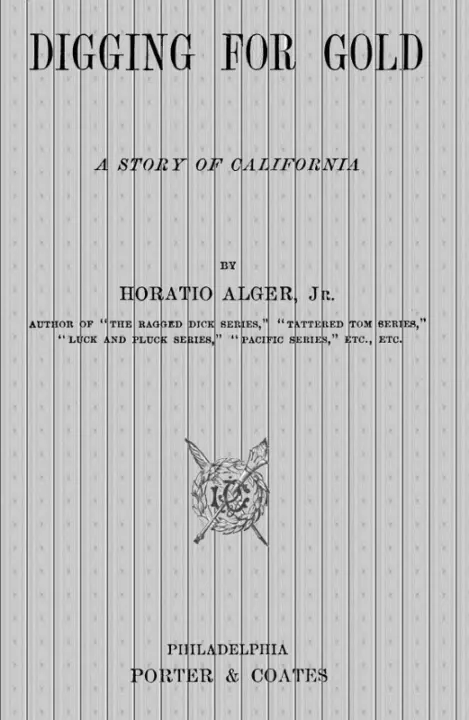
"Digging for Gold: A Story of California" by Horatio Alger, Jr. is a novel written in the late 19th century. The story centers around a young boy named Grant Colburn, whose life is filled with hardships as he works diligently on his stepfather's farm in Iowa. The narrative begins with Grant's longing for a decent suit of clothes for his sixteenth birthday and hints at his dreams of venturing to California during the Gold Rush, where he believes a better life awaits him. At the start of the novel, Grant is introduced as a hardworking and determined young man, struggling under the oppressive thumb of his miserly stepfather, Seth Tarbox. Despite the tough circumstances at home, Grant's aspirations are ignited when he learns about a local boy who struck it rich in California. He bravely confronts his stepfather about his need for new clothes, reveals his indignation at the lack of support from a man who possesses wealth, and dreams about finding fortune out West. The opening chapters set the stage for Grant's eventual journey towards California, emphasizing themes of ambition, social class disparities, and the quest for a better life.
Introduction adapted from the source catalogue; source summaries may be automatically generated.
Free to read · English · 59,065 words · No account needed
MAKE TIME FOR A GOOD BOOK
On by default. Untick to stop anonymous reading totals. Each page counts after 10 seconds in view. How this works.
Anonymous counting is on unless you have switched it off.
“That’s pretty conclusive evidence, isn’t it?” said John Vincent, tapping the marked bills.
“I didn’t dream of it,” said the restaurant keeper.
“I did. I suspected him as soon as you told me he was trying to fasten suspicion upon Grant Colburn.”
“You don’t think the boy had anything to do with the theft?”
“I feel sure of it. The boy is an honest boy. You have only to look in his face to see that. I haven’t been a detective for nothing. I may be mistaken at times, but I can generally judge a man or boy by his face.”
“Does Benton know that you suspect him?”
“No. I wasn’t going to give myself away. By the way, he had quite a stroke of luck tonight.”
“At the gambling-house?”
“Yes. At one time he was a winner of nearly or quite five hundred
dollars.”
“Then he will be able to make up to me the amount he has taken.”
“Don’t flatter yourself! I said he was a winner of that amount at one time. I didn’t say he went out with that sum. As a matter of fact, he lost it all, and left the place probably without a dollar.”
Smithson looked disappointed.
“Then,” he said, “I shan’t get my money back.”
“I am afraid not.”
“He must have taken hundreds of dollars.”
“Quite likely.”
“The villain!” exclaimed the restaurant keeper. “And I have paid him so
liberally, too!”
“Well, Smithson, it might have been worse. I suspect you have a pretty
tidy sum laid by.”
Smithson’s face changed, and he looked complacent.
“Yes, Vincent,” he said. “I’m worth a little money.”
“Good! Look upon this as a little set-back that won’t materially affect you, and put it down to the account of profit and loss.”
“Very, good! I will do so. But to-morrow I will give Mr. Benton his
walking ticket.”
Albert Benton came to work as usual in the morning. His employer came in half an hour late. By this time the waiter had become resigned to his disappointment of the night previous. He recognized his folly in not making sure of the large sum he had at one time won, and determined to act more wisely in future.
Presently, when he chanced to be unemployed, Smithson beckoned to him.
“Benton,” he said, “you remember my speaking to you about missing money
from the till?”
“Yes, sir; but I thought you decided that it was only a falling off in
receipts.”
“Yes, I said that; but it seems to me that the deficiency is too great to be accounted for in that way.”
Your reading position is saved on this browser. Take it to another device with a library code. Reading pages adapt to text, rather than matching a printed edition.
William Rounseville Alger & Horatio, Jr. Alger

William Rounseville Alger & Horatio, Jr. Alger

Horatio, Jr. Alger

Horatio, Jr. Alger
BEHIND THE BOOK
This eBook is for the use of anyone anywhere in the United States and most other parts of the world at no cost and with almost no restrictions whatsoever. You may copy it, give it away or re-use it under the terms of the Project Gutenberg License included with this eBook or online at www.gutenberg.org. If you are not located in the United States, you will have to check the laws of the country where you are located before using this eBook. Read the source licence.
The original source file, including credits and licence, is retained by this library. Request an original-format copy at no charge. Please include the book title and Project Gutenberg identifier #53095.
KEEP YOUR CURIOSITY GOING
Wilfrid Scawen Blunt
Wilfrid Scawen Blunt

E. W. (Edgar Watson) Howe
Cécile Tormay

Moritz Busch
Coulson Kernahan